Leslie:
Today we are going to be talking about academic freedom and the advocacy efforts that university faculty, staff, and students are leading to defend it. You might remember that on Episode 93, I interviewed Dr. Heather Steffen from Faculty First Responders, which is a group that helps university workers who’ve been targeted online usually for their politics or what they teach.
You may be aware of the fact that there are multiple initiatives that have developed in response to the attacks on higher ed in the United States, and we will talk about another one of them today. So my guest is Dr. Alison Gash, co-founder of the group, We are Higher Ed and also on the advisory board of the group Stand Together for Higher Education. These two groups emerge roughly around the same time and have a lot of synergies. So we are going to talk about sort of a range of advocacy efforts. But before we get into the details, let me first introduce my guest.
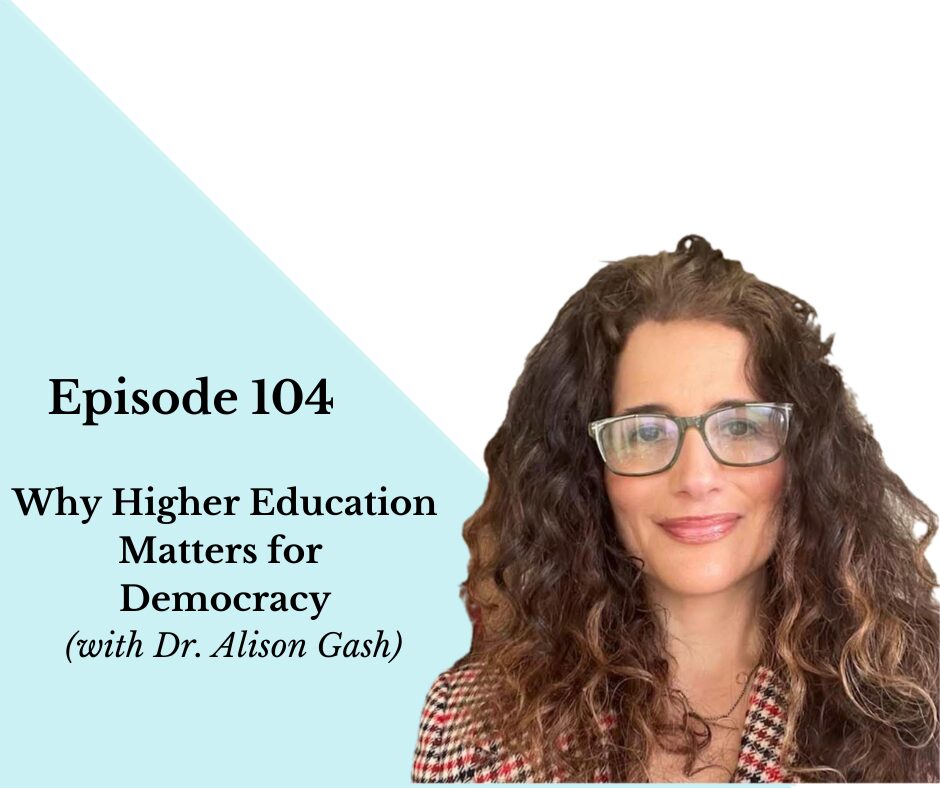
Alison Gash is professor and chair of Political Science at University of Oregon, and co-founder of We Are Higher Ed. Her research focuses on the intersection of law and social policy with a focus on race, gender, sexuality, gender identity, and youth-led advocacy movements. Her work has appeared in the Washington Post, Washington Monthly, Politico, and other national media outlets. Professor Gash’s education advocacy work at the University of Oregon and beyond has centered on supporting faculty who teach about resistance and resistance through an intersectional lens and communities at the center of the current attacks on higher education.
So Allison, welcome to Your Words Unleashed!
Alison:
Thank you very much. Thanks for having me.
Leslie:
So, can you talk a little bit about your own advocacy efforts and what led you to start or co-found We are Higher Ed?
Alison:
Yeah, absolutely. So, you know, I think that as with many advocates and activists, what it really started out was an attempt to bring together folks that were similarly worried and similarly concerned and similarly affected by what was obviously going to be a changing landscape of policy. And essentially how We are Higher Ed started was as soon as we realized that we were going to have a shift in party leadership at the presidential level, a bunch of educators sort of, saw the writing on the wall.
We knew how Trump had ended his last presidency with calls for ending DEI trainings. We saw what was happening in the interim with different states, deploying policies that were anti-woke policies, anti-DEI policies. And we had read Project 2025, which was really explicit about the measures that were going to be taken against higher ed and against academic freedom and particularly aimed at faculty and vulnerable communities. And so I basically put a call out on Facebook, and Instagram and some other spaces and was like, “are there other faculty out there who are worried? And if there are, let’s come together and let’s start talking about how we can engage in forms of mutual aid to support each other, to learn from each other.”
I was especially interested as a faculty member in a blue bubble to hear from my colleagues in Florida and Texas and other spaces about what they did and how they managed in the midst of their own attacks on higher ed that were happening a lot quicker than they were nationally. And so we came together. It was about, roughly 30 of us at the beginning. And we started talking about ways that we could mutually support each other whether that was creating lists of available faculty to write reviews, right, as folks came up for tenure. If you had a portfolio that was like, about racial justice or about gender or tethered to any of the particular subjects that were now being barred, were there people that we could find to write reviews for those folks?
And so we created, generated a list of folks who would be willing and able to write letters of review for folks coming up for tenure. So we started doing things like that. But then, you know, other folks in other spaces, other colleagues, started to really engage in responsive activism. So really, doing letter writing campaigns. Really calling for faculty to unite across discipline, across universities across region, to denounce what was happening at the federal level. And so I reached out to some of the folks that were launching these campaigns and said, “well, I’ve got 30, 40 folks in this group that are really interested in wanting to do some stuff.”
And so, Daniel Laurison from Swarthmore, who is the other co-founder–
Leslie:
I didn’t know that.
Alison:
Yeah. Yeah.
Leslie:
We went to grad school together!
Alison:
Oh, no kidding! Oh my God. I know so many people who know Daniel from like various spaces. It’s like he also is in Philly and I’m from Philly, so you know, it just all the lives crossed. But in any event, so he came over to our group and shared the draft of the letter that he had created and allowed us to sort of come in and redraft them the language. And so together as a group, we crafted this letter. And then the letter got tons of signatures, which was really. And so we realized, “oh, we need a space and a thing to call ourselves.”
And so one of the folks in our group came up with the name “We are Higher Ed.” And then we created a website to showcase the letter. And right around that time, the folks that organized Stand Together had also organized a letter. And so they were generating their letter and also getting a lot of signatures. And so we showcased their letter on our website.
And so, you know, it started to emerge that right around this moment, which was like roughly February, March of 2025, there were lots of groups starting to think about forms of resistance, and lots of methods for coalescing faculty around, right? Defending academic freedom, defending pedagogy, defending truth, defending evidence, all that stuff. And so We are Higher Ed started posting all the letters on the website, and started to be sort of a mediating space to let other folks know about a whole bunch of other efforts that were taking place.
So mutual aid defense compacts came online around this time, which was basically a way for university senates to create language, policy language, reform efforts to encourage presidents to resist. Any impending attacks on higher ed. So that got organized around that time. There were just a bunch of different efforts that sort of coalesced. And so we organized around We are Higher Ed. We organized around this idea of mutual aid. We organized around this idea of being an information clearinghouse and letting as many faculty, and folks in higher ed know that there were all these efforts happening.
One of the real principles around the work that we were doing was especially letting faculty know who were in colleges and universities where there wasn’t a lot of activism happening, that they weren’t alone. And that they could join a space and that they could be in community. And that there were people who were thinking about these things and talking about these things and standing up to these things, even if the folks on their campus weren’t doing it, right.
So a lot of it was about reaching into Indiana, reaching into Arkansas, reaching into spaces in Florida that maybe didn’t have that same kind of energy that a lot of us were able to generate on our campuses and making sure folks knew that they were connected.
Leslie:
Right, right, right. So can you tell me a little bit more about letter writing campaigns? So, what’s in these letters and why are they a particularly useful way to resist?
Alison:
Well, you know, so it’s such a great question because, there was a lot of talk about, “what’s the utility of the letter? Like, why are we even doing this and what’s the point?” And you know, to a degree it’s a fair question. But I think it was really about mobilizing. What it came down to for us was two things, right?
A. Identifying a set of principles, right? Identifying a way to explain what the value of higher ed is, right? I mean, in a very real way, higher education has been sort of coasting along without a new dialogue about what it is that we do and who we serve and what the goal is. And, we’ve just been sort of, you know, struggling through–
Leslie:
Why it matters.
Alison:
Yeah. Why it matters. Right. And so in a way, like organizing groups to write these letters forced us to have really critical conversations about what we do, what we perceive as foundational and sort of the most pivotal elements of, what higher education does and, what we stand for.
Leslie:
Can you tell me what those are?
Alison:
Yeah, absolutely. So they’re in our letters, but you know, essentially it comes down to, academic integrity, right? Evidence, some adherence to truth, facts, evidence, inclusion, right? So thinking about multiple perspectives, thinking about being an inclusive space for representing the realities and the experiences of all the people who are in our classrooms and all the people who are in our histories, and all the people who are affected by the stuff that we study. Making sure that spaces are engaging, that those spaces are empowering, that those spaces are activating, that we’re not shutting people down in those spaces. And those were, those were essentially sort of the core elements.
Each of the letters that folks crafted had different sort of takes on those things. But I think fundamentally right, those sort of four elements were in all of the letters. But the sort of practice of writing a letter and organizing around a theme of higher ed is important for democracy was also really critical because, that’s the thing that sort of, I think if you’re an academic, especially if you’re an academic in the social sciences, it’s like a no brainer. Of course, higher ed is important for democracy. But being able to articulate why it was important for democracy and why the sort of first step in the playbook of folks who are trying to limit democracy. Always look towards education as a really fruitful space to minimize the reach of democracy. Being able to articulate that was, I think, really helpful.
So on the one hand, there was a mobilizing element just to the drafting of the letters. But then sending it out and seeing how many people from different spaces representing different disciplines at different levels of leadership all signed off on this mission and this articulation of what we do, that was incredibly inspiring. And I think, each additional signature hammered home for all of us, right? All of us who drafted, all of us who signed it, all of us who were hearing about it, that there was a community, right? That there is a community of faculty, of scholars, of educators, of people sitting in educational spaces who are organizing around the same shared set of principles.
And that, I think sort of inspired more people to get involved and to catalyze the kind of community building that we needed to get sort of an organizational space to open up. So in a way, it was mobilizing for us and it was also a signal to other faculty that we are doing stuff right, that there is a fight happening. And then I think it also for some presidents, for some leaders, at universities, it emboldened them to resist. I think it allowed them to see that there were lots of folks that would back them up if they felt empowered enough to say, “we’re not going to stand for the sorts of constraints that are being placed on us.”
And then of course, for the targets of these efforts. Right? So for marginalized communities that were now being boxed out of the classroom, right. For BIPOC kids and queer kids and trans kids, and all the many young people who were sort of being named in a way, in these laws that were limiting discussion about their histories and their realities and their identities. I think it also, you know, the hope was that it was reaching into those spaces to say like, “no, we’re not going to, we’re not going to stand for this.”
Leslie:
That is so amazing, so inspiring. And so it sounds like these letters were really like, almost like mission statements for higher education.
Alison:
I think that’s right. If you go to our website and you look at the library of letters that we have, it’s really like alumni started writing letters, which was really cool. So like, Harvard alums organized around this letter writing campaign, and then they organized advocacy campaigns.
Crimson Courage, right, is a leader now. And a lot of this higher ed advocacy, there were folks in the sciences that started to organize, Stand Up for Science I think maybe similarly organized around a letter or certainly launched a letter campaign and inspired other letter campaigns among faculty who are not normally like oriented towards the advocacy space. So law schools got in on it, med schools, like faculty disciplinary associations, started and then groups of presidents. So I think, the letter writing was sort of infectious, right?
Leslie:
Who’s the audience? But who’s the audience for the letters?
Alison:
Amazing question! So the hope was like, “Oh, the people that we’re mad at will read these letters,” which obviously they won’t because why would you do that? But, and so I think the audience really was other people in education, alums, right? So anyone who’s been impacted by higher ed, right?
So, it’s one of the things that I think a lot of these organizational spaces were trying to achieve was to try to get everyone who had been in higher ed reinvested in higher ed. To revisit what higher ed did for them. And a lot of these letters, I think, were a way of communicating to them, “We’re all asking you for your help. We’re all asking you to recognize that the experience you had as a student in higher education is no longer going to be the experience that’s available to future students because of these constraints and attacks. So we need you to join us. We need you to help us, right? Help us make this case.” And so I think part of the audience was that as well. That’s a great question.
Leslie:
Thanks for clarifying that. And so, you’ve mentioned how, you know, this is also about protecting democracy.
So what do you think is the role that academics have to play in resisting authoritarianism? A very unique role?
Alison:
Yeah. I mean, look, the attack on facts, right? The attack on the sort of nature of truth, the attacks on, the need and the desire to rewrite history in a way that fundamentally isn’t accurate, right? The need and desire to censor ideas, to censor people, to censor communities, right? To censor things that are in fact out in the world, you know, and our important contributions to how we think about things. This is all anti-democratic, right? This is the essential, basic element of authoritarianism of fascism, right? It’s the capacity to censor and control the knowledge we receive the right our thoughts, things that we believe, and to limit our capacity to access true actual things happening. And to sort of manipulate, the world around us in ways that feed power, right? And don’t feed integrity.
That’s exactly where higher ed sits. That’s what we do. We are in the business of truth. We are in the business of critical thinking. We are in the business of discovery. We are in the business of resisting thought control, of resisting the manipulation of truth, of manifesting evidence of creating opportunities for critical thinking of questioning, right? These are all things that are the foundations of democracy, the foundations of folks being able to be engaged in a civic minded way, right? In constructing their world, right? Building a better world. So that’s what we do. That’s the whole reason we exist is to foster a space that centers those things. And that encourages people to have the skills to be able to create truth, seek truth, demand truth, identify fact from fiction and critically think and critically engage in their world. That’s what we do. We create the space for people to be able to do those things in whatever space they want to do.
That whether that is like the business world or science or social sciences or creative spaces, wherever you want to do that, that’s what we’re doing. And that’s what authoritarianism is trying to kill, right? Like, that’s what we do. And, so we need to hold the line.
Leslie:
I’m sure that that message has probably swayed a number of folks, I would guess, who are like in the, you know, STEM fields and stuff who may consider themselves apolitical. Right?
Alison:
Yeah. Well, I mean, you know, one of the first places that they sought to limit was science, right? Was scientific inquiry. So the manipulation of facts around vaccines is really telling. So now we’re being told that vaccines don’t do the things we thought they did and do a bunch of bad stuff that we know they didn’t because we actually have studies to show that they don’t. And now we’re going to revamp what vaccines people should have and shouldn’t have based on completely false information. Right?
If you don’t have a space, higher ed, where we can be like, “Hey guys, this is the actual studies, right? This is the actual truth. This is crazy talk! We’re going to show you what’s actually happening.” How would we ever have the capacity to question a government that is trying to feed us a load of BS, you know, pardon the potty mouth. But, how would we ever have the skills to do that unless you have spaces that force you to confront the possibility that somebody is actually telling a lie.
Leslie:
Right! And so there’s so much skepticism now of truth amongst the general public. A lot of suspicion, I would say, of expertise and of higher education in general.
So, what do you want the public to know about what’s happening in higher ed and why it actually matters to their lives?
Alison:
One of the really great things that I love about, especially working at a public university is seeing people come in with the nuggets of who they want to be and where they want to be in the world. Right? How they want to contribute. How they want to create, what they want to impart to others in the world. They come in with an idea of, the sort of vagaries of that notion, but they don’t have a sort of solid idea of what they want to do. And they come out after four years of being told to think about stuff, of being told to think for themselves. Of being told to absorb—but not absorb in order to follow, absorb in order to analyze. Absorb in order to compare what’s being told to you in one space, to what’s being told to you in a different space, and to try and resolve conflicts, resolve the complexities, right?
Higher ed is not about mind control. It’s about unlocking. It’s about creating a mindset that is fundamentally about questioning, fundamentally about puzzling over things and trying to resolve puzzles and inquire about why things are the way they are, and advocate for things that you think should change. And I see that every day in my students. In all of my students. That it doesn’t matter sort of where they end up, right? It’s true among the law school folks. It’s true among the nonprofit folks. It’s true among the folks that go into business or whatever.
But they come out with this feeling that they can enter the world with the skills they need to inquire about why things work the way they do and to make the best interventions that they think need to be made. What an amazing thing, right? What an amazing thing to be able to encourage young people to do. To have ownership over their thoughts, right? To have ownership over their creativity and have ownership over the way that they want to contribute to this world. To have ownership over the possibility of hope and innovation. That’s what higher ed does, right?
And to dampen that. I mean, I can’t even imagine on an individual level, right? The loss of individuals not having that opportunity. But the loss from a societal level, right? The loss from a knowledge production level. The loss of creativity, the loss of scientific discovery. The loss of the capacity to propel what our world forward, right? That doesn’t happen without higher ed. It just doesn’t.
Leslie:
Right, and so say like, I don’t know, member of the general public is like, “I didn’t go to college, my kids aren’t going to college. I don’t care about higher ed.” Is there anything you would want to make them aware of?
Alison:
I would say first of all, lots of great things happen even if you don’t go to higher ed, right? There’s all sorts of spaces where folks can continue to refine how they think about things and interact with the spaces that they want to occupy. I have two children. One of them might not be going on to a four-year college. They might go into the healthcare industry and they might get a special ed training in that space. And that’s what works for him. And that’s great, right?
But even if you don’t go to college, even if you are not invested in higher ed as a space to occupy, you benefit from it. You buy products that are made by people who have a higher ed degree. You access healthcare that is managed by people who have a higher ed degree. Everywhere you are, right? Wherever you’re working I bet the vast majority of the space that you are working and the things that you like and the stuff that you enjoy and ingest and the things you purchase are all created somehow, right?
The medicines you take that, right? All of these things were manifested by people who developed the critical thinking and creative skills to do what they do in higher ed. So even if you don’t go to college and you don’t have to go to college. For some people, the dollars and cents don’t make sense to do that because you can do something without having to go to college. But that doesn’t mean there isn’t utility in your life in terms of what it does for you.
Leslie:
Yes, and I think just here, I’m just trying to push more of a message of interconnectedness, like not just this us and them thing. We are all impacted–
Alison:
The other thing to remember, especially when we’re talking about public institutions, right? When we’re talking about state-funded public institutions, that’s one of the biggest sources of upward mobility is attending college. And that message gets lost when we’re focusing on Harvard, Columbia and these sort of elite institutions where you we’re sort of recycling through folks with money. But when we’re talking about public institutions, that’s when you’re talking about generational income increases, right?
When you’re talking about creating opportunities for your kids that you didn’t have, that your parents didn’t have. And so the spaces where upper mobility happens is exactly in those spaces. Right? That’s exactly one of the most pivotal goals and missions of public ed in particular.
Leslie:
Right, right, right. Yeah. Thank you for articulating all of that. I know I was playing some devil’s advocate, but I just to like state these things.
Alison:
Yes.
Leslie:
So if we return for a moment to the advocacy efforts that are happening, I know there’s, when I went on to your organization’s website, there’s a bunch of different groups on there that are doing kinds of things. So what’s happening out there?
Alison:
So one of the really interesting things that happened as a function of states starting to clamp down on higher ed. And then the federal government jumping in and starting to clamp down on higher ed is that faculty, other educational leaders felt compelled, right? Called to organize other faculty to actually sort of formalize that organizational space into groups like Stand for Higher Ed into other efforts. It also encouraged. Groups that were doing advocacy in other areas to turn their attention to higher ed.
So, one of the efforts that’s being organized is called Five Pillars. And so that’s a coming together of the AEUP, which is the American Association of University Professors, HELU, which is the Higher Ed Labor Union. So AEUP and HELU are both labor oriented, but they’ve blossomed out into really sort of organizing a higher ed advocacy space. And they’re bringing in folks from the Sunrise Movement and folks from Indivisible and folks from other spaces that were organizing around other issues and are now organizing around higher ed.
So some of the stuff that also happened was you have other groups that are now organizing these sort of corollary organizations tiered, geared and tipped towards, higher ed advocacy. Everyone started to try to figure out what they could do and how they could organize all of the folks in the higher ed space to fight back. Because one of the things, right, that’s always been true about higher education—and I think one of the reasons why it’s always been like an enticing space for advocacy of whatever kind—is that there’s so many people, right? Like if you can get higher ed in your advocacy space, that’s a bunch of people, right? That’s a bunch actual bodies, but it’s also generations of people, right? You can make a whole generational change if you target the places where young people are.
The whole point of the free speech movement was like, if we can sort of engage students in sort of thinking about and pushing for speech, whatever variety that may be, the ‘60s free speech movement or the more recent conservative free speech movement, they focused on colleges as sort of a space to do that. And so part of the thinking was like “if we can just harness even a tiny percentage of the thinking, of the brain power, of the bodies, of the passion of higher ed, we can be really effective.” And so I think part of the thinking on the organizational front was like, “we could just do this. We can organize all of these people to make a splash.”
And then there were other groups that were thinking, “oh yeah, we can organize these folks. We can come in and organize these folks to do some stuff.” Then there were folks who were thinking like, “well, faculty are organizing, but faculty are different from deans, right? Or mid-level program managers.” And so, there were efforts to organize the mid-level spaces, right? So like the program directors and the deans, former presidents, and the folks that lead research institutes and spaces like that, they organized as well, around a sort of single vision. So they have an organizational structure that they’re putting together as well. And then now there’s actually an organization called the Alliance for Higher Education.
So they just organized essentially as an umbrella organization of the myriad, sort of various organizational efforts. Because where we sit right now is we’ve sort of over-organized. We have over-organized into a disorganized space, right? Now there’s like lots of things, right? They’re still new. I found out about a new organization literally yesterday that came up because there’s so many of us, but we don’t all know about each other. And so now there’s an effort to say, “okay, like we need to stop creating the new ones, take stock of what we have, right? And figure out what each of us are going to be doing so that we can be organized in our organizing. We’ve mobilized, now we need to be organized and strategic in our organizing.”
And I think what some of these bigger groups like Alliance for Higher Ed, AAUP, they’re trying to organize all those groups, right? Stand Together is being really effective in that space as well.
Leslie:
It’s like watching a social movement form.
Alison:
Yeah, yeah. Right. It’s like watching a social movement and trying to like compel the creation of a more coherent network.
Leslie:
Right.
Alison:
Right. Because you know, the thing about faculty is generally speaking, we are people who don’t like people, right? We don’t like to work with other people. We like to work. We like to pop into the classroom. Do our lectures. Talk to some students and then lock ourselves up in a tiny room and write for most of the rest of the day. Right? We’re not people people, right? We’re not team players. And so, doing this work with a bunch of faculty who want to be the folks doing the organizing is really interesting.
But I think we’re at a space now where a lot of the organizational spaces are wanting to figure out like, “how do we do all this work? How do we get this all done?” Like, there’s just so much, there’s so much, right? There’s so much that is happening on campus in our communities, about the stuff that we teach, about the stuff that we research affecting our livelihood, affecting our families, affecting our neighbors. Like, how do we contribute in a way that makes sense and has an effect? And I think that’s where we are in year two is exactly in that.
Leslie:
Yeah. Yeah. And just so people know that like there are resources and they don’t create–
Alison:
Yeah. And it’s like, it’s not to say like, you want to create a group. But know what exists so that you know how to work with the people and the communities that already exist. How to find resources. One of the great things about Stand Together is that one of the things that they’re aiming to do is help faculty create other stand togethers on their campuses.
One great way to be an advocate, and to sort of be pulled into a infrastructure that already exists, is instead of building your own new organization, build a Stand Together Chapter. Start one on your campus. Start one in your city. Maybe you can collaborate with other colleges in your space to do this.
That’s a really great way to take leadership, right? To be a leader, but also to be brought into a coalition, right? So Stand Together is right, it’s a coalition with We are Higher Ed with a AAUP, with Alliance for Higher Ed. So it’s, that’s a really great organizational creative space, right, where you can actually think about creating your own advocacy space, but then be tethered to these resources.
Leslie:
Right. And you mentioned students before, so can students be involved in these initiatives or do you encourage them to go?
Alison:
Absolutely. Yeah. There’s actually been a push to make sure that students are involved in all of these spaces. A lot of the stuff that We are Higher Ed was doing initially was, it was all teach-ins, right? So it was all about bringing students together with faculty to hold resistant spaces that were all about sharing knowledge. And it was really cool to see one of the best things in a way that like Trump has done is it’s made like learning radical, right? And so it’s like right to have these like revolutionary spaces where we’re sitting around, talking about political philosophy, like I’m all for that. That’s awesome. Right? A lot of these sort of resistance and advocacy strategies have been about creating opportunities for student faculty partnership.
Five Pillars is partnering with Sunrise movement. Sunrise Movement is all student-led. They’re a pivotal partner in everything that’s happening in that space. I know Alliance for Higher Ed is planning on having students involved as part of the outreach that they do. And We are Higher Ed is certainly, we’re an incubator. So like if students have an idea of how they want to pitch something and they want, you know, people at different universities to do a thing, right? It’s a great space to just say, “guys, can you help us amplify what’s happening in our space? Can you get the word out that we’re doing these things?
Can you give us feedback? Can you partner with us on these things?”
I think, you know, I think there’s ample, desire, and intention to make sure that students are centered. And, as with any moment of like crisis, it invites an opportunity. To ask the important questions. And so one of the most pivotal questions that’s being asked in every space that I’ve been in is the cost, right? The cost of a higher ed education, right? The cost of college and university, and whether we are giving our students the adequate opportunity to be in these spaces, right?
Whether the costs have become so outrageous that half of our students can’t even attend. Whether we really are attending to the interests of students in all the different sort of economic spaces and all the different sort of identity spaces, right? Are we dialed in to the stuff that, that they need and they want for their future? So it’s requiring us to have those conversations to revisit the costs, to revisit value. To make sure that like, it’s not parties that are controlling that dialogue, but it’s about faculty and students and education leaders organizing that dialogue. That’s a conversation that’s happening in tandem with this sort of more defensive posturing.
Leslie:
So super informative. Just one last question for you, Alison. This is a very dark time, as morale is very low. What are you seeing in your organizing that’s giving you a sense of hope right now?
Alison:
It’s a great question and I always have the same answer, which is the elixir to authoritarianism is community. Being in spaces of building relationships, of engaging in connection to other humans who have a shared desire to move through this in a way that protects as many people as we can, protects as many values as we can. Authoritarianism wants you to isolate, right? Authoritarianism wants you to doom scroll, be on Facebook and yelling in a quiet room. It wants you to withdraw from society. And so, the best way that we can combat what it wants us to do is to be in community with other people, right?
And that could be at a protest, that could be at your church or at your synagogue or other spaces of religious communion. That could be at a coffee shop, that could be at a food pantry. Wherever it is that you can find people that you can lean on, where people can lean on you, where you can sort of mutually reinforce your desire for something different where you can process your exhaustion. Where you can process being a parent and having to raise kids in the midst of this craziness. Like where you can do all of those things in community. That’s where the hope is, right? It’s in those relationships with other people.
Because once you realize that there are other people who want the same things that you want. Who are willing to work for the same things that you want. That there are other people that you can help, right? By reaching out and asking, “what do you need? How can I help? Can I buy you groceries? Can I drive your kids to school because you can’t leave your house right now because of ICE, right? What can I do for you?” Just that simple act can profoundly reshape your sense of doom. And will also profoundly shape the person that you’re interacting with and their sense of doom. It’s a simple answer. But it’s really hard to like find the spaces to do that.
It’s really hard, especially when you’re under attack and you’re exhausted and you’re feeling just drowned out by all the things that are happening in our lives. It’s really hard to sort of do the work to try to figure out like, “okay, well how can I connect and where can I plug in?”And, but there’s so many different spaces out there. And that’s something that, you know, for sure, I’m happy to help people problem solve if people want to reach out. That’s been the most profound source of hope for me is in the building of community, in the creating of community. And it’s something that I try to do in my work. I try to do this for my students. I try to do this for my faculty. I try to do this in these advocacy spaces.
Leslie:
Thank you so much for creating these spaces and for sharing all about what’s happening, because I know a lot of people are really interested. They don’t necessarily know where to go.
So if folks want to get involved with advocacy work, where are the best places to go to find out more?
Alison:
Head on over to the We are Higher Ed website. You can certainly get involved with us if you have an idea of how you want to pitch something. We’ve got loads of people who are ready and willing to get involved in a bunch of different advocacy efforts. There’s also other organizations listed on our website. Then you can also head over to the Stand Together website.
They also have other organizations listed, and also toolkits, really important toolkits and other resources for organizing a Stand Together chapter, organizing something on campus. And then there’s also Alliance for Higher Education. So if you can locate their website, they will also be a clearing house of all sorts of really great advocacy spaces.
Leslie:
Awesome. Awesome. And if listeners want to connect with you, how do they do that?
Alison:
Yeah, absolutely. I’m on Instagram at Coffee Prof. I’m on Facebook, at Alison Gash. You can also reach me at my email, which is gash@nulluoregon.edu and I’m also on Blue Sky.
Leslie:
Amazing. Alison, again, thank you so much for taking the time to educate me and listeners about these efforts to defend academic freedom. We all have a role to play in this, and so I hope people feel educated and empowered to do something.
So listeners, please connect with Alison Gash on social media and you can also find out about these organizations and get involved by going to WeareHigherEd.org. Thanks again.
Alison:
Thank you so much.