
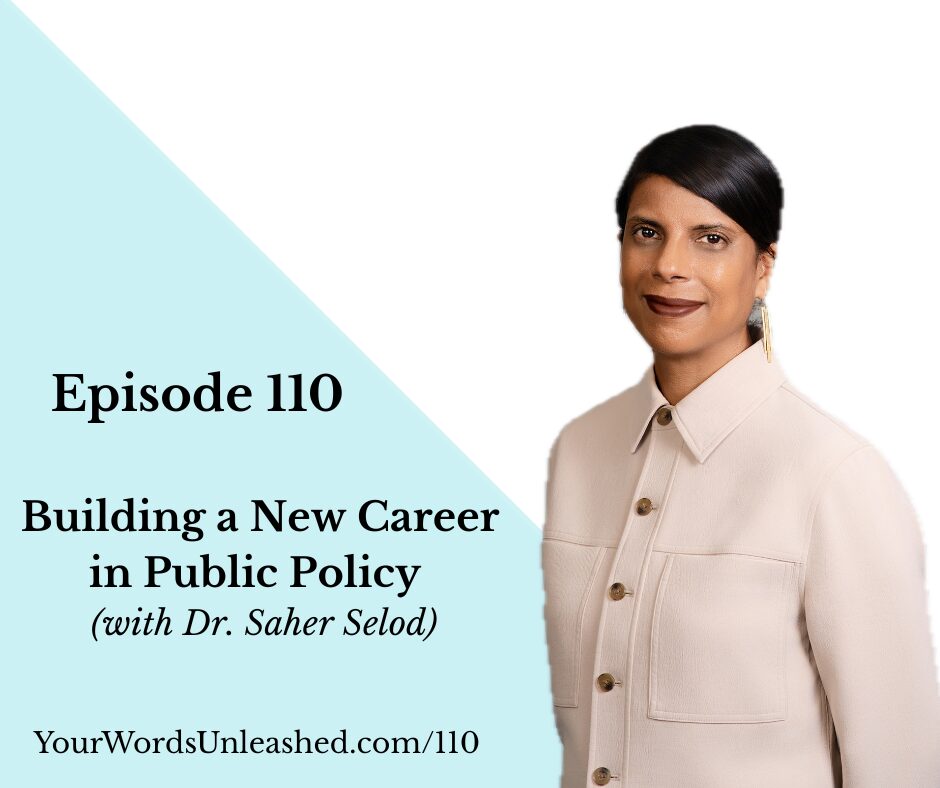
In this episode, I chat with my good friend, sociologist Dr. Saher Selod, about her successful transition from tenured professor to public policy work.
3 ways to work with me this year~
1) Private book coaching through my signature Your Words Unleashed 6-month coaching program. Finally publish your book!
2) Personalized career coaching through my one-semester Career Reset Program for overwhelmed academics. Gain clarity and a sense of renewed purpose.
3) Group workshops on a range of writing and career-related topics. Transform your relationship to your own work in the community of like-minded others.
I’m booking for the fall, so if you’re interested, email me at Leslie@nullYourWordsUnleashed.com or set up a free 30-minute consult!
Episode transcript:
Leslie:
I am beyond excited to welcome Dr. Saher Selod onto Your Words Unleashed!
Saher is the Director of Research for the Institute for Social Policy and Understanding. She was formerly an associate professor and previous chair of the Department of Sociology at Simmons University in Boston, Massachusetts. Her research expertise centers on the experiences of Muslims with surveillance. She’s the author of multiple journal articles and two incredible books on the experiences of Muslims with racialization and surveillance, both in the United States and globally. The first was Forever Suspect: Racialized Surveillance of Muslim Americans in the War on Terror, published by Rutgers University Press in 2018, and the second was A Global Racial Enemy: Muslims and 21st-Century Racism, published by Polity in 2024. At ISPU, she oversees a wide range of research projects on American Muslims, including the American Muslim Poll, which includes data on their civic and political participation.
So this interview has been a long time coming. Saher is actually a really good friend of mine. We first met at an event at MIT back in 2013, only a few months after I moved to Boston, and she was in her second year at Simmons. And at that event, we realized we were both working on our first books, so we formed a writing group with another junior faculty member, and we supported each other immensely during those first few years on the tenure track. Eventually our books came out. We got tenure, we published a lot more, and then we both left the academy.
I think that Saher is such a great example of someone who found a way to really utilize her academic skillset beyond the ivory tower, and I wanted to chat with her about her journey out of the academy and moving into public policy and nonprofit work because I know it will resonate with many of you out there. Saher, so good to see you.
Saher:
Oh, so good to be here. I’m such a huge fan of this podcast.
Leslie:
Oh my gosh. You were like, I think one of the first people to ever tune in. So I am so excited to have you here.
All right. First things first. So can you talk about your journey through academia and how you became a sociology professor and department chair?
Saher:
Yeah. So my journey is a little bit different I feel like from a lot of the other academics that I know. I did not go straight from undergrad to grad school. I explored a lot of different career paths. I didn’t know what I wanted to do. Like I started undergrad thinking I was pre-med, then I was pre-law, you know?
So I got a terminal master’s degree. I was in undergrad. I didn’t know what I wanted to do. I knew I wanted to leave. I went to the University of Texas at Austin and I knew I wanted to get out of Texas, so I applied and the first school I got into was DePaul in Chicago. And I said, “I’m going to go.” And at that time, I was really interested in criminology. I wanted to be a criminologist. So I moved to Chicago and I got a terminal master’s degree. I wasn’t in a PhD program and in Chicago I got a job at the Chicago Reader, which is an alternative paper. And so I was just like exploring, maybe I wanted to be a journalist, maybe I wanted to be a criminologist.
And then, 9/ 11 happens. And that really was the big turning point for me. You know, I was working at the Reader. I had a master’s degree, so I was able to teach, I was teaching in different places. I taught at community colleges in Chicago. I taught at DePaul a class. And when 9/11 happened, just my experiences shifted, my family’s experiences shifted so drastically. It was just almost like all of a sudden. We had always experienced forms of racism, partially because of our ethnic and racial background, but then partially because of our religious identity. But that really was the moment when I started to think about, “okay, what do I really want to do?”
And I decided that I really wanted to go to graduate school, get a PhD, and study the experiences of Muslims with racism. And I think teaching at community college made me realize I had this passion for teaching. So I really wanted to become a professor. That was what led me to become a professor, a sociology professor, you know. I went on the market just like everybody else. And, I had just gotten married and I had a deal with my husband, Eben that I stayed in Chicago for grad school, which is why I went to Loyola and I didn’t explore outside of the city. If I got the PhD, we would be leaving Chicago.
So I wasn’t going to get the PhD and then just say, “if I don’t get a job in Chicago, I’m not going to become a professor.” So, I got a couple of offers and Simmons was the best one. And so I came here, met you. And the department chair for that part of the question was, I think it was just my time. Honestly, most people don’t really realize this. A small department. I was an associate for a while and it was sort of my time to take on that sort of service at Simmons.
Leslie:
Yeah. Okay. So this gets to the big question of like, when you first started considering leaving the academy? I left a couple of years before you, so what kind of happened in your life or in your career that prompted you to start thinking about it in the first place?
Saher:
It is interesting because you were ahead of me on this, and even when you were talking about leaving you had a plan. And I was always like kind of intimidated by that plan because I just, I couldn’t even imagine that for myself and here I am. I just want to say this because, there are moments where you feel like, “this is not possible, this is what I do.” So, you know, I loved Simmons. I loved my department. It was very supportive of me. I had a good experience there. The students are wonderful.
And I think when I started to really, really realize that I was looking for something else was probably, it started with COVID. And COVID, it was hard. It was hard for all of us, but teaching on Zoom, everybody shifted. We went online for about a year and during that time, usually in the summers I was really doing a lot of research because I was at a teaching institute, so I had a higher teaching load than a lot of my other colleagues. And yet I was still publishing and writing books and things like that.
But the summers were really, really important for me to get time to do that. Writing and research. And because of COVID, we were, faculty, we were in meetings all the time about shifting pedagogy, how to teach online, and all this stuff, but it’s something just, it just shifted. Something shifted, you know, with going online and COVID. So that was one thing, that’s when I just started to go, “okay, I am really tired, I’m really exhausted.” Teaching felt like it was getting a little bit harder on some level, like, my mind sort of started to go to, “is there something else for me? Is this where I want to be?”
And so I started to say to myself, we’re back on campus and I started to say to myself, “is this what I’m doing when I’m close to retiring? Am I teaching? Am I going into a classroom and am I teaching? Am I doing what I’m doing right now?” And I couldn’t see myself doing that, but I didn’t know what I was going to do.
And so the other thing that really made me think about it was I got this fellowship and it was with the Public Religion Research Institute, PRRI. In addition to, you know, sort of just feeling like I couldn’t see myself where I was at in the future, I also felt like I really wanted my research to land in the hands of people who are making decisions, like policy makers. And I felt very fortunate. I was invited to give talks. I’ve given talks at all kinds of places. People have been very generous in inviting me. But you go to your conferences, your paper gets accepted. And then you look around and a lot of times there are not a lot of people in that room, you know? Just being very honest.
Leslie:
Especially 8:00 AM or like the last panel of a conference. Yeah.
Saher:
8:00 AM you know, whenever. And I was just sort of like, “okay, I’m researching, I know all these issues exist, you know, Muslims continue to be racialized.” There were counter-terrorism laws and policies like COVID, for example, we were seeing the CEO of Delta wanting to put unruly passengers on the no-fly list. I have a chapter in my book on flying while Muslim.
So I understood all these policies and laws and so that fellowship was really instrumental in me realizing that because they try to help you translate your research into something that’s accessible for policy makers. So that you’re getting academic research into the right hands so that it’s having an impact. I got that fellowship for two years and that really made me realize that in addition to me not seeing myself teaching, that I really wanted my research to make an impact.
Leslie:
Oh yeah, for sure. So I want to ask you how you found your current role.
But before I get to that, can you talk about some of the like emotional roller coaster of thinking about leaving and like all that side of things? Because I think that so many people jump right into looking for another job, but then there’s all this internal stuff that comes up and people don’t know what to do with it.
Saher:
Yeah, so I’ll take a little bit of a step back from, you know, there was the teaching and all that. But then, I was invited to be on a lot of committees at Simmons. So I was on the presidential search committee, for example.
I was in spaces where I was hearing things about the financial situation, the budgetary crisis. Simmons was sort of on, I would say, maybe not on the very front line, but we were going through this before a lot of institutions that are now going through it, whether they’re research ones or elite institutions. Now it’s a very different climate than that. So when I decided, really decided, “okay, I need to really figure something out. You know, this is a little sooner than I’m ready to leave.” I was aware that there were a lot of serious budgetary crises that my institution was facing that would impact my department and the liberal arts.
And this is something that Simmons was not unique. I have a freshman in college. They are not opting to major in majors that don’t seem to lead them to some kind of career path right after college, so I was sort of pushed a little bit. I was being pushed more. The pull was there, but the push was a little bit more immediate. So you were the first person I called besides Eben when I realized I think I need to start looking for something else.
Because even though Simmons, I knew that they respected me and they liked me and they valued me, the job was going to change drastically. It was already changing because of all of the ways in which they were trying to deal with the budgetary crisis. So when you know, an institution is going through that, we’re faculty, we’re in more meetings, we’re having to come up with new programs that might attract more students or even majors within your department. It’s a lot of work. It’s a lot of work, a lot of administrative and service work that you do for your institution to help it sustain itself financially.
But you were one of the first people I talked to because I’d been thinking about it. I’ve been seeing your journey and I was like, you’d been working on this for so long before you actually took that final step. And so it did feel very frightening to me because it was like, “I’ve done all this work, in addition to chairing a department, I’ve been program co-chair for a professional organization for a conference. You know, I was being asked to run for chair of a division, you know, everybody’s like, ‘run for this, would you run for that?’ But I was like, I have no skills. What am I going to do? I don’t want to do entry level work.” Like I was panicking, I was sort of panicking.
I was like, “I’m older. Financially, it’s not feasible for me to stay at an institution where there are no raises for many years. I have a daughter going into college.” You were the first person I talked to and you told me to slow it down a little bit, and that was so, you know, you really helped me. You were like, “okay, let’s talk about this.” And one of the things that you always said to me, which I think is important for everyone out there to hear is that, you never said “leave, Saher.” You said, “can you make it work? Can you stay there and find a way to make what you have work for you?”
The next thing you told me to do was you referred me to Jennifer Polk, who was just recently a guest. I listened to that podcast. Everybody should listen to that too. She was just recently on. So I made an appointment with her. She has From PhD to Life. And I only had one session with her. And she offers a lot of resources, but she just gave me such confidence, like in one session she just basically said, “you have time. You’re not in a rush. Your department’s not closing.” And she saw in me something that I didn’t see, that I had skills, that I was going to do okay. Like, she literally was like, “I don’t think you’re going to be doing entry level data entry work.”
And I was like, “really? Because I feel like that’s all I’m going to do.” So it was very hard because I think what a lot of people, and I imagine they see this when they see me posting on social media about leaving the academy. They might feel very frightened when they see me posting about it because honestly, the transition has been amazing for me, and I didn’t even believe other people when they said that their transition was amazing because you’re so socialized to think that this is the only job you can have, that you’ll have your summers, that you own your time. That even if you don’t make as much money as you should make truthfully in the academy. You just buy into all of the things that are holding you in it, and you can’t imagine that it’s better on the other side.
It may not be for everybody, but so I was dealing with that emotional rollercoaster of “oh my God, it’s going to be scary. It’s not going to be better. I’m going to have to ask people, my somebody for time off. What does that mean?” You know, all of these things that like, really make you feel like you can never leave. So you really helped. Talking to Jennifer Polk, she told me, “you have time, change your CV into a resume, like more of a resume. You know, there are these things that you go through.” And that really kind of calmed me down but it was scary, I’m not going to lie. It was a very scary time.
When you think, you know, “this is it, this is the job for me, for the rest of my life.” For me it was a very slow journey. I think I was in that for a couple of years at least, and the journey continues to evolve too, but I think career coaches like Jennifer, it’s like they help you build a bridge between your current reality and a future one. The other thing I want to say is I think that we all have fallen deeply into a sunk cost fallacy of “I have put decades into this. I am so specialized now, and I don’t see that as helping me later, but I’m specialized where I am now, which is helpful for me in the academy, right? And like I’ve built up a certain amount of social capital. People know who I am for what I do, how could I leave that?”
Leslie:
Right, it’s like you’re an expert in your area. And I think that, like people feel like it’s unthinkable that there could be a world outside of this world. And, we can talk about this now or later, but when you get out of it, you really start to see how different academia is from any other job.
Saher:
Yeah. I’m grateful for it. It brought me to where I am today, it was part of my journey and it was a wonderful part of my journey. I would go out to dinner and I was like, “I love my students and I love my colleagues.” And I did. And I really was happy I think for the first few years before I was tenured. And then, it was really interesting was when I left, both my husband and my daughter were like, “you’re a lot happier now.” And I didn’t even think I was unhappy when I left, and I was like, “was I upset when I came home?” And they were like, no, but I was working and I was exhausted all the time.
I was working, all the time. I was working. I was just thinking about this as I was preparing for this interview. I was in a car. We were driving to Maine for the holidays and Eben’s driving, and I’m on my computer with my personal hotspot grading in the car. There was never a place I wasn’t carrying books to beach vacation. Academic books by the way. Eben was always like, “you’re not going to open this up, this is too much weight.” And now it’s just, it’s a different world. My computer stays in my office until Monday. And on vacations, I don’t take it with me.
I mean I sometimes I do call it the upside-down world a little bit. It felt like everything we were doing in there seems so normal and everything. And then you get out of it and you’re like, “whoa, you don’t have to have a lack of a work-life balance. You can have your weekends to yourself, you can put your work away after 5:00 PM and do the things that I’ve not done in the last, like 15 years.” And that’s not selfish, that’s not a bad thing.
No, it’s the absolutely the right thing for me right now. It’s exactly what I value right now. And I think as you get older and you grow in your career, you value different things. I don’t know if I would’ve been able to hear this when I was a junior professor. I don’t think I would’ve. I’ve been like, “oh, no way.” This working all the time and really being in that, in the thick of that is exciting and I want to be this and that. And now, um, no, no.
Leslie:
Yeah, I fully, see that and, I think the grind is compelling for a period of time. And then your body kind of can’t handle it anymore. Your mind can’t handle it your life can’t handle it.
I mean, I still remember when you were still in the academy, like towards the end, and you were like, “I had to hold a meeting at 8:00 PM, on a Friday night on campus, and I was like, what?” Like how in what world is that okay. But it was such like a climate of urgency.
Saher:
And it wasn’t urgent is the thing. It wasn’t on campus. It was 8:00 PM on a Sunday night on Zoom to prepare for a conference. I was doing work for a professional organization and people on the meeting had children, young children But that’s the sort of culture that’s in the academy that is so different for me now. And it’s not to say that there aren’t jobs outside of the academy where that is not, that is certainly the culture. I’m very lucky that I’m in a place where work-life balance is very much valued.
When I first started at ISP, they made me read a document that they had, I think, they had put together because the former director of research and executive director had both been there for 10 years. And they had really worked hard to cultivate this culture at ISPU and I think they were just nervous, like “this new person, they better not come in and try to change the culture that we’ve really worked very hard to create, which is one of, that you should be able to do your job and also take care of yourself and have this balance.” And so, I remember when I read that document when I first got hired, I was like, “what is this, you know?”
Leslie:
Amazing. So good. And, okay, so can you now talk about how you actually found this job. How did you find opportunities in the policy nonprofit world?
Saher:
So this is where I did get lucky. I was in London and we were on a family vacation. And I was checking my email and I got, because you check your email while you’re in London on vacation. I always check, still check my email. But I got an email from a colleague who said that she had done work with ISPU, and they were hiring a director of research. And she really thought I’d be a good fit and I should consider applying for it. And this is where my mind still was at that time. I was like, “no, I’m not ready to leave.” I was really like hesitant about it, and so I told Eben, I was like, “somebody emailed me about applying.” He is like, “well, what harm would it be to just apply? You’re not getting a job. Nobody’s offered you anything.”
And so the application was actually fairly easy. I submitted it, I submitted my cv. And then I got an interview for it. So there were three rounds of interviews for this job as director of research. And I got the first interview. And I will tell you through the whole process, I was still like very hesitant about this. So I did well, I got an offer.
Leslie:
What year was this?
Saher:
So I’m two years in. It was 2023, when I was interviewing, and I started in 2024. So I get this offer and it’s a good offer. It’s a remote job, fully remote. I still was like, “I don’t think I’m going to take this job.” And Eben’s like, “why, when?” And I just wasn’t ready to say, like we were just saying, everything you’ve built up, everything you’ve worked for, your whole identity. This is the other thing that people have a hard time with, I think, is letting go of this identity that “I’m a professor. I’m an academic. this is what I do.”
So what I ended up doing was I went to Simmons. I went to my dean and I said, “I got this offer.” First I’m like, “can you match this?” And they’re like, “we can up your salary, but no, we can’t match that.” So I’m like, “okay, can I get a leave of absence?” I talked to somebody and they said, “see if you can get a leave of absence from Simmons.” And so my dean went to the provost and associate Provost, and I had a good relationship with all of them. And they did, they gave me a year and a half. And I think that was really, and I recognized that not everybody will get this opportunity, but I was very fortunate that I had been a good citizen at Simmons. And I do think they wanted me to come back, but they were like, “okay, you’re going to take a year-and-a-half leave.”
They saw it as I could potentially be bringing back something to academia like through this job. So, I had a year-and-a-half and then I went to ISP and I said, “look, I’m not giving up my position fully. I’m not resigning, but I’m going to do this for a year and a half.” And they were like, “we’re okay with that.” And that gave me the opportunity to hold onto my identity as an academic and check it out, which I’m grateful for because I think I don’t know what I would’ve decided to do. And that would’ve been a huge mistake because I really like my new job and my new role, and it’s been really amazing. It’s been an amazing career shift for me. So I can’t even imagine that I would’ve turned this down if I didn’t get that leave of absence, and it felt too risky to just completely academia and, do this other thing.
Leslie:
Yeah, I think that makes perfect sense, right? It’s like kind of testing the waters and if it didn’t work out, then you still had your job, which is totally logical.
Saher:
So I always encourage people to see if they can try something. I mean, people are afraid to ask, but you never know what your institution will say, you know?
Leslie:
Yeah, yeah, yeah. And it’s not like looking for other jobs doesn’t mean you’re necessarily going to leave. It’s just seeing what your options might be.
Saher:
I had been applying for other academic positions and I wasn’t successful. And, I got a few interviews and didn’t land the jobs. But this was the first non-academic job that I landed. Like just applying, it does not mean you have to take a job, does not mean you will get an offer. But seeing what’s out there, it will build up maybe some confidence in that it’s not as scary as you might think.
Leslie:
And I remember you going on some of these academic interviews, and coming back and being like, “it didn’t feel that good,” you know what I mean? Like having that experience also I think is really useful.
Saher:
You know how academia is, there’s a hierarchy and a ranking. And R-1 is where everybody wants to be. And then a well-resourced R-1 is really where everyone wants to be. And you’re always like, “there’s something somewhere else. And if I got to that place, it would just be better for me and my life would be better.” But I saw what happened at Simmons that it was coming, I could sense it in the interviews, like it wasn’t just Simmons, And now with the anti- DEI and with this current administration, it’s a totally different landscape than it was when I was interviewing at that time.
So when I would talk to you about, like, “I just went on this interview and I don’t think it was going to make me happier.” And I thought it would, but it wasn’t going to make me happier because when I think, especially once you become an associate and you’re well into associate, and like I was about to go up for full, you’re at that level. You’re doing service. You’re not, whether you’re at an R-1, unless you’re getting fellowships to buy yourself out of teaching and doing all the work.
So it was like a really eye-opening experience. So I’m glad I did it because, even though I didn’t get the offers, it did make me realize that I was probably going to end up in the same place, like feeling, is this what I want to do when I retire? Is this where I want to be when I retire? And it wouldn’t have been the place I wanted to be ultimately. So ISPU, it was a shift and I’m really grateful that I took the risk and I tried it out and, I love it. I really love it. To feel this way about your job, I didn’t think I was going to feel this way because in academia, that love that I had in the beginning. There wasn’t another part of it that I was finding that love and so, I’m experiencing that again. And I’m sure it’ll change over, you know, give me a few years. But right now I’m in that sort of honeymoon phase of loving it.
Leslie:
So tell me how your skills that you built in academia translate over.
Saher:
Yeah, so I have talked to many, many people since I took this job at ISPU. So people have reached out and wanted to talk and asked me like, “how’d you do it? What’s it like? What skills do you have?” We have lots of skills in academia, lots of skills. First of all, teaching. At ISPU, not only am I overseeing the research team, so the team that collects the research and writes the reports, there’s an outreach part, and that’s the part that disseminates all of it. Public speaking, teaching, all of these are really important because you have to go out there and you have to talk to a lot of different stakeholders. I still give tons of talk. So whether it’s speaking to policy makers, the media, I have to talk to the media a lot. We’ll have a journalist briefing on our latest American Muslim poll for example. So teaching. Don’t undervalue that you have this huge skillset that you are educating a population because in this world we’re still doing that. Any leadership role.
So the other part of it is, I will say, if your research touches on policy, that’s absolutely important to get into this world. So for me, I was studying counter-terrorism laws and policies and the impact that it has on Muslims. That is very important because we are often conducting research that we are trying to put in the hands of, whether it’s hospital administrators or right now the midterms are coming up. We’re really trying to share our findings from the American Muslim poll to people who are running for election during the midterms and Texas, New York, all over Michigan, all over the country. So understanding policy is pretty important.
But then the other part of it, it was like, I was in a leadership role. This is a leadership role at ISPU. So they were really interested in the leadership roles I had, like chairing a department, being on editorial boards, co-chairing a professional organization, all the co-chairing positions I’ve had. All of those leadership roles, or being on the presidential search committee, doing all this committee work that does demonstrate, because you have to talk a lot about like how do you manage difficult situations, all of these things. I’m managing staff in a different way than I did at Simmons as department chair. It is different, but those were really important skills that I was able to say. So when people say, “I don’t want to chair.” You’re three or four years into associate, you’re an associate, if you want a leadership role, you probably should take on some leadership roles in your institution because that’s something that will put you in the running for those leadership roles outside the academy.
Leslie:
Interesting. So you did tons of research, obviously in the academy. You’re doing tons of research now. What do you see as like the major differences?
Saher:
Yeah, so the biggest difference is it’s less about me and it’s more about we, that’s what I say. In the academy as much as we might study these social justice issues, it comes down to, it’s about us individually, right? When it comes to awards, fellowships, writing books. Even to the point when I was like, “I’m getting interviews. Why am I not landing the job or whatever?” “Oh, you have too many co-authored publications rather than solo authored.” It is a very individualistic space. The academy, this is a different space. This is a space where it really is about the research.
So this is a space where jargon, academic jargon is not something—we really want our research to be legible to a lot of different people, including the community. So we research Muslim Americans, so we want American Muslims to be able to understand the research that we’re doing. So it is held to the same academic rigorous standards that research is held to, whether it’s in the academy, but we’re producing reports that are legible to policymakers. Another main difference is we are really trying to put research that people can understand, so our reports aren’t even very long. Our American Muslim poll report’s like 40, 50 pages. A policymaker doesn’t have time to read 40 or 50 pages.
But then we have one to two pagers, we have graphs, we have a website. So you know, we do podcasts, we write op-eds. We are getting it out there in multiple different venues. We have a communications team at ISPU. So a lot of the stuff at in academia that I had to do, like write an op-ed on my own, I have a team of people who do. I have the best director of communications at ISPU. She’s like, “Saher, here’s an interview you need to take” and will help me, like, give me all the data that I need to like look at before I go and do the interview. So it really is about the research. And it’s a team effort and it’s really trying to make the research legible so that it can have an impact. And that’s the main difference I would say.
Leslie:
Yeah, how do you now define impact or how did you define it in the academy versus now?
Saher:
It’s hard because in the academy I feel like the impact of the research really wasn’t rewarded. Like what was rewarded was, did you get your article published in a top-tier journal? Did you get a fellowship that’s considered a prestigious fellowship? Also pedigree, we know this, if you come from a top-tier institution, you’re more likely to get a job at a particular type of institution. For me, because I didn’t graduate from one of the top tiered, institutions or programs, there was a lot that you can do to get ahead because you don’t have that.
So that’s getting fellowships, prestigious fellowships or publishing and top tier, journals, and I didn’t actually attempt that at all. So you’re rewarded for these kinds of things. You’re rewarded in the academy for getting a fellowship and publishing in certain spaces and places you’re not necessarily rewarded for being a public sociologist, truthfully.
Leslie:
Oh my gosh. You’re negatively rewarded for that.
Saher:
Right, because what is that you’re spending your time on doing podcasts maybe, or writing an op-ed or speaking to the mainstream, even though you know that internally, like your department would benefit from some of this, right? Because students can’t see like a pathway with a sociology degree in a lot of departments to a career, because we haven’t made that pathway clear for them because we’re too busy. Like, we’re like trying to get AJS articles published or, whatever.
So that’s what’s rewarding. Now at ISPU, how do you assess impact? You assess impact when you start to see people changing laws and policies based off of your research. And I’ll give you an example. This was something that predates me. This all goes to credit to this amazing team that we have at ISPU. One of the American Muslim polls showed there was a question on there about experiences of Muslims while banking. And so Muslims were experiencing discrimination like their accounts were getting closed or they were having these issues when they were banking. And so they dug deeper into it. Wrote up like a mini-report on banking while Muslim and Elizabeth Warren used that in one of her committees to argue that banking practices needed to change. This is the kind of impact that we’re looking at.
That’s just one example. Like we just had a meeting with a governor’s office about the rates of Islamophobia. Another aspect is are we aiding in the improvement of the lives of American Muslims? So we have a study on health equity and it was done in southeast Michigan. And so at ISP we do work with PhDs and academics. The PI on this one is, an amazing academic in Ohio, I think, Ohio State or the University of Ohio. I’m so sorry if I got this wrong, but he did this very rigorous research project which looked at how the whole system has to be looked at when you’re looking at health disparities. So that we want to see the health improvement.
We want to see these disparities decrease for Muslims in southeast Michigan and across the country. So impact is really different in terms of the academy, I think and where I’m sitting right now.
Leslie:
Yeah, totally. And I think part of it is the speed by which things can get into someone’s hands.
Saher:
Yeah. So journal articles take forever. First of all, it takes maybe six to eight to nine months. And I feel for them because journals are desperate to find people to review and it’s so much extra labor to do that reviewing. You know, this, I’m still asked today. I still get asked, I still review journal articles, although I review a lot less because of my time constraints. But, it takes forever to get your journal article out there and then people have to read it and then they have to, use it in some way. And like I said, it’s not likely that it’s a policymaker who’s going to go and read a 30-page journal article filled with academic jargon that they don’t really get right.
Leslie:
And that is paywalled.
Saher:
There is also paywall that they have to pay all this money to get, right? But on the flip side, we publish a report. We have this amazing communications team. They produce social media posts out of it. They produce podcasts, I’m going to do another podcast for ISPU on Wednesday. They produce one pager, two pager, graph-filled with graphics that people can hold onto and say, “okay, we can see clearly Muslims are going through this in this one-to- two pager. Now maybe I’ll go through the full report and find out more data.” It’s a different method of dissemination of your research.
So yeah, it’s a lot faster.
Leslie:
And so I know a lot of academics would really love to be able to use their skills in this way. So what advice would you have for folks who are interested in policy or nonprofit work?
Saher:
Yeah, I think it’s very important to write op-eds, to be honest with you. It’s hard to get an op-ed published, especially in this news cycle. But that was one of the things that I learned at PRI and even at Simmons, they had the Op-ed Project. When I first started there, they identified like, “Hey, Saher, we think your research would really be something that you could do an op-ed on.” And so, I went through that class and then I didn’t really write an op-ed because I thought it was too hard. And that’s the interesting thing, like when I was there, I was like, “Oh, I don’t know how to write in this way because I’m so used to writing in this way.” It is not that hard to write an op-ed, but op-eds are ways of making your research legible to a larger population.
So whether it’s the media, policymakers, like if you get an op-ed published in places like The Hill or certain places policymakers in DC are reading these news sources. So, you know, that’s like figuring out how to write your research in a way that makes sense. So if you want to get into the policy world, if you can find ways to write about your research in a way that people can really access it and understand what needs to change, what are the issues that you’re talking about? I think that’s pretty important.
I was asking the team before I did this, like we have weekly research check-in meetings and I was like, “can you all tell me why I got hired at ISP? Because I’m going to be on this podcast of my friends.” And they were like saying that, for them, they really wanted the last director of research, just, she just didn’t have a PhD. So having a PhD was really important because we’re applying for grants. So have you applied for grants? Do you have grant writing skills? That’s really, really important as well in a space that’s doing research on these different things that relate to policy.
Really starting to engage with reports are not theoretically driven documents. But they are important because if you can, I co-authored a report for someone while I was Simmons actually, and I think like, writing a report is very different than writing a journal article. So if you get some experience with writing a report. Whether it’s a research center at a university for example, that’s also something that I think would help in terms of making it to an interview showing that you’re able to work in this world. You have to shift in your thinking. While the academic language is very important in academia, and I don’t want to say that word jargon as an insult, you know, it is important.
And the theoretical concepts that I was advocating for, I still do. I still write journal articles. I just put one in revision yesterday and racialization was a very important theoretical framework for me, but I can’t take that in this world and write about racialization to policy makers. I just, I have to really make it legible for them. So the ability to make your research legible is very important. So these are some of the things I would say. And just, if you’re really passionate about what you’re studying and you want to see change, it’s okay to explore policy as a place to do it.
I think educating students is really important. I’m grateful for the professors who still love doing it, especially as my daughter’s in college. Please, I want her to take classes with people who are passionate about it and educating them is very important too. But if you’re like, “I really want to work in a place where my research is going to make a difference in whatever field you do, then policy work it’s not a bad place to, to be in and it can be just as fulfilling if not for me, more at this point in my career,
Leslie:
Yeah. So really just think about your audience. And what does your audience need? Right? And widen that audience as well.
Saher:
Exactly.
Leslie:
Before, we were touching on like identity, right? As an academic professional identity. And so now that you are no longer in academia, what do you sort of think of as your professional identity? Or do you have one anymore?
Saher:
I think it’s different from a lot of people who I think go straight from undergrad to grad to being a professor, because I didn’t do that. I don’t think that identity was the biggest identity for me, I mean, it was something I was definitely proud of—being a professor and an academic, but I always felt for a lot of reasons: one, I study something that’s very interdisciplinary that within sociology felt like it wasn’t legible within race scholarship, I was trying to argue that this is about racism. So, I always felt like an outsider to a certain extent. I’m a person of color, I’m a woman, but then also, I was a little bit older when I went to grad school, so it didn’t take over my whole life.
I had friends in Chicago. My closest friends were not academics, so I didn’t feel like I was losing, I didn’t lose that much. So my identity now, and I think that is hard for some people to really lose that identity because they’re so invested in it. They’re friends are academics and whatnot.
I think of myself as still an academic, I’m a researcher. I’m overseeing studies on Muslims. I’m very lucky that there is this organization. It’s the only one in the United States that studies all kinds of things that Muslims are dealing with. The American Muslim Poll, racialization of Muslims is connected to the discrimination and the Islamophobia index that’s in that. And then certainly I’m overseeing all these other studies that are not in the niche topic areas that I studied of surveillance and racialization. But I still see myself as a researcher and an academic and I don’t think that my identity went through too much of a shift, I guess. And I think that’s the thing, like the alt academic, this is more like adjacent to academia in a lot of ways, because you’re doing research, you’re disseminating the research. It’s just a different, like you said, it’s a different audience. It’s not students and it’s not other academics. It’s a different audience.
Leslie:
And I’ve been very open about how hard that identity transition was for me because I was all in and I didn’t have a big break, and all of my social world was academics. It’s interesting to note also that like, even though you didn’t feel like your primary identity was in academia, it was still scary to leave.
Saher:
Yeah, for sure. And I don’t want to make it sound like I didn’t fear losing that identity. I did. That was part of what was holding me back was “how could I not be this anymore?” But I realized like, it wasn’t like all my friends, my husband’s not an academic. I always had a world outside of it.
And I will say this, the one thing that you really realize is when you’re going through that crisis that I was going through when I thought, with the budgetary crisis that I knew was coming at Simmons, and who I felt I could go to and who I felt I could talk to and get advice from and support from who showed up for me in that moment. And it was very few academics. You were one of the few, you were one of the very few. And I feel like in retrospect, like I don’t think people knew how to support or help because maybe they were like, “well, I can’t offer you a job, really.”
But I think that really highlighted for me that these were colleagues and professional relationships that often, this could be a whole other podcast, like there’s a blurring of professional relationships and personal ones that often shouldn’t get blurred, right? There are certain relationships that should just be professional, and there are some that are personal, but I realized that these weren’t my close friends. These weren’t the people that I was going to go to for advice or support when I was going through that. There were very few academics that I could turn to at that time.
Leslie:
And yeah, I think that makes perfect sense. So folks out there, if you are thinking of leaving, find someone else who has left. There’s so many now. There’s so many now because they’re much more likely to understand what you’re going through.
So Saher, thank you so much for this. I think it’s really, really useful, really insightful for all the folks who are listening, how can they connect with you?
Saher:
So they can find me on LinkedIn. That’s probably the best way to connect with me. Or just email me at my ISPU address: sselod@nullispu.org. So I am happy to talk to anyone about my journey further. Thank you for doing this. I’m a huge fan of your podcast, you know that, so I’m so excited to be on it.
Leslie:
Yeah, I’m glad we finally made this happen! And you are amazing and thank you so much for being so open with your story and sharing advice for folks who really might be considering this transition into policy spaces. Folks, make sure to connect with her on LinkedIn.
I will talk to you all again soon.
If you enjoyed this episode, be sure to also check out:
Ep. 45 – Leaving Academia, Part 1: Assess Your Situation
Ep. 50 – Leaving Academia, Part 2: Challenge Your Beliefs
Ep. 94 – Leaving Academia #7: What You Only Learn AFTER You Leave