
Leslie:
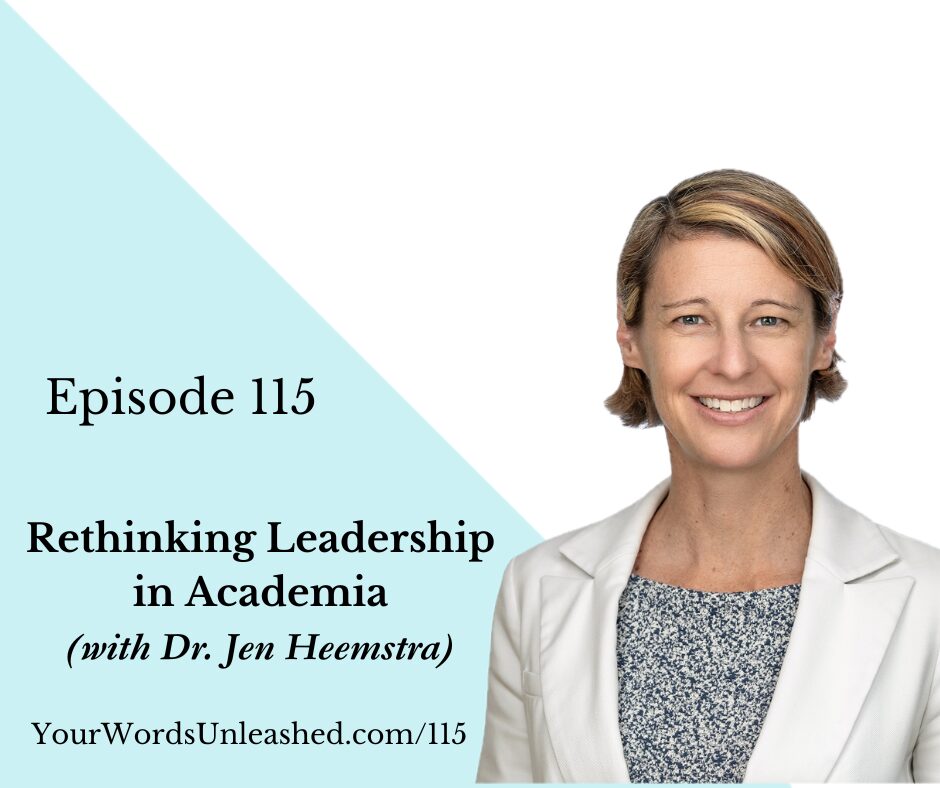
Today, I will be speaking with Dr. Jen Heemstra about all things related to leadership. Jen is Chair and Professor of Chemistry at Washington University in St. Louis. She is an academic leader whose work bridges biomolecular research and inclusive academic culture. As Director of an interdisciplinary research lab funded by NIH, NSF, and DOD, and co-founder of FlameNet and #MentorFirst, she advances both scientific discovery and mentorship. Her leadership journey, shaped by challenges and a commitment to empowering future researchers, reflects her dedication to fostering kindness and respect in the STEM community.
Jen is also the author of a really engaging and incredibly useful new book published by Harvard University Press titled, Lab Work to Leadership: A Concise Guide to Thriving in the Science Job You Weren’t Trained For. What a great title! And in it, she shares all of the lessons she’s learned over many years about how to lead a research group and create an environment that’s both healthy and productive. And I would say that even though it’s geared towards folks who are running a lab, the lessons really apply to anyone moving into a leadership position.
And I’m excited to have this conversation because it’s always baffled me that academics are given little-to-no training in how to lead people and get them on board with a shared mission. I, for one, suffer through having two different department chairs with little in the way of leadership skills. And the result was a group of demoralized and checked out faculty members. And I saw firsthand the importance of having leaders who can resolve conflict and motivate others to do their best. And that is so much easier said than done.
So my guest today is a true expert on all of these topics. So let’s dive in. Welcome, Jen!
Jen:
Thanks for having me.
Leslie:
I am super excited for you to be here. And since you have this amazing book, I would love it if you would read the first couple of paragraphs so people can get a sense of the tone and the topic.
Jen:
Well, thanks so much for that opportunity. I often actually start my talks on leadership by sharing this story because I think it’s so important for us to know that we’re not alone in having this struggle of feeling like we have this job we weren’t trained for. So my book opens up with,
“I was never trained for this. This thought was racing through my mind as I sat in my office grappling with how to manage the first major conflict in my research group. I was a few years into my faculty career and a student in my lab had just completed their qualifying exam. They were angry about the feedback from their thesis committee and were letting everyone in the group know it. At the same time, the more senior students who had already passed their exams were frustrated by how the situation was distracting them from their research. Another faculty member on our floor had heard the rumblings of conflict and came to my office to let me know that if I didn’t do something, my lab was at risk for a social implosion. I remember my stomach filling with dread. I closed the door to my office, fought off the desperate urge to climb under my desk and hide, and proceeded to Google the term ‘conflict resolution’ in the hope of finding some guidance to carry me through the situation.
Not exactly the ideal on the job training scenario. Sound familiar? Maybe your issue wasn’t conflict resolution, but if you’re a faculty member, the chances are good that you found yourself in more than a few situations where reality strikes and you suddenly realize that you were never trained for this job either.”
Leslie:
I love that so much, right? I feel like it just really gets to the heart of like people moving forward in their careers and realizing that all the research skills are not enough and there’s a lot of soft skills and there’s a lot of like inner work and all of these things. And so I love that your book is out in the world.
Can you first tell listeners though about your own journey through academia and what inspired you to write this book?
Jen:
Thanks so much for that question. Well, first of all, I never ever thought that I could even be in academia and be a faculty member. I came up in a family where I wasn’t, you know, the only meaningful advice I got on going to college was make sure that you meet a husband! Never mind the heteronormative part of that advice, but also just the complete disregard for the idea that college had anything to do with career preparation, right? That was the sole advice I got from my mother who had gone to college. She had failed to meet a husband, had a job that she didn’t like, and so her advice was like, “don’t be like me.”
My dad had never gone to college and he was actually much more helpful. He was like, “look, just go have fun. What an amazing opportunity you have to go and do this.” And so I fell into chemistry actually a bit by accident through a night job that I had working in the chemistry department. So it was the job that was helping me pay my rent that gave me the opportunity to start doing chemistry research. And then I just struggled with so much self-doubt and thought, you know, I think from an early stage, I looked at the faculty job and thought, “oh my goodness, that looks absolutely amazing.” I had realized I loved research.
I’m a very independent, like do-it-myself person. I don’t like having a boss. I like being in charge. I like being creative. I like pursuing the things that I want to do. And when I looked at that job, I thought, “goodness, that looks amazing.” You get to run this lab and teach and mentor students. But it also just looked really, really impossible. And I’m only here through a lot of really difficult situations, but also where I had really phenomenal mentors and an incredible support network to get me through those.
And so after kind of all of this, like I should never be here, I could never have this job, I found myself on my first day as a brand-new assistant professor going, “oh my goodness, I can’t believe I’m here and what an incredible opportunity this is!” And I just dove in, but then, like I share in the book, I started having these moments of like, “oh wow, there’s this part of the job that I wasn’t trained for.” I was trained how to do research and I had phenomenal mentors in my PhD, my postdoc, my undergrad research. I had fantastic mentors, incredibly healthy lab cultures all along, but there just wasn’t—I think things have changed now. But 20, 25 years ago, there wasn’t this sense of valuing these professional skills that you would need in order to lead a research group.
I think everyone just assumed, “well, you’ll just pick that up later.” Or there just wasn’t even the idea that that was important. But the incredible thing about really two or three experiences that shaped and led to me writing the book, one was definitely this awakening about conflict resolution. This in the moment, like, “oh my goodness, what am I going to do?” Because what I learned from that was that, you know, there are these resources out there. I didn’t have time to read and digest a lot of those before I went and handled that situation. So I didn’t handle it as well as I would have liked. But then in the aftermath of that, it was this realization of, you know, wow, yes, just like I study chemistry. There are scholars out there who study organizational leadership and psychology. And these skills that I need is what they do is their everyday, all-the-time scholarship and expertise. And so there are a whole bunch of resources out there that I can learn from.
The other really important piece of it is that (and I talk about this in the book because I think it’s not only was it so formative for my career, but it’s important to share these stories) that I got to my tenure vote and I had, you know, everyone’s worst nightmare as a faculty member happened and I had a not positive tenure vote. It was 50-50, which, you know, your listeners know immediately is not good. I often explained to people, I’m like, this isn’t like winning a national election, right? Where 51 % gets it done. This is like taking a test and 50 % is a definitive F. And so, I’d failed and I had to face that down. But it was the best thing that ever happened for me. It was the worst day of my life, but the best thing that ever happened for my career.
Because part of what happened in that is that I thought I had been playing by the rules. I thought I was trying to fit in. I was trying to do what people on the faculty expected of me. And then it wasn’t good enough, right? I thought, “oh my goodness, I got all the grants. I got the papers. I played by their rules and a lot of good that did me.” But in the same moment, the way that my research group showed up and just said, “wow, this was terrible, this was unjust.” But then they said, “you know what, we’ve earned tenure. We’re going to get it somewhere and we’ll go wherever you go. As long as we get to keep doing our research, we will go where you go.”
And that was also one of the most humbling experiences of my life because I realized, I thought, “gosh, I feel like I’ve done nothing to earn this loyalty. And it forever changed my viewpoint that these people that I had been trying to please, many of them were, I mean, half of my colleagues voted for me and were incredibly fierce defenders of me. And because of them and a fantastic leader, I ended up getting tenure at that institution. So I don’t want to act like I didn’t have people who came into that situation for good. There were incredible people who stood up and took a stand and made sure that I got tenure.
But it really changed me in thinking like, “wow, I thought I had to play by these set of rules, but forget that. I’m going to start doing what I think is right for my group. My group comes first. The members of my lab, the students, post-docs, they are my colleagues. And it’s kind of us against the world sort of thing.” And it freed me from having to try to fit into the academic culture. And I really just felt like I could break free from that. Also, I got tenure, so that helped a lot. But I just felt like, “okay, I’ve had something to say and now I’m going to say it.” A lot of what’s in the book, you know, doesn’t necessarily run counter to our academic culture anymore, but also I didn’t feel like I had to avoid upsetting people or I didn’t have to try to play by the rules anymore.
And so, that allowed me to start getting involved more in learning about leadership and talking about these things on social media, on calling out the things that could be better in academia. And then that’s what ultimately led a postdoc in my lab, Dr. Shayla Shorter was like, “Jen, you should write a book.” And I was like, “no, I can never do that.” And the really ironic thing is that Shayla was in our lab as a postdoc working on our projects around growth mindset. And so she just gave me this look like, “Jen, that doesn’t sound very growth mindset.” And I was like, “oh, I know, I know, I know.” And so eventually that started me thinking about it. And it still took a lot of people supporting me, speaking this into truth for me. It took coaches. It took obviously the amazing opportunity that I had to work with Harvard University Press. All of those things had to happen, but it was really out of that. Shayla was the first one who planted that kernel of maybe this is something you could do. Yeah, it’s something others need, right?
So sometimes it’s like flipping it around to like, “does the world need it?” as opposed to “can I do this?”
Leslie:
You raise some really great points about failure as a growth opportunity versus a time to shut down. And I’m gratified to hear that it was a moment for you to kind of go back into your values and your own priorities. You know, sometimes people, they get these really negative reviews of different kinds and they really have to dig deep around, “do I want to continue being in academia?” And when they decide they do, then it puts them on a more purposeful path. So it sounds like that really happened for you.
So we throw around this word “leadership.” And I think in academia in particular, like this is a leadership role, but how do you actually define leadership? What does it mean? And what does it mean, I think specifically in academia?
Jen:
Yeah, so often when I give a talk on leadership, I actually start out by saying, you know, what even is leadership? Because I think it’s actually much broader than what we tend to assume it is. And if I’m talking to an audience of students and post-docs or early career folks, I want them to know that in fact they are leaders. Because I think this is part of how we’ve gone astray in our culture is by not really embracing both the empowerment and what we can do as leaders, but also the responsibility that we have as leaders, even if we don’t have a title.
In fact, I think that leadership itself is very separate from leadership titles because I definitely know, and it sounds like you know, some people who have leadership titles, but in fact are not leaders. Because a leadership title gives you authority, but being a leader is really all about using leadership skills and hopefully doing it well. So I like to think a leader is anyone who envisions a way that something could be, usually be different, be better, and then uses leadership skills, things like strategy, goal setting, management, whatever it is, in order to make that happen.
At a very basic level, anyone who is even just imagining how they want their life or their career to go and is taking any action to make that happen, that’s self-leadership and it’s leadership. But certainly, you know, we’ve probably both seen some people in formal leadership roles who just check out and say, “oh, no, I’m not going to do anything.” And you’re like, “oh, you’re actually not being a leader.” You know, the grad student who’s leading change in your department, who’s leading some new initiative. That’s what leadership really looks like. And I think we get this especially wrong in academia because, and this was a big part of the motivation, kind of the culture that I felt made this book necessary.
I mean, I’m a chemistry professor. I never set out to write a leadership book. It was not on my list of goals when I started my faculty career, but it was really a response to a need and an opportunity that I saw. And that’s because in academia especially, we define leadership as these sort of titled roles and administrative leadership roles, like being a chair or a dean or a president. And there’s a lot of things wrong with that. One of those, well, actually a big thing that’s wrong in our culture is that not only do we define it that way, but then it’s kind of culturally implicitly expected that you also denigrate the idea of having those roles.
You know that every time people talk about moving into a leadership role, an administrative role, is like going to the dark side. You know, the really insidious one is, “oh, well, if someone wants one of those roles, then they’re the person who shouldn’t have it.” And so the number of people, when I became a department chair, they said, “oh, my gosh, I’m so sorry you’re department chair!” I’m like, “what you talking about? I moved my family and my lab across the country because I wanted the opportunity to be able to lead and make a difference.” And it’s so insidious in really two ways. One is that we create—this is like my little soap box, I have a hot take on this—we say all these things, but then yet I hear so many people complain about the leaders at their institution. And it’s like, “wait, wait, you dissuade anyone good from wanting to have this job, and then you complain that you don’t feel like you have good people in that job at your institution.”
If anything, we should be talking about how important those roles are and talking about the things we appreciate that our academic leaders are doing and valuing the difference they make. And really valuing the fact that people are willing to downsize or deprioritize their research and teaching in order to take on these roles, right? If we valued it more, then maybe we’d be happier with the people who are in those roles, right? I’m at a place where we have great leaders. But I hear a lot of people complain. And then the other thing that’s kind of specific to the sciences is that, you know, I understand that if you’re in the humanities or some of the social sciences, your research and scholarship, it really is just, you know, it’s you working on a book. There’s still self-leadership, but you don’t necessarily have to lead a group. You don’t have to do that till you do become a chair. But in a lot of the sciences, engineering, when you start your first task, research is going to get done through other people.
Your first task is to recruit this group of students, maybe post-docs or staff, and then to lead them in doing these research projects. And so from day almost one, you’ve got a leadership job. And in fact, in industry, the equivalent, they call it group leader and they train people with leadership skills. But in academia, because we have this narrow definition, we don’t really acknowledge that that’s a leadership job. I wish someone had pulled me aside on day one and been like, “hey, by the way, you were trained to be a researcher and maybe a teacher, not really. We didn’t really train you for that either. You were trained to be a researcher. You were told this is research job. But by the way, you now have this second job. And you didn’t really get trained for that. But here’s the place where you can go pick up some of these skills.” Even that would have been really helpful. There wasn’t really this acknowledgement of that. And again, I think that’s something that has changed significantly over the last two decades, but we still have a long way to go.
Leslie:
I mean, I hope it’s changed, but you still hear a lot of nightmare scenarios from folks that are starting labs or, you know, they’re failing, end up just like not getting tenure or they have to move institutions. All kinds of things now because of that second, almost half-of-a-job in a way. I don’t think there’s a go-to place to get the resources until the book came out. And I think about my husband, he’s a PhD in biology. He went into industry and the first time he moved into a management level, he got sent to a two-week course on managing people. And I was like, “oh, that’s interesting because I’ve never seen anything like that in academia. And yet it seems to be the same set of skills.” I just thought that was really interesting.
What would you say are like the main challenges that group leaders face when they start this without all of that preparation?
Jen:
You know, I really appreciate that you brought up industry because it makes the problem and what we do in academia so obvious and so clear that it’s like,” oh yeah, so you’re managing people. You need people management skills!” But in academia, I mean, even it wasn’t so long ago, seven, eight years ago, I was talking with a friend who is a thought leader in culture and DEI and is a scientist. And when I said, “oh no, just as a group leader, you have a leadership job,” they were like ready to fight me. It was like I had struck at a core part of their identity and they were really upset by the fact that I would associate them with, you know, kind of what they viewed as “evil leadership.” I think that person has come around a lot and probably wouldn’t do that now, but that was just, and it wasn’t that person, it was just the dominant culture that we were in, that that was expected.
I mean, I was sitting at a dinner with a whole table of faculty and they looked at me like I just said this horrible, insult. But it’s so obvious that, you know, if you’re managing people, you need people skills. And so I think just the realization of that is maybe one of the biggest challenges. Like if someone had just pulled me aside and said, “hey, you have this whole other job now. You’re going to have a conflict in your lab. You’re going to have people with personal emergencies. You’re going to have to deal with a grant rejection and think about how you message that to your team who’s counting on you to get funded. You’re going to be in situations where you’re under a lot of pressure and you have to think about how you best inspire and motivate your team, how you create a sense of urgency without being abusive or creating unproductive stress for them.” You know, if someone had just said, “you’re going to have to deal with all of these things, those skills are out there. Just go get those skills for yourself,” I think that would have solved a lot of it.
That mindfulness, being aware that these were things that we needed. I think that some of those skills too, they’re just so incredibly difficult. I mean, leadership and mentoring are so challenging because every person you lead is different and none of them are you. And so your approach to help each person be their best needs to be something unique. As if there’s kind of all these dials of like, how much pressure do you put on someone to motivate them? Do they want you to be highly involved or not involved at all? Do you have to seek them out or are they always going to seek you out? You have to tailor that ideally to each person and that’s something we’ll never hit.
But then actually the thing that is so unique to academia that’s really, difficult or leading in this context of a research lab, you know, I’ll read leadership books. Like I love Multipliers, right? It’s a great book. And the whole premise is like, figure out what people’s skills and talents and interests are, figure out what each person is good at, and then try to arc them towards job duties that use their natural skills and talents and preferences and the things they like to do. But in leading an academic research lab, you can’t do that. As much as I might wish I could look out over a group of grad students, PhD students, and say, “okay, you’re going to onboard and mentor all the new researchers in our lab. You’re going to plan every experiment we do. You’re going to write up all of the manuscripts because that’s what different people are most skilled at.” Academia doesn’t let us do that.
The folks who we lead and train, we can kind of prioritize some things over others, but you know, it’s this job being a PhD student where you have to kind of be able to do all of these different functions. You have to come up with ideas, manage your project, run the experiments, analyze the data, write the manuscripts, present it in a compelling way. And maybe that’s good, but it also, I think, is a huge challenge as a lab leader because often you have to coach people through doing things that really don’t align with their strengths and interests, but are really necessary for the PhD. And in industry, you don’t have to.
In fact, I tell my group, I’m like, “the amazing thing, the further I go, like the less I have to do that,” right? Like I like numbers, I love math. I don’t really love diving into budget spreadsheets, but I have an amazing colleague who I work with, who is our business manager in our department, who does all of that. And so that’s no longer something I need to do. Whereas I feel like earlier in my career, you have to do all of those different things.
Leslie:
Let’s talk about your book. So there are many chapters in it, and it’s very well organized and thought out. And I’m wondering, how did you decide on the structure and how to present information and strategies and tools?
Jen:
Thank you for saying that. I’m glad that it made sense in the flow. I will say that that structure is actually what took me from saying, “maybe I’ll write a book, but I’m not sure,” to saying, “oh my goodness, I need to write this book!” It was that as I started, so I took a year and all I committed to was “I’m going to open a Word document and write anything that comes to mind that I might want to put in a book.” You know, if I listen to a podcast and I pick up some nugget and I think that’d be a great reference or read an article or a book or whatever, I’ll write down some thoughts.
But as I started to do that, then kind of different leadership skills emerged. But it was the realization that there could be this arc from leading yourself to leading others, but then to developing future leaders. And it was really that third section that inspired me to write the book because the leading yourself and leading others, you know, right? If you don’t lead yourself well, then you can’t lead anyone else. You can’t, you know, pour out of an empty cup sort of thing. So you need this foundation and then you apply those skills to leading other people. But a lot of that is out there in the literature. It’s not necessarily contextualized to the academic situations, but you could kind of find that.
So I was like, “okay, if I don’t write this book, people can still go find that knowledge.” But I think what’s really unique in academia is that we are developing future leaders, right? I tell my leadership friends like, “hey, I work with this team that you know, no one will stay longer than five years and the median age will forever be 26 or something like that,” right? You know, have students of all generations and all different paths, but it’s always this ever-evolving thing. And so, you know, for us, success looks like people leaving. And so our job isn’t just it’s to be a good leader to ourselves, to them. But then we have this other job of actually preparing them to lead wherever they go.
In the sciences, like you noted, most of our students go to industry or government or policy or informal science communication. Some of them go to academia, but that’s not the majority. But it was this idea that, “okay, I could write a whole section of how do you take all of these skills that we are just learning ourselves as faculty, as lab leaders. And then use research about that time you have with the people in your research group to actually help them in developing these skills and getting to practice these skills so that when they go out in the world. Wherever they go, if they’re leading other people, leading themselves, if they’re in industry and they have a conflict on their team, they could actually say, “oh, wow, I feel kind of prepared for this. Someone has taught me this.”
And so we can essentially break this cycle in our field of not training people for leadership. So that was what I was like, “I don’t know another book that has this. I feel like this is really important for our community. It’s worth me writing a book in order to get this out there.”
Leslie:
Awesome. I’m so glad you did! And just to be specific, when you say the skills of self-leadership, can you give some examples?
Jen:
So one big one, and actually what I opened the book with was time management, because I think that partly this is the thing that I hear the most discussions on. I think it’s the challenge that feels most pressing for faculty members. But also, it’s really the basis for everything else. Because if we don’t have our time managed effectively, then we don’t have time to be developing or practicing really any of the other leadership skills, I would say. And so time management is a big one. Goal setting is huge, right? Especially in academia where the goal is kind of set for you as, you know, get tenure.
I know, the fact that a whole industry, I imagine you do some of this coaching of, you know, quote unquote, I just got tenure, now what? The fact that exists is because we don’t get taught how to set goals that are meaningful to us. And so we just default into the goals that the system gives us. A really big one I’m feeling right now, in fact, I find myself giving more and more talks on this, is kind of how goal-setting fits in with motivation. How do we think about how we define success? Because that really impacts our mental health and our motivation.
And a conversation I’ve been having with a lot of other leaders is essentially like, “hey, I signed up to be like a construction worker. I signed up to build programs and expand enrollment or, you know, start this new project or this new initiative. And in these times in academia and, you know, science is under attack, the humanities are under attack, everything’s kind of under attack. You feel like you’re doing a lot more fighting fires, right? You set out to build things and now you’re just trying to prevent them from being torn down.” And that can feel very dispiriting and demotivating. But we’re having these conversations of like, “hey, firefighters are some of the most important people in society. And when you don’t have them, people get hurt. And sometimes even, for firefighters, sometimes success looks like the building still burns down, but you save all the people.”
And that to me has been something that is just so important right now in self-leadership is that if we don’t actively redefine success and really redefine it around the impact that we’re having, the net impact that we’re able to have, even if the outcome isn’t great, if we’re preventing it from being a lot worse, that’s really important for our motivation. I say that, you know, when I had a dean who essentially was the one who led the saving of my tenure case, and I always think back to like, that was so impactful on me, obviously. He didn’t wake up that day thinking, “gosh, I have it on my to-do list for this faculty member to get a bad tenure vote so I can step in and fix it.” You know, it wasn’t something he set out to do that day. But yet, and he might’ve felt like, “oh, I just dealt with this terrible situation.” But his doing that profoundly impacted the trajectory of my career. It was what made me want to go into leadership myself, but it allowed me to have a future in academia. And so I think those are some of the leadership skills are especially important right now if we’re going to preserve ourselves and stay strong for the fight that we’re in.
Leslie:
Yeah. I think those are really, really insightful points. And yeah, that’s a big part of my coaching as well, especially when I’m doing career coaching for folks who usually they’re tenured and they’re in that slump of like, “I just don’t know what comes next. And I want to do something meaningful to myself, but I don’t know what that is.” So it’s really like going inward again to your own core values, right? And trying to figure out “how do I align my next steps and the work that I do with my values, but it still makes sense within the academy?”
Jen:
And I think when you ask people about success, that definition has to shift over time. It has to become more aligned with your values. Otherwise, you’re going to burn out. And I think that’s a big source of the burnout. On top of like the crazy schedules and all the things that people do is that oftentimes the work is not aligned with what people actually value. And the metrics of success are often very vague. I mean, we see this struggle for graduate students that they go from being undergrads where it’s like you have quizzes and exams and final grades, and then they get into grad school.
And actually, a grad student in my lab asked me this. We have monthly meetings and my group members, they write a report and it’s like an IDP combined with a project management plan combined with their meeting agenda. And I read them all in the morning and I go out for my morning run and think about all the agendas and what I’m going to say. And I will never forget, you know, sipping my coffee, I’m not even through my coffee yet, opened up the report of one of the grad students in my lab at the time. And her agenda item was, “how do I know if I’m succeeding in grad school?” I just sat there like, you know, coffee halfway to my mouth and just paused and put it back down and thought. And then I wrote a little comment on the document. I leave a little feedback. I’m like, this is like the existential question of academia. I’ll try to have some good thoughts on it by 10 a.m., you know.
But it is, it’s so diffuse. And I think actually, I’m curious if you see this in your coaching, but I think something that is a tremendous opportunity in academia, but also creates almost some paralysis around the decision-making is that once you are tenured, if you have the privilege to be tenured, I once heard someone say, it’s like you pop your head up out of the foxhole and there’s like this boundless vista of things that you can get involved in. You can take your career in any number of directions. You can have impact in so many different ways through so many different roles at the university or in your professional society or through service, through leadership, through your scholarship. Through writing trade books. All of these things. Science communication.
But then because it’s such an opportunity that we can change our job duties quite a lot without ever changing our job title, but then do you feel like there’s almost just so many opportunities or do you feel like people just don’t even let themselves see what those opportunities are?
Leslie:
I think it’s the plethora of opportunities and not being able to discern which ones they actually want to do versus feeling like maybe there’s some sense of obligation or even guilt. Like I’m the only one that can do this. Or if I don’t do this, then who else will do this? That’s a lot of the stuff I see. You know, I was coaching someone who was on sabbatical and she was about to go back to become, I think, chair of her department. She was like, “I’ve been feeling like I am not steering my own ship. Like there’s so many things I’m involved in. It’s almost like going on its own and I don’t feel like I’m in control or in charge of it.”
And then so usually it comes down to taking a lot of things off people’s plates and being like, “does that project really align with how you want to show up, who you want to be, and what you want to be doing if we turn it back to you? And not like, ‘oh, it’s such a great thing for others.’” Actually, I think being selfish in this case is very useful. Because it’s not a bad thing, it’s more like this is the work that’s not going to burn you out.
Jen:
Oh, that’s so good. I love that advice that often we forget just how much autonomy and agency we have. I talk with my coach about how I’ll often become like a prisoner to my email or I’m still a people pleaser. I grew up in a really difficult household where I, you know, had to kind of like sometimes scheme to find a place to sleep at night or whatever. I grew up being a people pleaser and that is still deeply ingrained in me. I work on a lot, but I’m like a champ at taking things that I should love to do and turning them into things that feel like I have to do. And then, I’m like, what am I doing? I actually want to do this. I love doing this thing.
You know, I’m also like a Enneagram three productivity focused person. And so I can turn it into like, gotta check it off the list, gotta check it. And just completely steal away the joy in things that I should be really, really enjoying. Or I can get this compulsion of like, “oh my goodness, if my email box isn’t empty by the end of the week, like that’s not okay.” And just look at it to let go and be like, “you know, if it’s important enough, they’ll email me again.” It’s a lot of coaching to get me there.
Leslie:
I mean, that’s self-leadership too, right? And it’s interesting you mentioned people pleasing because I imagine when it comes to then having to help resolve conflict in your own group, that’s doubly hard.
So what are some effective strategies you’ve come up with to help resolve conflict and maintain a good working environment?
Jen:
For a while, I would joke that if I were ever to write a second book, it would be called, Please Just Tell Me What to Say. Kind of like a center for nine difficult conversations. And that’s because I am naturally a fairly conflict-averse person, or in certain circumstances when the relationship is really important, I’m a very conflict-averse person. And I get really nervous and anxious probably because of some of that people pleasing as well. And so for me, one of the big strategies is just having a few go-to lines that I can come back to. Like if I know I have to do something where someone will be really angry with me, I kind of just keep in my head, “what is the thing I’m going to say?”
Like often I’ll have to say, “look, I’m making decisions based on what is in the best interest of this group. Here’s the value that’s guiding all of my decisions. It’s to preserve our group culture, help us be as effective as possible in our research. And you might not agree with that. You might have different values, different goals, and we might disagree on that, but that doesn’t make what I’m doing wrong.” Like I will defend that we’re doing it this way. Just coming back to, my goal is for us to have this culture where we treat everyone with kindness and respect, and here’s something that’s happening that is not aligning with that culture. And here’s why it is so important for that to be fixed. And here’s why we won’t tolerate any behavior that undermines that culture that we have in our lab, right?
So kind of having lines that you go to. For me, I’m a runner and so I often read about visualization. You know, they say when you’re going to do a marathon or whatever, you should visualize yourself struggling and feeling tired, but then staying strong and getting through it and crossing the finish line. And I do the same thing for difficult conversations. I’ll often kind of think through in my head how it will go. I’ll often envision all of the worst things that I think someone might say to me or to another person. And then I just visualize kind of like that running. Just visualize sitting there and letting it sort of flow past me, but not have to land on me. And I just visualize myself staying cool, calm, collected, relaxed, even though all of that is happening. And then when I end up in that situation, if someone starts yelling or whatever, I feel like I’m able to stay cool and calm and collected.
But then also have that line that I come back to of like, “we don’t speak to each other at this volume. This tells me that we might need to take a break.” The third skill that I think it took me the longest to learn, and I talk about this a bit in the book, something that’s kind of great about conflict resolution, if I’d realized it sooner, is that we can apply our research skills. It’s really important. We have these researcher skills where we’re trying to gather information and analyze what those data are telling us and draw hypotheses and test those hypotheses. We have to do the same thing when it comes to conflict because often as a group leader, what comes into your office as the complaint is not the actual issue. Often people aren’t telling you the full story because there’s this insidious power structure. So it’s often much, much worse than even what they’re telling you.
There’s personality conflicts. Sometimes the thing that people are upset about isn’t the thing that they present with. So an example I use in my book is, you know, maybe you have a conflict because two grad students are working on a manuscript together and one of them says, “hey, here’s what I expect the other one to write and I want it done by Monday.” And then the other one says, “that’s impossible. I can’t write the whole manuscript” and gets really, really upset. And sometimes it’s just a miscommunication. You have to figure out, did you actually mean they had to write all of that? Or were you saying they’d write part and you’d write part and it’s just a miscommunication here and we just need to get the right information? Or, you know, is it something like, “hey, they’re throwing a party over the weekend and you didn’t get invited, so yeah, they were trying to needle you about what you did over your weekend? And that’s really, you know, the heart of the issue.
Or sometimes it goes back to something that happened two years ago that, you know, “well, last time we wrote a manuscript together two years ago, this person put all these unreasonable expectations on me.” And so now I’m going to do it to the other person. You have to kind of try to get at that root issue if you really want to solve what’s going on. And then to try to teach other people to do that too. In fact, with our lab, we have a policy which is like, you know, “look, everyone always has the right to just say, ‘hey, this person did something that wasn’t okay. It went against our culture. Jen, you go deal with it”. But in this idea of developing leaders, I want to give people the opportunity to also say, “hey, I’d like to have you coach me on how I can go deal with it.” Or “I’d like for us to all sit down in a meeting together.” You know, essentially to give them the option to be part of that process so that they can develop the skill to do this for themselves into the future.
Leslie:
That’s so useful. I mean, I feel like in my old department where I was for a decade. It was a very political department with factions, and that’s, I think, pretty normal. And it felt like many of the things people were fighting about today were based in like someone got their feelings hurt 25 years ago and it was never resolved. And then it just starts to layer on and layer on and then it becomes like the way people look at each other. And it seemed like a lot of hurt feelings and no conflict resolution. And then they think they’re fighting over like who’s getting hired, but really, they’re just pissed off that one person didn’t support another person a very long time ago. I mean, that’s how I viewed it as a junior faculty member.
Jen:
That’s so spot on. That is absolutely spot on. And in fact, I once had a leader who said this and it stuck with me. And they were like, “you know, when you sit in a faculty meeting and you hear people have these disagreements about whatever, you know, what piece of equipment the core facility is going to buy. Or these even the factions over, they don’t value your research field or I think what you’re doing in your research field isn’t as rigorous as mine. There were like 90% of that. I’m sure this is an estimate, but like the majority of that goes back to some disagreement over who got hired or didn’t get hired or who got tenured or didn’t get tenured because all of those things become sort of a moratorium on each person’s individual value.
Whether or not the decision went with what they advocated for or not. Or whether, you know, if you hire in a certain area, then you’re valuing their field or not valuing their field. And that so much of it just goes back to some hurt feelings over, but it shows up as like ideological disagreements or disagreements about strategy, but it really is just back to having that opinion. But also like no resolution of that conflict. Did you have PTSD watching t=The chair on Netflix? Did you ever watch this? I did.
Leslie:
I remember thinking, you know, I don’t remember it that much. I liked it. They didn’t come out with a second season, so I guess it wasn’t that popular. Maybe it was too accurate. It was too niche, too accurate.
Jen:
Yeah, there were lines in there that I was like, “oh, I feel this like deep in my soul. Too close to home!”
Leslie:
We’ve talked about a lot of different things, but I do want to touch on parenting because I do think this is something that people talk about and yet there doesn’t seem to be any good strategies out there. And so I know you’ve got a couple of kids. You talk about it in the book.
And so, you know, what advice do you give other scholars who are parents—mothers in particular—who are trying to balance their work with being there for their kids?
Jen:
So the best advice I ever got on this, and for a lot of people it’s too late, but maybe I’ve seen for some people it’s an awakening. And it was actually just an insight from Dr. Mary Ann Mason, who wrote the book, Do Babies Matter, quite a while ago. But she studied, you know, how having babies, but also marriage and all these different things, impacts women’s progression in academia at different times. And one of the really interesting insights at the time, I forget the exact data point, but it was something like having a child made women much less likely to get an academic job and much less likely to get tenure. But that only applied to married women and not single women.
And I was like, “well, that’s not what I’d expect.” But it turns out something she said to me when we met is, you know, basically the number one factor in how parenthood kind of translates into hurting or helping your career is your partner. And so the most important thing is the partner that you choose. And I have seen this, right? I’m fortunate to have an incredibly supportive partner who has had my back. Certainly, we sometimes have to have hard discussions about my commitment or my travels or what he needs, his commitments, all of those things, but we’ve always been in it together. And then I’ve seen especially women who have partners who just drag them down and make them feel guilty about any work they do or who still make them do all of the domestic work, all of the cooking, cleaning, and childcare.
I’m fortunate to have a partner where we’ve traded that back and forth at different points in our careers. But at this particular moment, he does a lot more than I do, and I’m so grateful for that, right? And so I think that that was the number one most important thing I got. But sometimes that’s changeable, sometimes it’s not. But then I think the other piece is just to get comfortable with imperfection. I had a child before I even started my faculty career, and that was not a thing that was done in R1 science when I did that. I didn’t even know any women at the time who had had a baby before starting their academic career, let alone before tenure. And now I know that there were a very, very small handful. Actually, one was in my department here. She’s now at another university. But there were very, very few role models for that. And so I just always felt like, “wow, this is so hard!”
But then a big realization was, you know what? Well, two realizations. One was everyone has to draw the line somewhere. Even if someone has no partner, no kids, not a lot of hobbies, they still fundamentally need sleep. They need rest. There’s always another paper that can be read, another grant that can be written, another email that can be sent. There’s always more you could do. And every single person has to say, “wow, I wish I could do more, but I have to stop now.” And as a parent, I just need to draw that line a little bit closer in. So I had to get really good at imperfection of like, “this is as good as it’s going to be.”
But also, I think we often go too far into the area of diminishing returns. We tend to err on the side of putting in more and more effort even when it’s not getting us really any closer to excellence. And so being a parent taught me that I just had to let things go. I’d be like, “yeah, it’s like 80 % of the way up that curve.” That’s going to be good enough. Grant review is stochastic. Manuscript review is stochastic. This is good enough and good enough. But I think the upside to that is that I never knew this job without having kids. And so it made me have to build my habits right from the start around reality.
And I’ve seen people who have known the job when they could just work all the hours they wanted, kind of. And then they have a kid and then it’s like a massive, massive readjustment. And so I think there’s some ups and downs, but actually the best advice I ever got was from Dr. Nalini Nadkarni, who was my colleague at University of Utah. And she was like, “we need to stop talking about balance because balance doesn’t exist.” And you know, it’s like trying to balance on one of those bosu balls. You know, if you ever achieve balance, it’s gone in an instant. And so she said,” we need to stop talking about balance because that is something we can never achieve. But we need to talk about avoiding imbalance.”
So it’s like trying to be on one of balance balls and you’re never perfectly balanced, but you don’t want to be so out of balance that you like fall off onto your head, right? So it’s about kind of being comfortable with the fact that you’re always a little out of balance. Like the goal is to just be constantly kind of adjusting, saying, “hey, I have a big grant deadline. I’m going to be out of balance working more these two weeks and I’m okay. I’m going to embrace that. I’m not going to feel guilty about it. But then I’m going to make sure I carve out extra time for family. I’m going to be a little out of balance of not working as much the next week after that or the next two weeks.”
And so it’s really about trying to achieve a balance that we feel good about kind of integrated over, you know, a month or, or a year. You know, not this idea that every day has to have 9.6 hours of work and then 2.3 hours of family time and 1.2 hours of exercise and hobby time. Like that’s just, it’s not realistic.
Leslie:
Yeah, it’s impossible. And I do question the word balance as well. It’s just more like maybe it’s like integrate, trying to integrate work and parenthood. And it sounds like it’s really about being intentional, right? That like, if you know these deadlines are coming up, you can plan around it. And if you actually give yourself permission to not feel guilty during that time, you may actually do it faster and have more time for your family, you know what I mean? Versus the folks that are stuck with the tension.
Jen:
So I think that’s you have to not feel guilty. Yeah, actually I’ll speak like a real scientist. It’s about having a distribution of effort that you feel good about.
Leslie:
Awesome! That’s a great place to wrap this up. Jen, I’ve really enjoyed this conversation and I know listeners have gotten a lot from it. How can people find you? How can they connect with you?
Jen:
The easiest way to find me is at my personal website, which is www.jenheemstra.com. I also have a fairly unusual name. So if you just Google Jen Heemstra, you’re going to find my faculty page and my personal page. But that personal website has information about the work that I do in leadership. It has a contact form that will come to me in my email. It has information about the book and it has a ton of resources and blog posts and different things like that to help you in your leadership journey.
Leslie:
Amazing. Well, Jen, thank you so much for being here today and offering such useful advice and strategies. And I really highly encourage all of you to go out and purchase Lab Work to Leadership. Again, it’s useful for anyone who’s moving into leadership or who’s already a leader and they want to strengthen their skills.
So thanks again for being here and everybody take care until next time.
******
If you enjoyed this episode, also check out:
EP 58: The REAL Problem with Imposter Syndrome (with Dr. Angélica Gutiérrez)
Ep. 84 – Service Shaming in Academia & How to Fix It (with Dr. Cullen Merritt)
Ep. 96 – How to Write Prolifically (with Dr. Abbie Goldberg)