Leslie:
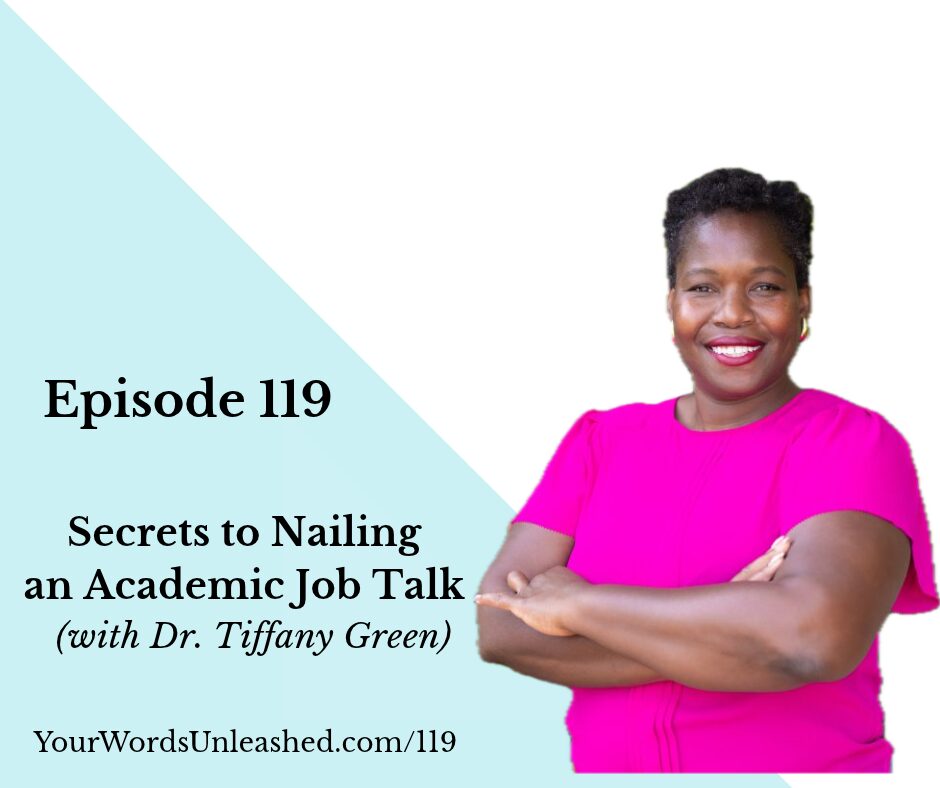
Hi there, folks. We are back with another amazing interview. Today I have the pleasure of speaking with Dr. Tiffany Green, Associate Professor in the Departments of Population Health Sciences and Obstetrics and Gynecology at UW Madison School of Medicine and Public Health. She’s also a keynote speaker and a public speaking coach who helps scholars strengthen their job talks.
And since the job market is in full swing, I wanted to have her on to talk about how academics can become more effective public speakers and create talks that have maximum impact, which I know we all want. But before we dive in, let me tell you a bit more about her background.
Tiffany L. Green, PhD, is a nationally recognized economist, population health scientist, tenured professor, and scientific communicator. She is a three times TEDx coach and spent more than a decade as a member of Toastmasters International as a competitive speaker, evaluator and coach. Dr. Green uses these experiences to create innovative tools for effective academic presentations. She’s dedicated to training the next generation of scholars in scientific storytelling to increase the clarity and impact of their science.
So Tiffany, so happy to have you on the podcast!
Tiffany:
Thank you so much, Dr. Wang. Should I call you Leslie or Dr. Wang? Leslie, okay.
Leslie:
I wouldn’t. So, Tiffany, can you talk about your journey through academia and a bit about your research and teaching?
Tiffany:
So I feel like it’s been a long time since I’ve been in academia. I started out as an economist in a straight up econ program. And I did what I tell students never ever to do that at graduation: I applied for one position. You should absolutely not do that, but I did it and it worked out for me. And I became a part of the Robert Wood Johnson Health and Society Scholars Program, which unfortunately is now defunct, but was just a life-altering thing for me.
And the important thing about that position is that I was in an interdisciplinary soup in all of the best ways. We had people from environmental epidemiology, medical anthropology, science communication, all those things in one place. And to communicate across those things required that I learn my own discipline and learn how to talk to people across disciplines.
And when I think about it, a lot of that work really started there, my interest in scientific communication. And so that has been a really central part of my journey. And as part of that program, we had support from outside experts that the foundation would bring in to support us with communication. All that said, scientific communication has been such an important part of my journey, even from the very beginning of my work in academia as a postdoc and throughout.
Leslie:
And when you say scientific communication, can you give just a really simple definition?
Tiffany:
Basically, the ability to talk about my work without people’s eyes glazing over and that it is understandable to them. I would say that my biggest strategy for scientific communication is my two boys. They will let me know whether something I’m talking about is: one, interesting, two, whether it’s actually understandable, right? And so a part of my work is to make sure that my kids understand it in obviously in an age-appropriate way.
And then start leveling up to people outside. Do people in my field of reproductive health think this is interesting? Well, how about people outside of it? How about policymakers? How about the general public? This journey has really taken me so many places, including working on my first book proposal, because I realized that the way we were talking about things like maternal mortality was completely incomprehensible to people from communities. So the work that I do in public speaking coaching really emerges directly from the work that I do in my own scholarly life and with my children who are my biggest supporters and my biggest critics.
Leslie:
How old are your kids and then what specifically do you study?
Tiffany:
I have two little boys, seven and eleven.
Leslie:
And you are communicating science to them. Amazing!
Tiffany:
They give me the business. Like they will tell me, “I don’t understand anything you said,” or “huh, that sounds interesting,” or “you got a grant. How much are we getting?” And I have to tell them, “we’re not getting any money. And that’s how academia works.” And to outsiders, as you know, it sounds absolutely wild.
I research the causes and consequences of racial inequities and reproductive health because I think every person should be able to reach their highest potential. And I want to make a distinction between the work that I do and maternal and child health. I’m interested in health and well-being and autonomy throughout the reproductive life course. I’m not just interested in the what, I’m interested in what people want and what they desire. So that has sometimes brought me into conflict with people in these spaces, but I am all about bodily autonomy. I’m all about personal freedom such that people can individually and collectively reach our highest potential. I tell people I am a kid who grew up watching the Jetsons on TV. I thought we would have flying cars by now. And my goal is to get us there by achieving reproductive equity and reproductive justice.
Leslie:
Awesome. Thank you for explaining what you do.
Now, onto the public speaking stuff. How did you get into this? It’s something people are so scared of. So how did you learn to love it?
Tiffany:
I’ll be really transparent here that I grew up in the church and in the black church. And as many people have said, the black church is often a conservatory. It’s funny because I’m not particularly religious at all now, but part of that work was learning how to speak in front of audiences, right? And then as time moved on, I would participate in oratorical contests inside church, outside of church.
Those were really important formative things for my career. I got the opportunity to speak also in school, right? But I didn’t put like systems around it until much later. And when I met my now- husband, he was in this organization called Toastmasters. And it wasn’t that I was a bad speaker, but I think Toastmasters gave me a little bit more scaffolding and the really important ability to evaluate speaking, which is essentially coaching. And that is how I learn how to give feedback that actually mattered and that was actually useful. Now, when I talk to academics, I tell them that Toastmasters, in many ways, was a valuable experience.
There are some things that I would not suggest in terms of delivery and other things. We can get into that later if you want. But I do think it’s very, very good for one thing especially, and it’s learning how to think on your feet. And a lot of times in academia, particularly in job talks, the thing that syncs people isn’t actually the talk itself. It’s how you’re responding to the questions that you have. And Toastmasters really taught me how to think on my feet and how to organize my thoughts in such a way that I can give a coherent answer to a question.
That’s just thrown at me seconds before. So that I think was really valuable. And Toastmasters also helped me to get in contact with Ted because that was a message. I think it went across email or something like that. And I went into TEDx women, I think. And I went into it and I was like, “it’ll be so cool to give a TEDx talk.” And when I walked away, I had absolutely no desire to give a TEDx talk. What I did have a desire to do is help people bring their stories to the stage. The thing I realized with a lot of Toastmasters is that they were very focused on giving this dramatic speech or something that was a good speech by Toastmaster standards. And that’s not the standards of TEDx, at least where I was in Richmond.
It was, do you have an idea worth sharing? And I became really obsessed with helping identify and coach people who had ideas that were actually worth sharing, that were actually interesting to me. And I found that I had a really strong ability to kind of get to the point and pull out things that mattered that the person didn’t even know mattered. For example, there was a woman, I wasn’t coaching her in particular, but she was talking about excavating homes of formerly enslaved people, like slave cabins and things like that.
And then I was like, well, how did you grow up? And she talked about growing up in these little houses, in these houses, kind of cave almost things. And I was like, “so you grew up in a hobbit house.” That looks really obvious to me. And she ended up integrating that into her talk, and it was a big hit. So I mean, I don’t know how to explain it. I have this incredible love for identifying the thing that people don’t even see in themselves and being able to pull that out and help them realize how valuable and how wonderful that thing is.
I think that a lot of people are afraid of public speaking. I get it. That’s not really my fear. I go on sometimes I have a little bit of anxiousness right before I go on. It’s almost like excitement and then it goes out like But I know other people don’t have that. And I try to give them the confidence to talk about their ideas by saying what you have to share is valuable, right? I’m just giving you the tools and the strategies and the scaffolding to be able to go out there and get what you want and be able to persuade through your words.
Leslie:
Yeah, no, absolutely. And I think, you know, probably a lot of fear of public speaking comes from not knowing how your stuff may land with other people as well. Like will I be able to give this talk in the way that puts my best foot forward? That’s hard for people to know, right?
Tiffany:
Yes. And I think the other piece of that is is what I would really emphasize for your listeners is that if you want to be a good speaker, you should not really look at other academics for the most part. That is not something that has always been valued or we’ve been taught to value a certain style that’s not actually compelling in other contexts.
I actually spent a lot of time, not a huge amount of time, but I spent a decent amount of time watching people like comedians. And not to be funny, but because they have this very unique insight into human nature, the way they’re able to respond in real time when they do crowd work, for example, the way they position their bodies. Some are able to like have a complete set just sitting there. One of my favorite comedians, Ali Sadiq, just kind of uses his mic as a prop and the way he paces on the stage and tells stories.
All of those things, I’m not gonna do that in a talk. I’m not, you know, gonna you know fling myself all around the room, but it did make me comfortable with working the room in a way where I don’t have to stand still. And I tell my clients, depending on what levels of ability they have, etc., that you have to feel comfortable in your own body. So that is part of the work that I do as well. Like, how do you want to bring yourself into this talk? What props do you use? What movement do you use to make this connect with the audience?
Leslie:
I think self-awareness of your body is something that academics are rarely, if ever, taught. I remember when I was a graduate student at UC Berkeley, and we had tons of candidates, job candidates coming in all the time. So I attended all of them. And I just I remember one talk where during the Q&A, the guy was thinking and he literally reached inside his shirt and scratched his belly. Like through the buttons, and he had no idea he was doing it. And I was like, “my God, like that is really inappropriate.” But I could tell he didn’t know he was doing it. It’s like the lack of awareness. He got the job.
Tiffany:
He must have been good.
Leslie:
He must have been good because it’s still in my head twenty years later!
Tiffany:
Wow, that is something else. I know that one of the benefits of Toastmasters is that when I competed, I did something I hated, which was to tape myself. And I noticed that I was like, “Are you rocking from side to side? What are you doing, girl? What are you doing?” And so those are the kinds of things obviously that person that you’re talking about must have been so good, they couldn’t ignore him. But in this competitive market, you want to at least address the things that you can control. And you can control potentially scratching your belly or rocking from side to side.
Like I tell students, there’s nothing wrong with using your hands, but if I’m doing this, you can’t see me, listeners, but I’m waving my hands from side to side. You’re just looking at my hands. You’re not listening to what I’m saying, versus whether I’m intentional about using my hands, then that’s something very different.
Leslie:
Yeah, I think there’s so much of a need to have intent in a job talk that goes beyond just the words that people are saying.
So what got you really interested in helping people with job talks in particular?
Tiffany:
I have seen many a bad job talk, and I hated seeing talented and promising scientists tank their chances of getting the job they wanted because the talk was bad. It was that, and actually my own job talk. I was formerly at another university, and I got this email. I kept getting all these emails from friends, like, “hey, we’re hiring here.” I thought I would never come back to UW Madison after my postdocs, but I think this is a first, maybe only time that it looked like a job had been written exactly for me.
It was a cluster hire in reproductive equity. For your listeners, a cluster hire is when a university basically decides they don’t have a deep enough bench of people in certain areas, and they provide funding for units to hire people in certain areas. So mine was reproductive equity. And I applied. I got two out of the three positions for the final. And they were like, “you know what? You can do both job talks together.” And these were very different units. One was in the school of medicine. The other was in public policy. On one hand, you have economists and public policy people who are very quantitatively oriented. And then there’s clinicians and public health people who, for good reason, don’t trust a lot of economists like me.
And I had to figure out what could I do? I wanted this job. This was something that was important to me. And I started practicing in front of everybody, in front of people who weren’t familiar with my area, even in front of Toastmasters Clubs. And I was also secretly pregnant at the time and sick as a dog. And I said, “baby, we got to get this job, right?” That’s my seven-year-old. And I was like, “how can I tie this together?”
And I was up on social media one night and I saw the story of a young black woman who had these big dreams, wanted to have a hair salon, and then she got pregnant and got sicker and sicker. And she went back to the hospital after she delivered and she died. And I talked about the fact that, hey, you know, black babies are more likely to be born too late and too soon. Black birthing people are more likely to die before that first year after birth. And this is important for to me as an economist because of X, Y, and Z reasons. But as a mother and as a human, this matters to me. So I’m hitting people with all these things and I’m getting them to trust me with the story. And I was told this is not me, saying that that was like the best job talk they’d had in a couple years.
And it’s because I made a point of thinking about the through-line of my talk, thinking about the story and anchoring my work in that story, but also having the methodological chops to back it up. My job isn’t to dress up your talk if your science is not good or other things. My job is to help you find your core anchor, help you find your “why” so that you can tell a compelling story about your work. Your journey thus far and where you’re going to go and get people excited about being part of that. People like being a part of success. They love it. That is your job to show people that you are a scholar that can stand on your own two feet or you can stand alone, but also you are someone who would be a valuable part of the community, et cetera. That’s the goal of the job talk. It isn’t to convince people you’re smart. That’s a baseline assumption if you are coming to a final job talk.
Leslie:
I know your website is the www.storytellingprofessor.com. So obviously stories are central here.
What are some ways you’ve seen or advised people to use a story in a job talk?
Tiffany:
I think it’s the anchoring. Some people tell a lot about their life story, et cetera. And I think that can be important, but you have to be careful. The first thing is that the story needs to be clearly anchored to your scholarship, right? If you’re talking about, I don’t know, going boating with your cousins in the winter, whatever. We’re in Wisconsin, people go ice fishing. But that’s interesting, but it’s not particularly relevant to the work. But if you’re talking about ice fishing and growing up ice fishing and you do work on climate change, then we have a story that’s anchored to the work that you’re doing. Hopefully that makes sense.
So the first thing I really get people to understand is what is your why? Why do you do the work that you do? I also do some work with grad students on three-minute thesis, which is where I really got started doing a lot of this professional coaching. And there was one student that was doing work on machine learning and fossils. And I was like, “okay, sounds great. If you like it, I love it.” I didn’t really understand what was going on. And then I remembered because I am a very inquisitive person, I asked people to tell me, “Tell me something that’s an unpopular opinion of yours. Tell me something that’s really interesting about you.” And this person said, “Well, I have reptiles as pets and my mom is still taking care of them for me in South America.”
I said, “huh, that’s kind of interesting.’ So I kept going back with this student. I’m like, “Well, why are you doing this work? Why are you using machine learning to understand fossils in the fossil record?” And it turns out after some more probing that they had grown up in South America, they had watched the nature documentary when they were younger. And they realized that the animal friends that they loved were in danger of going extinct. And that’s why they came to the United States to be a biologist so that their nieces and nephews could grow up with the same animal friends that they had. That’s the story. And we were able to construct the narrative of their work using that.
And I and I was like, “Do you go back home to do this work?” They were like, “Yeah.” So instead of saying “the data were collected,” [it’s] “I go home to X, Y, and Z place to collect data and use machine learning to understand the evolution of these animals.” Do you see the difference? I’m telling the same thing, but I’m actually using their story to take the listener along the journey with them. I think that fundamentally one of the problems in the work that we do is we think people understand.
I think a grad student did this study a long time ago where people would like tap out a tune on the table, et cetera. And they would swear people knew exactly what song it was, but they had all these other pieces in their head that the outside listener could not understand. And stories help to remove that barrier and literally take the listener into your head with you. And they’re reliving the process with you.
And I think that is just so necessary because a lot of the questions people end up asking sometimes are of clarity. They don’t understand what you’re doing. And the more people don’t understand what you’re doing, the less you can go into depth about the work that you’re trying to do that you want to bring into the world, right? So stories are in many ways both a shortcut and a revelation when it comes to your work.
Leslie:
I mean, stories are primal. They are how we learn, right? And so to take the story out of knowledge immediately narrows down who can get what you need them to get from it.
Tiffany:
I love the primal. I love that it is so primal. Like I talk to students about the tortoise and the hare, even if they don’t remember all the details, right? And I realize that can be very US centric, etc. But the slow and steady wins the race. And I talk about from my Caribbean background, the Anansi stories, the trickster spider, and how those ideas are conveyed, or indigenous stories, how cultures convey knowledge and values and ideas over time.
But in academia, we somehow, particularly in the social sciences, we somehow have fooled ourselves into believing that being more objective means taking stories out of ideas. And I think this is particularly challenging for those of us that do work that is considered research, etc. That we want to remove ourselves from the stories. And we’ve bought into this idea that stories are not objective when they are a really important vehicle, a primal vehicle, as you alluded to, to getting our point across.
Leslie:
Yeah, right. Because they immediately evoke images, they evoke our senses. Like I’m always telling my scholarly authors that I work with, like sometimes they will tell a story, but all they’ve given are just the most basic details of a situation,: someone’s name, where they were, something that happened. And I’m like, what was the temperature like? Smells, what were the sounds in the air? Like I want to feel like I’m there. Otherwise, the story is two dimensional. How do we make it three-dimensional? Once it’s three dimensional, then you’ve got my buy-in.
Tiffany:
That’s it. And that’s what Toastmasters did a lot. Like that, that taught me a lot about how to evoke emotion. Like, what’s the temperature like? What was the weather like? And I get people to think about what was a person doing? How did you feel in that moment? I was working with a wonderful scholar who was teacher of the year and had to give the graduation speech. And she was talking about her grandparents in Kenya. And I’m like, “okay, so tell me what your grandfather had. Did he have a walking stick? Did how far did he walk? What was the weather like? What was it like when people would come?”
Her grandmother was a midwife in the community. Okay. “Was there a knock at the door?” All right. So then, you know, so those sorts of things judiciously applied. You don’t want to put everything in, right? Like too much salt. Salt is good, not too much salt, right? But those are the things that make you distinct and real and convince the search committee that you actually know what you’re talking about.
Because I know we haven’t talked about AI yet, but like that, that has really, I wouldn’t say raised the it is raised the floor for like just being that bait at that baseline, right? And so how do you distinguish yourself from people that are using this technology to sound very bland and the same? Your story is a thing that helps people understand not only why you’re doing this work. But it takes them on the journey and convinces them, they know exactly what you’re doing. For example, “I use this method, but it didn’t work. And let me tell you why it didn’t work. And this is what I did instead. And here’s why.” So storytelling can also be deployed in that way. I have to explain to clients, it’s not about saying once upon a time. It can also be about the story of your missteps. That is science. That makes it real. And that also makes you quite confident.
‘Cause so many academics are afraid to talk about what they did wrong. I’m not. I realize it takes a different kind of confidence, but that didn’t work. We did that. I tell people all the time. Like I worked with a community consultant for a project we were doing in the local Hispanic immigrant population. And she told my friend who’s a social psychologist and she was like, “What y’all are doing is not gonna work. People are not gonna do that.” And we were like, “It’s gonna work. It’s gonna work.” It did not work. It didn’t help.
Leslie:
Right. Not yeah. Most things don’t.
Tiffany:
But yeah, that’s part of my story. If I don’t tell that part of the story, then people will say, well, she’s… No, I make mistakes.
Leslie:
Yeah. Part of it, I think, is just being human, right? And recognizing that we are all flawed and we’re all trying. And success can often maybe overshadow the number of times we’ve failed, right? If we don’t call attention to it. But actually, this is a good segue to talk about mistakes.
So you’ve seen many job talks in your life. I have as well, but I bet you have more than me. What would you say are the top mistakes you’re seeing people make in their talks?
Tiffany:
I actually had a very scientific poll on LinkedIn asking professors about this. And the big ones: You use methods but don’t explain what the methods are and why you’re using them. And so I’m forced to conclude either you’re bad at explaining things or you actually don’t know what you’re talking about. You’re moving past it. I mean, I remember as a grad student, I would kinda like, you know, hopscotch across these methods because I didn’t want to explain too much.
Or spend too long on the lit review because I felt like my results weren’t enough, right? And so that is another thing. I should have never had a lit review. I see a lot of people just kind of talking about the literature without contextualizing their space in the literature, right? What you’re really giving is motivation. It’s not title slide/ lit review and you’re just listing all the people who have ever written something on this. You’re using it as a driver and motivation for the talk.
Another thing that I think is big is people confuse a gap with the literature with an urgent problem that needs to be solved. I tell people, “sometimes that gap in the literature needs to stay there. It needs to stay over there.” It’s like this tiny, right? I really try to get them to understand the so what. One of the challenges in this moment I find particularly with folks who do health equity research is that I have to give the hard feedback. I don’t give it straight like I give it to you now. Like this is not important because of the population. It’s not. Yeah, people are inherently valuable. Your research question is not inherently valuable because it looks at XYZ at population. I ask them, why is this important? What is this so what? How does this transform what we’re doing in sociology, in social work, in economics, right? How does this transform what we’re doing at the policy level?
Why is this important to you? I think that is really the missing driver because, you know, once people don’t really establish a so what, my eyes start glazing over. If my eyes start glazing over, I’m not gonna be particularly interested in what you have to say.
I think another thing that really sinks people is a Q&A. They are really either defensive. It’s okay not to know everything, but either dismissive or you don’t answer the question, you think you can, well, you can bullshit your way through it. And I’m just like, nobody is falling for that, friend. There’s that.
I think less important, but still, I think meaningful in this moment is you don’t have to have like these really TEDx looking slides, but slides with all the bullet points makes you blend in with the crowd. I think not having well designed slides is a really big missed opportunity to be able to tell your story. So those are the some of the big ones that that I see when terms of job talks. Because if you can’t explain your work, if you can’t say a compelling talk, then you’re probably not going to be a good teacher. And even if you have a very research-oriented department, et cetera, you still have to teach, you still have to convey information.
You still have to write grants that convince people that are not in your immediate area that the work that you’re doing is important. If you can’t do that, then particularly in this funding environment, even hard money departments are kind of looking like, so are you going to be able to bring in money? Are you able, and again, this is very R1 focused, right? If you’re at a selective liberal arts college, right, you are going to need to show that you are a compelling teacher, that you’re able to still do research that matters, etc. So this idea that you don’t have to be again, I think teaching-focused schools obviously probably have a better level of teachers, et cetera, but you still have to teach. You still have to convey information. So I think all of those are really, really important.
Leslie:
Totally. So I think another word for so what is stakes. Why should we care about what you’re doing? And being able to translate that to different audiences.
I am curious about the slides though. What makes a compelling slide deck?
Tiffany:
Yes, I think a story driver. I had a colleague a long time ago. We were working on a paper that sadly did not end up getting published. I remember Dr. R.J. Briggs. I’ll shout him out. And he was looking at my slides one day. He was like, “I don’t like this.” I think I might have had like a lit review or something like that. He’s like, “I like headline slides.” And if you see any of the presentations from me or from my research lab, it’s one band, one sound. We all have headline slides. So instead of looking like a lit review, I’m making a statement about what I believe. For example, if the literature is going in the wrong direction, et cetera, it’s like bam. Like “this is widely believed, but this is not true.” I’m just making that up. All of the slides are a headline.
If I’m talking about data, I don’t have summary statistics. I have what am I focused on in these summary statistics, what is important here? For example, the work that I do looks at pain treatment and bias. And I show that across these situations, across these geographic contexts, black people and Asian people are less likely to get pain medication than their white counterparts. That’s the headline. That is a slide, right? It’s not lit review. And so those little things, particularly when we’re in a world with really short attention spans, you’re able to with each slide hammer home what you’re trying to do. And it’s harder for people to tune out if you are creating a driving narrative across all of your slides.
Leslie:
Basically, summing up the take home point of each slide for folks instead of assuming they will do it from all of the different data and stuff that you’re offering.
Tiffany:
Yes. Another thing that academics do is they’ll be like, “I know you can’t see this.” If they can’t see it in the back, you can’t have it on there. You can’t have it on, like that is not it, right? I make a really big point of having things up there that you are focused on. So you do not need to show, and I’m this is for my social sciences people that do quant work. Do not put–and I did this before when I was in grad school–do not put the entire slide of regression results on there or statistical analyses. What are people supposed to focus on? Instead, I’ll shorten those things up. I’ll have a nice red box or some other color box around the results I want people to see. And I’m telling them, “this is what we found.” And this is what we found, right? I think data visualization can be really effective.
Shout out to Dr. Stephanie Evergreen. Full disclosure, I took coaching with her and I was part and part of the Dataviz Academy. And while I don’t have time to do Dataviz much anymore, the work that I invested with her has had, I can’t even calculate the ROI. I use it in grants. I use it in papers. Like visualization, like having really well-designed graphs and charts and not having a bunch of chart junk on there, that can be enormously compelling and effective. I might use icons, et cetera, to be able to, rather than bullet points, to really convey my points.
It’s not necessarily that I have these hard and fast rules, but having the presentation be cohesive, not having different fonts on different slides and like all those little things really add up. People won’t understand why they’re a little uncomfortable or annoyed, but it’s that. It’s the inconsistency across slides.
You don’t have to make it fancy, but it needs to be consistent. It needs to be clean. So too long, don’t read headline slides, using data visualization, whether quantitative or qualitative data. There’s some beautiful qualitative data visualizations that I’ve done and we continue to do in my research lab. Avoiding the bullet points. You don’t need all those bullet points, especially throughout, right? Being really intentional about the design of your talk so that it’s your backup. It’s not the thing. You’re not reading from the slides. You’re using them as a backup singer group, not the main event. People should not be able to follow the entire presentation without you.
Leslie:
Those are such great pieces of advice. And I’m thinking also of all the things you’re describing is moving from a place of trying to prove to other people that you know what you’re talking about, you know what you’re doing, to a place of confidence and intention. And I think that that’s very hard for graduate students to do. I mean, I work with tons of faculty members. It’s very hard for them to do in their writing. And it’s a big shift to say they already trust you’re an expert. Now what? That’s what I’m hearing from you.
And I’m wondering, like, you know, you also work with faculty members who go back on the market. And what would you say, are there any differences in the talks that they give or things that they should do versus grad students?
Tiffany:
So I draw from my own experience when it’s very awkward. You know, I come from economics where it’s very normal for people to go on the market pre-tenure. But I noticed when I was in other contexts that people were like, “they’re not loyal,” other things. I’m like, this is capitalism, but whatever. But I noticed that. So a lot of times that can be kind of shrouded in some secrecy, particularly if you don’t want it getting out that you are that you are on the market. So that’s one challenge that there’s not a collective conversation about it because there’s not shame, but there are often conditions at certain universities where you want to get out.
And I think this is particularly relevant because, and I spent a lot of time hanging out with sociologists, for example, the market looks a little bit different now, where the where you’re not just seeing like these entry-level jobs, but jobs that may be advertising for advanced assistant professors or associate professors, and you’re having rather an exchange between top institutions rather than new people coming into the system. So I think that’s an important nuance that we need to consider.
The other difference is people will have higher expectations of you. People are not going to have the same expect expectations of a graduate student or a postdoc that they are going to have of an assistant professor, right? They’re going to have questions about why you’re leaving. You’re going to have to have good answers that don’t bash your current institution, but also think about the pull that the current institution is bringing to you. So you that that you want to really think about.
Again, there’s going to be expectation that your story is more well developed, that your scholarship is more mature. The way that you talk about your work is more mature. I think those are some of the big challenges. So the stakes are higher when it comes to that. People are not going to have the same expectations of you that they have of a more recent graduate or a recent postdoc. So the thing that I really had to do in my own talk was really practice it quite a lot. And what I tell people is really similar across graduate students, postdocs, and assistant professors that having that job talk where you are talking to different audiences, you cannot give that job talk in your department a lot for obvious reasons. But making sure, do you have a friend in another department where you can kind of practice the talk to?
And that’s the advantage of that for me was that they were people that were not in my discipline, were not necessarily familiar with all the stuff that I that I was doing, but may have a baseline understanding of some of the methodology that I was using. Toastmasters was a whole different ballgame. I remember I was so offended. I was tired, I was pregnant and ready to fight, right? And they were like, “You’re using a lot of jargon. Like, what is your personality?” I’m like, “what are you talking about?” But it was true.
There’s to some extent, there is gonna be some verbiage that maybe somebody on the street isn’t gonna understand. But do I need to be using that? To what extent do I need to be using jargon in this context? Where’s my personality? Could I be doing more? And you also want to practice with a friend who is in your discipline and is familiar with some of the conventions of what you’re doing. So when you practice with those three audiences and this applies across the board, then you’re getting those really important perspectives and you’re going in with specific things that you’re asking each of those audiences to do.
I’m not asking Toastmasters to interrogate the validity of my scientific research. And that frankly is one of the reasons that I don’t do it anymore. I don’t have time to like just listen to people talk about gardening, which is amazing. I need somebody who could really talk about my work, right? For people that are outside of the discipline. Is the question compelling to you, even though this is not your area? For people in the in my discipline, okay, am I missing anybody who I should be talking about here? What am I missing in the methodology, et cetera?
And I think the other piece I would say is that economists, we have a reputation. I’ve been in med schools all my career, not econ departments. But I think the thing that we do that’s both good and bad is we have brutal seminars compared to public health. I think people are really, I don’t want to say soft, but people are like, I was like, why are we dancing around these obvious challenges with this paper? Like, why are we not actually having enough respect for this scholar to talk about the work? And economists are not afraid of that. And because of that, I got very used to being asked hard questions during talks. So at this point, nobody really asked me questions that are more, I wouldn’t say not rigorous, but everything is uphill from there once you talk to economists.
So I would say going to those seminars, not to adopt the more unsavory aspects, but really see what it’s like. When someone asks questions that are really in-depth and rigorous. This sounds really terrible. Don’t cancel me, y’all! But you need to have feedback from people that are going to take your work seriously. And it doesn’t have to be economists, but it needs to be people that are going to tell you what you need to hear with love. You cannot have yes people around you when you’re prepping for a talk, much less a job talk.
Leslie:
Right. And there’s always gonna be a chance, especially if you get more than one interview, that you are asked a question you cannot answer. And it’s okay to say,” I don’t have an answer for that,” as long as you don’t do that with all the questions.
Tiffany:
Yes. Well, I think one of the things that’s very valuable about the storytelling approach is that you can integrate that into the work. ‘Cause a lot of times you’ll have the “not a question but a comment” people and you inwardly roll your eyes, right? But part of that process is you’re telling people not just what you did during a job talk, but what you did and didn’t work. “So I tried this, but this doesn’t work because this, therefore I did this.” So that cuts off some of those questions right there that you’re like, “this is why I didn’t do this.”
Other questions, I tell people they’re sort of content questions, and that they require you to know your data and processes and methods very well. Then it’s sort of like extensions of that. RAnd that also requires you to know other things in your field very well. I tell this, and this is very unfair, but I think quantitative researchers are very arrogant when it comes to qualitative researchers because they’re like, “this is not generalizable.” I’m like, “dude, that’s not the point.” But what I tell qualitative researchers is like, there was one student that works on trans populations. I said, “well, I think one of the arguments here is that address-based sampling, as we do in surveys, is not going to reach this population very well. Those surveys are not particularly representative. To do this well we have to do this. This is a first and important step.
So part of it is also knowing your enemy and really understanding, well, what are the alternatives people could ask? They’re gonna ask why I’m not using this survey. But that requires you understanding, understanding before you get there what the alternative paths are. You know, like the choose your own adventure book sthat we had when we were younger. That’s what you should treat a job talk like. What are the other choose your own adventures that people could ask you and really force them to answer their question.
Like if they say, “well, there might be bias here.” Okay, that’s a great point. In what direction do you think that bias might be? That’s fair game. You don’t want to be hostile, but say, “that’s a great question”. Because the question it really is, yeah, there might be bias. To what extent? If it’s downward bias, then we’re good. Then my results are underestimating the effect size here, right? So you really have to force people to really clarify the question that they’re asking. That gives you a little more time. It creates a conversation. And then think about how does it affect your results? To what extent does that affect your results? And how does that fit in with where you’re going with the research?
Leslie:
Yeah, that’s super helpful. And you alluded to AI a bit earlier, and I really am wondering, especially since I’m not in the academy anymore, how do you think Gen AI is affecting the job market?
Tiffany:
I think it there’s two things. One is, I’m begging fellow faculty to not use AI in their letters of recommendation because it’s hypocrisy, right? Yes, other colleagues might be using AI, but they’re like, they didn’t think enough of this student not to use Gen AI. And because it makes everything sound flat and the same, the conversations are so shallow with Gen AI. like the Supreme Court decision of you know it when you see it, right? And yes, there have been studies about recognizing it and not recognizing it, but after multiple emails from students with the same exact verbiage, the same exact patterns, I think, you know, in general, I have a little bit of a clue.
I think the other piece that it’s doing is it’s raising the bar for what kinds of research are important. I think there was a time when you could get a lot of least publishable unit papers potentially funded, or published rather, I think that time is ending. I think there’s particularly in the field of health equity, I think there’s going to be more of an emphasis on new and novel data sets and connecting disparate data sources that have not been used before. And I also think there’s going to be a continue to be more of a push on showing underlying mechanisms rather than just describing a phenomenon like, the prevalence of X, Y, and Z. I think we’re going to continue to see more, particularly in top journals, really push people to do work that is less shallow, for lack of a better term.
I don’t think it’s going to destroy academia. I think a lot of people are using it. I don’t use it because I wish we would have an honest conversation about how we can talk about plagiarism on one hand and then use technologies which literally do not ask people for their permission before using their words and ideas to train devices for billionaires.
Leslie:
For sure. my gosh. It’s too big of a conversation to have right now. But this has been such a great conversation.
Can you talk about the kinds of work you do, the kinds of programs and things that you have to help grad students on the job market?
Tiffany:
Yeah, so I have two different things. You know, one of the things that I struggled with as an academic entrepreneur, acapreneur, whatever, is making sure that I was being accessible to grad students. And the way that I’ve started doing this is through universities. And so if you are a university administrator, a director of graduate studies, a dean, I do workshops at universities. We can do an all-day workshop, we can break it up across two days where I literally take people from nose to tail. Like how do you how do you start with telling your story? And we build that into an effective job talk. And I also can do follow-up coaching as well. There are people that prefer to make work with me one-on-one. And that also is a is a possibility where I will work with you on a predetermined number of sessions on your job talk.
Obviously, it will be more if I have to we have to build it up from the beginning. So there’s options for people that have a job talk that at least is in draft form and those that are starting from ground zero, where I will work with you across job market season to make sure that you are ready. We can practice Q&A. I have frameworks for how you do Q&A, how you set up a job talk to be effectively sequenced, et cetera. So those are the two things: university workshops and then people can contact me for one on one sessions as well.
Leslie:
Amazing. So how can listeners connect with you?
Tiffany:
Sure, you can send me a note at my website, thestorytellingprofessor.com. Or you can reach out to me on LinkedIn, is where which is where Leslie and I connected. I’m pretty active on LinkedIn. And if you send me a message, I’m happy to chat with you about how I can help you tell your story and get your career to the place where you want it to be.
Leslie:
Well, Tiffany, thank you so much for sharing all of this incredible advice with my listeners. I know that the job talk is just something that’s shrouded in so much secrecy, just like most things, I think, in academia. And so thank you for demystifying it and really like helping people lean on their strengths. Also, I know you have a newsletter. It’s called From the Desk of the Storytelling Professor. So, listeners, please go subscribe to that. Go to her website, find her on LinkedIn. Thanks again, Tiffany.
Tiffany:
Thank you so much for having me, Leslie.
Leslie:
Folks, have a great next couple of weeks. I will talk to you again soon.
If you enjoyed this episode, make sure to also check out:
Ep. 43 – Harness the Power of Storytelling
Ep. 83 – The Secrets to Creating a Viral TedX Talk (with Dr. Jennifer Reich)