Leslie:
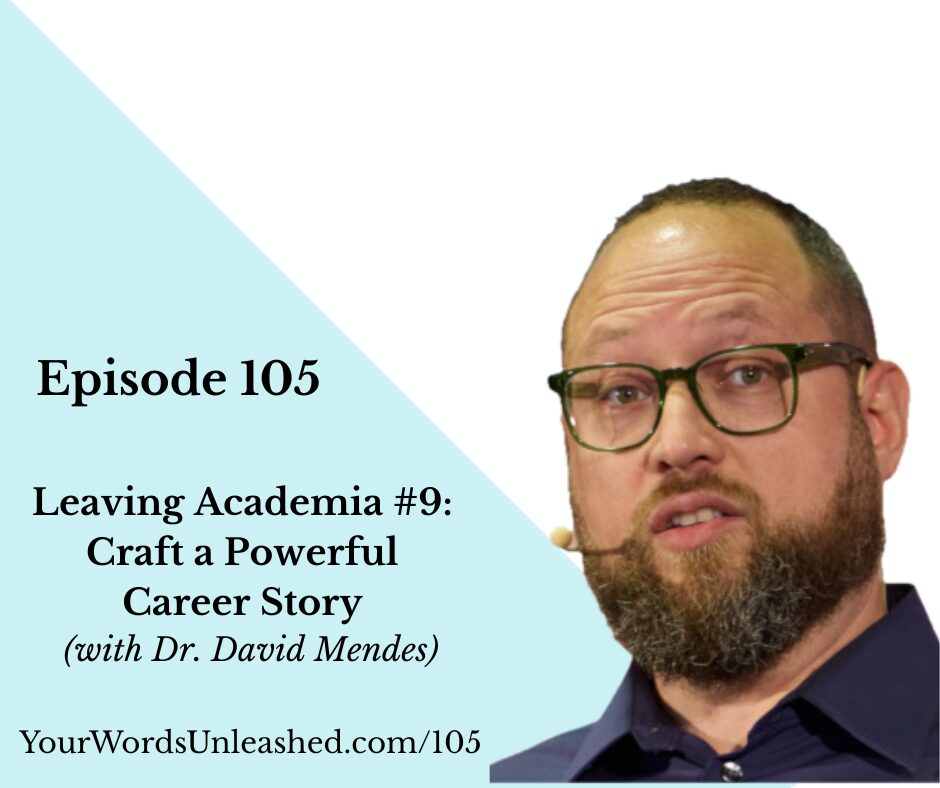
Today I’m thrilled to be chatting with David Mendes, PhD. He’s the host and producer of Beyond the Thesis with Papa PhD, a bilingual podcast that explores the many career paths available to PhDs beyond academia.
With a background in cell biology and science communication, David helps researchers craft compelling career narratives and navigate career transitions with clarity and confidence. Since 2019, Papa PhD has featured over 300 guests and become a trusted resource for graduate researchers worldwide seeking purpose and direction after their degree.
So I’m so excited to speak with another podcaster, especially someone who’s been doing this for a lot longer than I have. And I also wanted to talk to David about science communication and how he helps PhDs craft empowering career stories that help them get jobs outside the academy.
This is the ninth episode in my series on leaving academia. And if you haven’t listened to them yet, you might want to start with number one and go in order. They address things like shifting your mindset, identifying and aligning with your values, and letting go of an academic identity in ways that move you towards a more satisfying future.
So thanks so much for being here, David!
David:
Thanks for having me, Leslie. It’s really a pleasure and like you said to meet between podcasters and to meet someone else that is in the same ecosystem. It’s really heartening to see how much help out there in the community for the academic people out there trying to be good academics, but also considering making a move out of academia. It’s a pleasure to be here.
Leslie:
Yeah, I’m really thrilled to have you here. And so I always ask people about how they got to where they are.
So can you first talk about your journey through academia and your transition into science, communication, and medical writing?
David:
I’ve always been curious about how things work and about nature, and that brought me to finish my, it’s a long degree, but now, let’s say my master’s in Portugal in microbiology and genetics.
But, after that, I didn’t go straight away to my PhD. I stayed and worked in the microbiology lab that I was at for my final project for a couple of years. Then taught a little bit in a thought lab, biochemistry, cell biology. And that’s when I figured that I’d like to teach class, and what was needed was a PhD.
And so after working a couple of years in between the two, teaching and also some communication in the medical domain already, that’s when I launched into the PhD and I got into a great PhD program in Portugal. The Biology and Biomedicine program at the University of Coimbra and after a year of seminars the moment came to choose where you want to do the research for your PhD.
And that’s when I, after visiting a few countries and labs, I landed in Montreal and then I stayed. And that’s where I am. I did all the lab part of my PhD in cell biology at the Montreal Neurological Institute, so the MNI at McGill University and then at the end of the PhD. And that’s something I’ve since understood that a lot of people go through.
So I started a PhD because I wanted to teach, and I finished the PhD and I understood because of seeing my supervisor, other scientists around me, other lab directors, etcetera, what their day to day was. I understood that was not the career I wanted to follow. And yeah, I was a bit lost at first, and within a year I have found out about medical writing. Something I had never heard of as a career outlet for people with training in science in my case, in life sciences. And yeah, so my interest, my scientific interest was always there.
Even when I was working before the PhD, it brought me to the PhD and I switched from microbiology and genetics to cell biology and, closer to neuroscience. And then going through the PhD showed me that was not my path. And that leads to why I started the podcast. But we can talk about that later.
Leslie:
Yeah, no, I’m going to ask you for sure about your podcast. I feel like most of the people who listen to my podcast are humanities, social science folks.
So can you explain what science communication is? Medical writing, like all of that whole world?
David:
So my first, let’s say foray, into science communication was actually before the PhD. So I was in Portugal and this describes a basic need or a basic why of science communication of this project that I was on. At the time, the Portuguese government was for the first time going to offer generic drugs in pharmacies. And there was some resistance, there was some pushback from the medical community. There was a need, the need was for the government to give access to people to the community and to the population, to generic drugs. But there was the perception from the drug administration in Portugal, their perception was a reason for this pushback is a lack of understanding of what they are, and also some preconceptions of what these drugs are and their quality, et cetera, et cetera.
So they took young graduates and I was one of 15 people-ish. And they trained us to give a presentation to fill that gap of knowledge. So give a presentation. Also, we had materials that we were given to then support what we were sharing on the presentation and then to address objections that we were going to get. And then once we were trained in that aspect of things, they sent us throughout the country to the different medical centers to give the presentation, address objections, and then support this campaign.
And science communication is basically that, but it then it can come in different colors and for different audiences. It can be within an organization. It can be to the wide public. It can be in a context of a pandemic where you need to explain things that need to happen and why, because you need people to adhere to certain behaviors, et cetera or take some treatment that is new. We’ve been there, right?
So science communication at large is this exercise of taking knowledge that is complex. Maybe there’s a lot of jargon around it when we are in the lab doing it or we’re at university. In social sciences, we’ll be talking with also a certain level of language that’s probably has more jargon. And that when you’re talking with experts, you expect they have the same back background as you. So there’s things you don’t need to say or to explain because the assumption is there that we are on the same level in terms of knowledge.But then once you need to transfer that knowledge to a different audience, managers, deciders parents, et cetera, you need to adapt. You need to find what the key aspects of the knowledge is that the different audiences need to take up and appropriate themselves and then write it in a way that’s adapted.
And that’s something that I learned and I was asked to learn, and we had to learn in that first medical writing job. So medical writing describing what I did in those first almost five years, it was taking medical, sometimes market data from the publication level—so new indications for X, Y, Z drug or new medical device coming out. And so taking that level of writing, digesting it, and then preparing it and, delivering it to an audience that, in my case, it was mostly sales pharma, sales forces and or management. Sometimes it was like executive summaries, things like that.
But the idea was—again and that’s where I more formally was trained to take something complex, understand what are the layers that are important for us, researchers for us who are in the domain, but are going to just add friction to someone who’s not in the domain. Find that core that is like the minimum that needs to be passed on, and then package it in the right way for the specific audience. That’s basically it.
Leslie:
So that kind of translation I think is so, so important these days. And I know that there would be like a lot of postdocs and grad students that would have interest in moving into science communication.
Like where would someone start with that? Or what advice do you have for that?
David:
There’s a lot of interest today. Also, what I see, at least here in Canada, is that even the funding agencies now are adding in the grant requests that the forms that they send out, they are adding sections that have to do with science communication. So what has your lab done? What has your group done in terms of science communication in your domain?
Yeah, it’s very important and it’s very important today. Also specifically because with the explosion of social media and of echo chambers and of fake or fake-ish news, et cetera, et cetera, it’s important that us, we who are in academia and who have created the data and, know the data, have some role in also sharing it directly to different audiences. Things I’ve seen that really work well and that here I don’t know around you, but here there’s already.
In the research groups, in the research institutes, some recurring events and programs that are helping young researchers, young scientists dip their toe in the science communication pool. And I’m thinking about my thesis in the Three Minute Thesis type things.
So participating in SciComm contests or events that happen around you is a great way to, in a very low stakes context, just try finding something in your research that you want to share and popularize in a certain way. So decomplexify. And then if it’s your thesis, get into one of these programs, you’ll get coaching and then you’ll actually go on stage and deliver it. So that’s one way.
Leslie:
Could be very scary for some.
David:
It can be scary.
Leslie:
But yeah, sounds like a great experience.
David:
Yeah, and now after almost seven years of podcasting, where I place myself in the extrovert, introvert scale has changed. But I would’ve been very stressed during the PhD doing something like that today, today it’d be different.
But other ways, and you see this if you open Instagram or even TikTok, if you have a medium—and in the past it’s been blogging. You know, it’s still doable today, although it’s less in fashion, let’s say. But there’s platforms like what’s it called? There are platforms that are turning, blogging into something more.
Leslie:
Oh, Substack.
David:
Substack. that’s it. Substack is a great one today if you like writing. Medium was like that for a while. I think Substack came and because they made it more encompassing. It’s the one I think to target today.So you can write, if that’s your thing, you can have a platform. You can have your Wix website where you write about your subject of predilection. And of course, you need to think who you want your audience to be. And then adapt, like I was saying, your writing to that.
But there’s writing now. So TikTok, Instagram. Some people have it really easy, putting a camera, being in front of a camera and just doing something short and very instructive or funny also with humor. So there’s the video aspect. Podcasting is also one every year I take part in, here in Montreal, there’s this ComSciCon. And it doesn’t happen just here. At least in North America there’s more venues, more places where ComSciCon happens, where around 50 young scientists have a long weekend where they get like these master classes and they actually, they come with a project.
That’s how you get selected. These, you suggest a SciComm project, and then you come out of that weekend with a more finalized project, but you will have met other like-minded people, some mentors and other people that are maybe in the media doing science communication. So taking part in this type of like wider programs is also good.
I know in the States you have the Association for Science Communication. And then one of the founders has been on the show, Kirsten Sanford, and they have resources and there’s a conference each year where you can. I think right now it’s probably the proposal, the call for presentation et cetera is closed for this year, but each year they have a really great conference.
So that’s it. It’s trying to, either you’re self-motivated and you launch your channel and whichever, in whichever medium you prefer, or you hop on, on the bandwagon with something that’s happening around you, be it a three minute thesis thing, or be it a science communication conference or training that’s offered.Sometimes also departments or institutes now are actually offering training related with science communication. So that’s it. So there’s no formula. What’s very special about it is unless you’re a scientific journalist, and there’s, it’s very, how can I say?The format is very defined. What’s important if you want to launch yourself personally into science communication is that it’s fun for you and that it looks and sounds like you, but also like that, like things you like. So one thing that can inform you is what do you like seeing? What is it that you like in the media that you watch or that you consume? And then do your version of it, it’s a best way to start to have less friction, I say.
Leslie:
Yeah, no, I think those are really fabulous, super useful suggestions there. Like depending on people’s level of proactivity, they can choose their path. But it does mean making some decisions connecting with others, taking part in certain things. So I think that is all really great. And now I want to ask you about your podcast.
So yeah, what originally inspired you to start beyond the thesis with Papa PhD? I mean, first of all, that’s a really interesting name for a podcast and you know, you’ve done 300 of these. So like, what has the podcast taught you? Why did you do it? Why do you still do it? All the things.
David:
Yeah. I touched upon it a few minutes ago and the why or the origin of it was my transition to that first position after the PhD because. And in my case, the end of the PhD was a climb in difficulty and in troubleshooting, and I had less and less, let’s say, bandwidth to look at different things to network, et cetera, plus the thesis writing which meant that I didn’t prepare. I didn’t network per se during the PhD.
I was a visiting research student from abroad. It meant that between trying to go back to Portugal, in my case, and some at least once a year. But also dealing with the fact that I was having these technical difficulties, et cetera, meant that a lot of the things that I now really recommend during the different interviews that I have on my podcast, I didn’t do them then. And it took some time after getting my degree to look back and to see those gaps and those holes in the way I navigated all of that. But so the origin is the difficulty I had right after the PhD.
Another part of it was that cause I didn’t go into medical writing right away. I was doing some tutoring for a school board here in Quebec. But it was a part-time job and it was for adults that wanted to shift their university path. And they needed to do some pre- university subjects that they hadn’t and that were blocking them from going into, let’s say, health related university training. So I did that for a while. But like I said, never became full-time and I kept looking.
But once I was in that medical writing path, I got invited to a first career day and then a second career panel, things like that. And the issues that I really took it upon myself that, you know, that that difficulty at the end, I thought, “okay, this was all me. And now I need to figure something out.” So I floundered for a little bit and thankfully organic networking led me to that first tutoring job and then the next one. The next one actually, it was more my effort of going back and asking or trying to find out where people in my institute were working. That’s what led me to medical writing.
But what I understood after 1, 2, 3 career panels was that those difficulties that I thought were just me, there was a bunch of young graduates or almost graduates that were. They had those same questions, those same doubts, and felt those same gaps. So that’s what led me to understand, “okay, there’s something here missing in the preparation of graduate students.”They are well versed in their domains of research, not well versed in career readiness. And it’s not them, it’s a systemic thing. There’s no mandatory course on career preparation. They exist but often they’re optional.
And depending on the domain, like in my case I can’t imagine going back in time. A PI around us being very pleased that their student went took part of their afternoon to go take a class on career readiness. It would actually be frowned upon, right? So that’s the why. And then why I actually started the podcast was like a concurrence of circumstances that I was playing the clarinet in this band. I was the guy who had the text or the microphone, et cetera. So I had gear that I could use for a podcast. And in 2019 I saw it was on Facebook, I think ,“why you should start your podcast in 2019.” And I had been to a career fair, a career event not long ago.
So it was fresh in my mind. And those things together, stars align. And I said, I could start a podcast. And I know people who were doing their PhD in the next bench beside me or next lab and who are now entrepreneurs, who are now in science communication, et cetera, et cetera. Let’s see if they want to tell this story. And I asked five and they said yes. And then another five, and they said yes. And I, and that was the beginning of it.
Leslie:
What’s kept you going? 300 is a lot. I just hit a hundred episodes and I’m like, oof. That was a lot!
David:
Yeah, it’s an interesting question. Maybe one thing I can touch upon, and it has to do with how you launch yourself into science communication. And, I think it’s important to mention, and this is the point where it happened for me is knowing the audience you want to talk to, and not just knowing it very vaguely, but having almost a file on them. What age range, they are male, female, whichever gender, but try to have a “persona” is the term that’s used.
When we are thinking of a communication project, it’s important to not only to have a message you want to take and share with the world, but the world is very wide. You need to really have, and I had actually, I had two personas. One was a male and it was, there was a name, there was an age, there was a where they were professionally, almost a character description.If you’re playing like Dungeons and Dragons, right? You need to have a lot of details on that person. And that then informs how you write to them, what guests you bring on the show. If it’s a guest show, what subjects you choose what guests you refuse. For me it’s something that happens quite often is people reach out and I say that doesn’t align with my persona.So I’m, sorry, but it’s not going to work. Yeah, I didn’t, I hadn’t mentioned that. And it’s really important.
And for me, it was easy because I was seeing them every time I was going to one of these events. It was easy to say, okay, this is, last one, two years of the PhD, first 1, 2, 3 years after, that’s my persona. Why I continue is because, one, I learned something with every conversation. And you probably have this experience because you exchange emails with a guest, and most of my episodes are with guests. I haven’t had the inspiration and I haven’t found it in me to do solo episodes yet. Maybe it’ll come at some point, but it’s this possibility. And this for me especially who I was, and I consider myself an introvert. Like I said it’s I think, and I feel that doing this for all this time has changed how I perceive even myself and how I’m perceived. But at the beginning, it wasn’t easy to, you know, for example, to invite someone who hosts a podcast that I had been listening to for years.
But I, mastered up the courage and I did it and it was fun. Yeah, it’s this connection, this possibility of every week or almost every week meeting someone new, talking about this specific question of “what did you do after your PhD?” So there’s this personal selfish side of it. But then with time, there was something else, which is finding out that people who are in their professional journey, and some of my guests have been academics also, not just people outside of academia, but they’re in their journey and they have never been asked about their journey. And so one thing I’ve found is I really enjoy it when I finish an interview and I get this very positive energy or positive even words.
Sometimes people say, “David, you know what, that story that I told, I, hadn’t told it for 10 years or since my PhD I hadn’t even thought of it.” And so I started also appreciating a kind of a service that I was offering unknowingly to the guests of being able to, for that hour have a stage to share things that they had maybe not talked about in years. Good ones, you know, less good ones. The important thing is that I felt that it was a kind of a two-way street. I was getting something from getting to know this person, but they were also appreciating the fact of having this platform to talk about their successes, but also their difficulties. And I think also people, at least in this community, they like the feeling that they’re helping the next generation somehow not fall into the pitfalls that they had. And yeah, those two things have kept me going. Yeah.
Leslie:
Yeah. No, I think it’s very inspiring and it’s interesting because I’m definitely an introvert, but interviews I’ve always been fascinated by. I’m trained as a qualitative researcher, so interviewing was a big part of what I did. And so it’s also like a transfer of a skill, right? From like academia to non-academia.
And I think it’s always interesting that there are tangible benefits for people from being interviewed, from telling their own stories. And I think probably even more when you are telling it publicly, right? Because it’s kind of like, “let’s not reinvent the wheel.” I mean, that’s part of why I do any of what I do is like, “I made these mistakes. I really don’t want people to have to go through what I did if they could avoid it.” So that really resonates with me.
And so you’ve talked to so many people, how has your, own perspective on what’s possible for PhDs beyond academia shifted and changed?
David:
First thing that I understood after all these conversations, or the most important one is that, it’s going to sound a bit vague, but our vision is what limits our possibilities. And when we come out of the process of getting a PhD, we have this kind of tunnel vision, which is success is tenure track career. That’s it. And so our vision is blurred, from that to the left and to the right of that, it’s blurred. And we feel that sometimes even people feel that anything, but that is a demotion or a failure even. And that’s also, another motivation to keep on going. And just to add, because you made me think of it, is this is having impact, a negative impact on the mental health of young researchers.
And like I said, more and more institutions are offering either training or, support or, be it in science communication or career readiness, et cetera. But it’s not generalized and there’s a lot of anxiety out there.As long as I see that it’s out there, I have a reason to be doing these interviews basically. But, a lot of this anxiety is because of, you know, lack of information. It’s not because there’s nothing out there, but we just don’t know about it because we’ve been in this sprint tunnel vision for 3, 4, 5 years, et cetera.And we haven’t just raised our gaze a little bit and look to the horizon and not just look. And that’s also one of the key things that I say is talk with people. It’s to, widen your network while you are a young scientist, while you are even in graduate school. And there’s different ways to do that.
But what I want to say with this is basically after a PhD you can do anything. And now I’m going to give some examples. This means that you can take your career and say, “I’m going to take this idea from the lab and make it a business, and you become a scientific entrepreneur.” You know, that’s really a project that’s led by you. You can also, especially in my domain, for example say, “I want to keep doing what I’m doing in the lab, at the bench, in the private sector.” And you can be an R&D scientist in a pharma or something like that.
Then for example, in your case, social science, humanities, it’s different. The type of skills that you’ve developed can allow you to do many things. You can again, have your own career as a consultant depending on, what domain you work on. A lot of people end up finding their career goals and their career journey in taking their knowledge from university into different organizations through consulting. I’ve seen a lot of guests doing that.
And then because of the ease of dealing with complexity, the ease of dealing with long projects, working within an organization within government in large projects, I met someone she had a PhD in rehabilitation, but she is working in a Pan-Canadian kindergarten like government subsidized kindergarten for everyone, project. It’s not related to her domain of research that she worked on, but all the transferable skills she brings from research she can use and she’s, putting to use in these types of large projects.
Now, when I say this, it may be a little bit disheartening for people listening because, “oh, saying I can do everything. It’s the same as there’s nothing specific that I can do.” So there’s a magic ingredient and I kind of alluded to it a few seconds ago, and a magic ingredient to all of this, which is people, it’s networking. I don’t know if you want me to pause and react to what I just said, but I think that’s the next ingredient. And the next thing I’d like to talk about.
Leslie:
I think you definitely should because there are so many academics who say, “I am terrible at networking. I hate networking. Networking is the worst. Or I don’t know how to do it, so I’m just not going to do it.” So any tips or strategies for networking, especially for introverts would be helpful.
David:
Yeah. A lot of people in conferences I’ve given that have come after the conference, they have didn’t ask a question during, but then they come at the end. That’s typical of us introverts and they feel the same.
First, the thing about networking is there’s—you hear the word and it elicits some images. Oh, “I need to put on a suit. I need to, I don’t know, to print business cards. I need to go to these events and schmooze and try to act a certain way.” That image I don’t like it, it’s nothing. And I remember going to an event a long time ago with that frame of mind, and I just, it just felt weird.And me being an introvert, yeah you don’t feel that like you’re at your best. But to that, one first thing is because at least for us, introverts, the thing that stresses us is uh, “now I need to act a certain way. I need to, basically, I need to look like an extrovert,” which is the toughest thing because you’re the opposite, right?
And the first thing I want to deconstruct is you don’t need to act a certain way and you can be who you are and actually you should be who you are because if you act a certain way. And it’s, let’s say it works, someone wants you contact and wants to reach out. Let’s say it’s a job opportunity, but then you’re someone different during the job interview process, there’s a disconnect. And you can’t fake throughout that relationship. So authenticity is important.
And one for introverts specifically, one superpower that we have, and I think that’s why we’re doing interview podcasts and we have these microphones and headphones, et cetera, is listening. And I would say that if I could talk to me like 15 years ago, I would say, “don’t go with a script of something to say. Go with a list of questions to ask. So why are you here?” Let’s say it’s specifically scientists that are there. Okay. “What domain do you work on? Why are you interested in networking?” Another thing, if you go to events, sometimes you have access to the list of people who are going. So to help yourself, try to identify people who you’d be interested to talk with. This also applies to conferences, scientific conferences. And prepare questions in advance for that specific person.
And once you ask people, and it’s a bit like me starting that podcast and seeing that people were actually eager to share, it’s the same in a networking setting. Once you become the interviewer, it’s much more comfortable and people will be happy to share something, and eventually they’ll ask you a question, and then you’ll just, you just need to follow their cue.
There’s no, “okay, now I need to appear and I need to say, ‘hi, I’m so and so, and blah, blah, have a script.’” You don’t need that. And that’s not ideal at all because what’ll happen is that eventually it’s kind of a, you know, a tennis game, you’ll ask one, two questions and then there’s going to be a question coming back, and then you’ll just answer. And that’s, for me, has been a learning that actually doing the podcast has been a gym for me, for that muscle of being in that listening mode more than performing or acting.
Leslie:
I think that’s great. I mean, starting with listening. and I think also recognizing that, definitely I think a lot of people will be super happy to talk about themselves, but if they’re not, like if they don’t want to engage, it’s not personal, you don’t have to take that as a reason to stop networking.
Maybe they had a bad day, maybe they’re in a rush. I just know that a lot of people get dejected easily.
David:
Yeah, no, that’s true because yeah, often if you are introverted, you are also very self-aware. And so you can take it personally quite easily. This also applies to a lot of networking can be done on LinkedIn today or similar platforms that also applies. Sometimes you write and they’re super busy, they don’t answer. It’s never personal. It’s just not the moment. Yeah, never take it personally because then you know, it’ll put you out of balance and the evening is lost.
But yeah, so going into a cluster of people just listening in and then trying to go with the flow, but asking questions. For me personally, it would be easier one-on-one. So I’d try to see another person who’s maybe looking for someone to talk to than going into a group. But going into a group that’s dynamically talking can work also, because same thing as in LinkedIn. If you get into a LinkedIn group, you can see what people are talking about, understand the main interests and then eventually post something or reply to a comment that’s already ongoing. So it takes off that pressure of “now I have to put out something new out there and awesome.”
Leslie:
Right, be part of a conversation. This leads into some of the work that you do, I think, around helping people craft stories about their careers. So I’m really curious about this because I’m not totally sure what a career story is so, can you clarify what that is and how people can craft one?
David:
Yeah, the reason why I gravitated towards this idea of strategic storytelling and career storytelling is that lot of the young people that I talk to and that have gone, let’s say to a career fair and tried to engage in a career conversation with a potential employer, they have this difficulty of talking about what they bring to the table professionally in a way that resonates with the person in front of them who is not an academic.
Because, again, the academia formatting it trains us to not only think of what we do in a certain way, but talk about what we do in a certain way with a lot of jargon, with a lot of underlying knowledge that we don’t talk about because we’re all expert experts in the domain.It’s how can I say? It’s expected that we all know it’s the ground on which we base all of our conversation. And those first conversations, and usually people learn and then they get coaching and whatever, and they change the way they talk, but the scientific and academic way of talking is very data, it’s very cold. And it’s not so much a story as a kind of a pearl necklace of accomplishments, publications, et cetera. That does not bring any emotion. It’s not warm, there’s no thread that someone who’s not from the domain can easily understand, “okay, this is what the person means.”
Leslie:
Or why it matters to them.
David:
Yeah. Why it matters to them, exactly. To them or to their final user, et cetera. But the other thing is because we spend all these years working on this very pointy subject, we tend to just talk about that about who I am academically in, within my highest degree, which is, let’s say the PhD. But for someone who’s hiring you and who is thinking, “okay, is this person going to fit into my team? Does this person understand the mission of my company or my organization? In a wider sense and its importance to our end users or clients or the, to the general?
Let’s say it’s in the government, to the general public. If you just focus on those five years, you’re missing on a lot of your story as a person that will help them better have a feel of, “okay, this would be a great addition to my team.” And so what I mean with this strategic storytelling is to take a step back from the detail and the granularity of your research and try first to develop some discourse on why it is important in a more general sense. Why does this, for example, you could think why I was in an institute in a part of an institute that was called the neuronal survival center. So even that, the name of your research group may be a starting point for how to talk about what I do without the granularity, but with a mission that someone who’s not an expert will understand.
The first part is step back from the details of the research. Tell what you do in a way that, let’s say someone you meet in the elevator or your grandma would understand. That’s one thing, and that’s part of what often we say that science communication is that is, can you explain it to your 12-year-old nephew? Then you’ve done something interesting. The other thing is you were someone before your graduate degree, and so the storytelling that I want people to do that way I think it’s interesting is to also, so take that step back and widen your gaze too. Go back. So why actually, did you go into science? Why actually did you get interested in neuronal degeneration? Is it because you had a loved one who was affected by a disease? Are you in this or that domain because you have this or that preoccupation or goal in terms of improving society or communities around you?
And once you start telling this narrative that has people, that has community, that has conversations in it, that doesn’t have just data. And of course I’m talking, coming from life sciences, it’s an article in a journal in my domain. It’s very dense and very, how can I say? It’s not palatable, let’s say, for everyone to go through that. But I’m sure in the human sciences also, there’s some publications, some writing that can be very dense also and very almost hermetic. So just the simple thing, and I’m simplifying it a lot, is to, in this process of changing from, “I have bullets to share on, I did this, I published this.” Okay, step back. So you’re far enough from the CV that now they’re blurred. You can see them. How can you tell a story that starts before, goes through that part of your life and then brings us to today, but considering in all of that, the eyes of the person or the ears of the person in front of you and how they can make sense of that without being thrown off by all the jargon, et cetera.
People need a story. People need, to retain something and to remember someone, a story with difficulties, obstacles. How the obstacles were cleared. Goals, visions. It’s always better. It’s more memorable and it’ll do a better job at creating this image in the mind of the person considering hiring you of who you are as a human, with skills, with an expertise, but that will need to then interact with a team that’s already there or people on the ground, et cetera. I don’t know if this is too vague.
Leslie:
No, it makes perfect sense to me actually. And I think that just in hearing you talk today, there’s like some common themes, right? So one of them is like your why. You know your why, and that why is that thing that connects, ideally, the different milestones in your life and career and brings you to also like beyond the academy.
So values, right? Mission, purpose but I think also knowing your audience, like centering the needs of your audience and recognizing that like you are no longer talking to your dissertation committee. Like an employer doesn’t need to know, I think granularity is the right word. Like the really fine details.
They already know if you have a PhD, like you’re really intelligent, you can do the work. But they want to know who you are as a person, what makes you tick, and that you can join their team. And that you’re, like, it’s going to work out on a three-dimensional human level.
David:
Yeah. And that’s why if you say,” you know, actually when I was a teenager, I was, you know, I don’t know the scouts or I’ve always done this sport or this martial art,” anything that adds to this very 2D thing that is a CV and it makes you a 3D person who has interests, values, et cetera. It’s something that’s we, in academia, you don’t talk about that because it doesn’t make sense. It’s not important, it’s fluff. But in this context, it’s actually what’s important. It says, “okay, we know you’re very good in your domain. We know academically you have the skills, but how are you as a human?How do you interact in a team setting? How do you deal with adversity, et cetera?” And that is best told with stories.
And so, it’s important to find examples and to identify in your journey. Either, like I was saying, things that you were part of and that you’re proud of that are not specifically academic. And it could be different things. For some people it’s “during graduate school, I was also in the theater group and I organized X, Y, Z,” but also the other things like that martial art that you’ve been doing since you were young—that interest that you have that is really off topic from your research but that makes you who you are.
Those things are important! It’s important not to, like we do very often in academia, relegate them to, “oh, this is just fluff, what’s important is my list of publications.”
Leslie:
Yeah, widening the focus there and humanizing things. So I, yeah, I think that’s so helpful. So one, last question for you. So right now, the job market is horrible. It’s always been pretty bad in academia. It’s a lot worse now, at least in the United States.
And for a grad student or a postdoc who’s listening who feels really stuck or scared or unsure of what’s to come, what do you want them to know and what piece of advice can they take with them?
David:
The world needs you, needs your brains, needs all those transferable skills that we were mentioning. Your perseverance, your resilience, your ability to work on long-term projects. For us, because you’re surrounded by people who do that every day it’s a given, but I don’t know in the States what the statistic is, but I think in Canada there’s 2% of people in the population who have PhDs. It’s really not a lot. So there’s a lot of like blind spots for us, because we are surrounded. We’re in these institutes, these departments surrounded with these people who are all doing the same type of thing, that are brilliant, et cetera. That we probably admire that we end up not mentioning or not considering things as special in the skills that we have. And they are special outside academia. They are prized. They are important.
So the world needs you. There’s issues—the climate migration policy, there’s so much out there of complex issues that need people like you. Now, how do you access those ecosystems that are not a stone’s throw from where you are?Again, I was saying it’s the magic ingredient. It’s networking. You need to get to know people outside your small, let’s say circle of your domain of research and get to be known. And because again, it’s a two-way street.
Leslie:
Right.
David:
And once you say, “okay until the end of my PhD, once every two weeks. First, I’ll identify someone that I want to reach out to”—and this needs to be authentic—”because I have an interest for what they do or for the type of communication they share on LinkedIn in my domain. And I will ask, I will reach out. I’ll say, ‘look, I am in this year of my PhD. I am interested in what you do’ or ‘I saw this publication that you did last week and I wanted to reach out and learn a little bit more about what you do in, where you are in government or where you are in the private sector, because I’m trying to also figure out where I’m going to be in two, three years.’”
And that’s not too complicated. People might not answer, like we said. But you know what? Most people do and they’re super happy to, again, help someone who’s coming up that ladder to share their journey, how they navigated it and give some advice. You might even get some mentorship if things click and if the connection is there.
But basically, for me based on all the conversations I’ve had, the terrain is full of organizations teams that need people like you. But today, especially, visibility is super important and because the market is difficult, companies and institutions and organizations want to make sure they hire the right person as fast as possible. And the shortcut for them to do that is to hire people who can be vouched for by someone already in the organization. Creating this network of authentic connection with people who are in the ecosystem who are out there on the terrain will be the key for a quicker transition after getting your degree.
Because if a dozen of people in the public sector, in the private sector, et cetera, that you’ve engaged with in the last six months you can, by the end of your PhD say, “Hey Frank,” or “Hey Ellen, just letting you know that in two months I am defending. And we’ve been talking for awhile, you know my interests. If you see something out there, if you know of a team or someone who needs someone like me, just send me a DM and I’ll be glad to discuss” and that’s it. But you can only do that if you’ve planted those seeds months in advance.
Doing the search and the networking when you are on the market for a job is really tough because then you’re entering conversations with this transactional frame of mind and that mars the conversation itself.
Leslie:
Yeah.
David:
The other way to do this, and some people really have great results this way, is to get involved with professional associations in your domain and then volunteering.
So in my case it would’ve been Society for Neuroscience or something like that. And that’s another way to not only network and get to know people who are from maybe far away geographically, other universities. But also you are working with them on projects and so they really getting to know you and they can really vouch for you, to connect you to someone else.
Leslie:
Absolutely. In sum, put yourself out there. Talk to people, take some risks, right? And have some real authentic conversations. Allow people to know you and how amazing you are.
David, this has been such an incredibly useful conversation. What are the best ways for listeners to connect with you?
David:
If they go to Papaphd.com, there’s ways to contact me there. And then same thing if you listen to Beyond the Thesis on whichever app you prefer, there’s always a possibility to comment on an episode that you’ve liked.
But the best way is on LinkedIn so if you look for David Mendes, PhD or David Mendes, Papa PhD, you’ll find me. And then that’s the best way to reach out. I may not respond immediately, but I respond to every message I receive.
Leslie:
Good on you! Okay, so folks, please listen to David’s wonderful podcast and reach out to him, especially if you’re looking for ways to write your own career story.
I will talk to you all again soon.
If you enjoyed this episode, make sure to also check out:
Ep. 101 – Leaving Academia #8: Find Career Clarity Beyond the Tenure Track (with Dr. Jen Polk)
Ep. 94 – Leaving Academia #7: What You Only Learn AFTER You Leave
Ep. 77 – Why Academics Hate Self-Promotion (But Need to Do It Anyway)