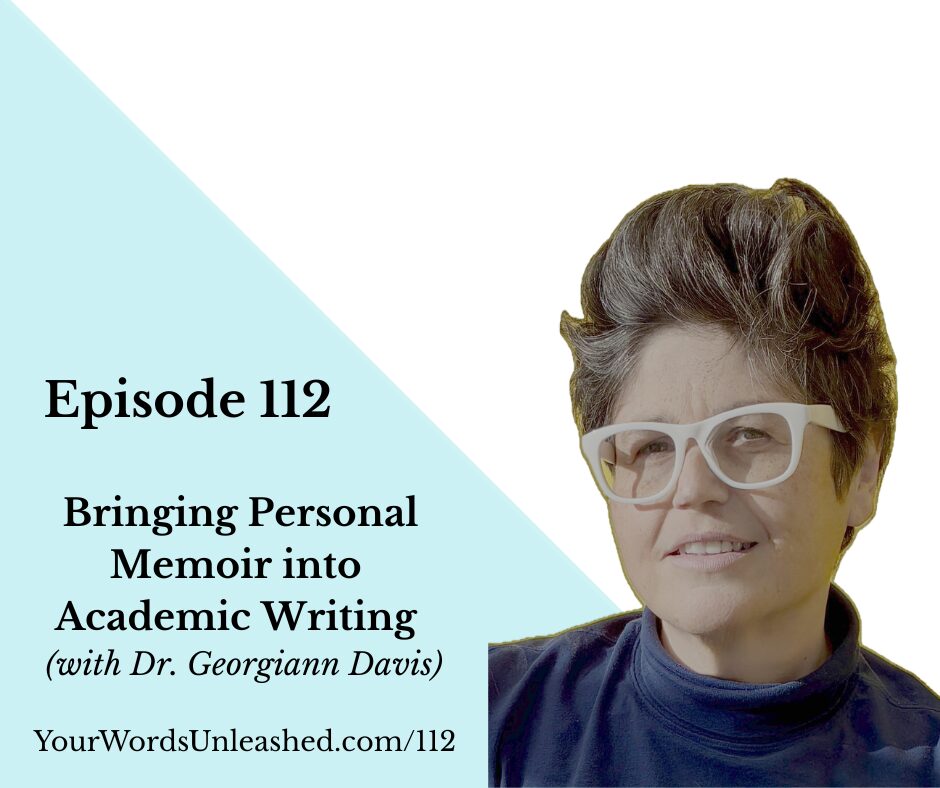
This episode is about how scholars can bring personal memoir into academic writing.
3 ways to work with me this year~
1) Private book coaching through my signature Your Words Unleashed 6-month coaching program. Finally finish and publish your book!
2) Personalized career coaching through my one-semester Career Reset Program for overwhelmed academics. Gain clarity and a sense of renewed purpose.
3) Group workshops on a range of writing and career-related topics. Transform your relationship to your own work in the community of like-minded others.
I’m booking for the fall, so if you’re interested, email me at Leslie@nullYourWordsUnleashed.com or set up a free 30-minute consult!
EPISODE TRANSCRIPT
Leslie:
Today I’m beyond excited to welcome Georgiann Davis onto the podcast today!
Dr. Georgiann Davis is an intersex scholar activist whose research, teaching and activism is focus on institutional violence and feminist theories. She’s an associate professor at the University of New Mexico. Her work has appeared in outlets ranging from the Los Angeles Times to the American Journal of Bioethics. She’s the author of Contesting Intersex: The Dubious Diagnosis and a new research driven memoir, Five Star White Trash, which explores familial trauma, medical abuse, and injustices within the criminal legal system. Georgiann previously served as board president of interACT: Advocates for Intersex Youth and as past president of Interconnect Support Group, one of the largest intersex support organizations in the world.
So for a long time I’ve been wanting to interview someone about their experiences of writing a personal memoir. I’m an avid reader of biographies and autobiographies. It’s truly one of my favorite genres, and I just think there’s something so powerful about first person nonfiction narratives. But as you know, this is not a particularly common format for academics to write.
But I’m always paying attention to what folks in my social network are doing, and I learned that Georgiann had recently published Five Star White Trash. I got it and inhaled the entire thing. It was a true page turner to say the least, and I wanted to have her on to talk about all things memoir-related and her experiences of bringing personal writing and storytelling into the academy.
Georgiann, thanks so much for being here!
Georgiann:
Thank you so much for having me.
Leslie:
So I thought it would be cool to do something a little bit different, which is to start by reading the first paragraph of your book, because I just want listeners to get a sense of the tone and the topics that the book deals with.
Georgiann:
Sounds good. “Chapter 1: Middle School Dropout.”
“The summer before fifth grade, my Aunt Maria took me to the gap for school clothes. Married to a judge, she just knew preppy clothes would help me fit in at my new school. I trusted her. She was Sandra Bullock classy with natural beauty and a modest style. Her social circles were filled with college-educated white people, unlike anyone my immediate family socialized with. My parents had moved us from our three-bedroom apartment in a racially mixed area near Chicago’s Midway Airport to an elaborate four- bedroom home in a suburb of Chicago that we couldn’t afford.
Inside its three-car garage, you’d find a red convertible Mercedes and a navy blue Cadillac that was outlined in fake gold trim with the matching grill. My parents didn’t want my brother and I to go to school with all the black and brown kids who were moving into the neighborhood, so we fled like many of our white neighbors to a suburb that had some of the best public schools. We used credit cards to go on elaborate Caribbean vacations and buy real fur coats. I had a white one with Disney characters on it. All of us always got what we wanted and more. I made it halfway through the seventh grade before dropping out. My brother Theo was expelled his sophomore year of high school after stabbing someone in the hall. We never fit in. We were white, but not the right kind of white. We were five star white trash. We had borrowed money and tried to use it to buy class.”
Leslie:
All right. Thank you so much for that.
There’s so much that you touch on this book, and so really what inspired you to write about your life and to write about these really intensely personal experiences and your family, and really just kind of lay it all out there?
Georgiann:
Sure. So, I’m a sociologist and my first book is titled Contesting Intersex: The Dubious Diagnosis. And I didn’t go to study sociology or get my PhD in sociology to write about my own lived experience with intersex. So for folks who may be interested, I was born with an outward female appearance or female phenotype, but internally, instead of XX chromosomes, ovaries, a uterus, et cetera, I had XY chromosomes and internal undescended testes. And none of that was discovered until I was like a tween.
And I talk a little bit about that in this book of course. But then when I found myself into sociology, I really was interested in inequalities and I really was interested in inequalities because I had lived a lot of inequalities and also, I found myself ridiculously actually as a middle school dropout working in a hospital. And I was interacting with all these medical providers and I realized quite quickly that certain medical providers, the ones with more prestige, often white men, in particular, we would jump as quickly as we could when they came to ask us for something as a clerical worker.
But then others were more women, more people of color. We were in family practice and obviously sometimes women of color together were in family practice or pediatrics. And I quickly learned were lower prestige specialties. So this kind of fascinated me as a middle school dropout, I always thought before I worked in a hospital that a doctor was this most prestigious person and there weren’t these intra-occupational specialty differences.
So that’s what I wanted to study. That’s sort of the short of it. And when I got into sociology as an undergrad and then eventually into a PhD program, I was really interested in studying that. But I found myself in a feminist theory class and in that feminist theory class, we were reading all sorts of stuff, including something about intersex. And at that point, I knew, I discovered myself that I was intersex and that’s a whole ordeal. But I found out myself that I was intersex and doctors had lied to me and my parents with tell that lie or kept it from me.
And no one was saying anything bad around that table in that graduate seminar. Like they weren’t doing anything that made me feel uncomfortable. It was just doing what graduate students do, theorizing about intersex, talking about it. And here I had this big, dark, deep secret. So something in that space, probably the feminist space of a sociology doctoral level class, a feminist theory class specifically—all of that made me really comfortable to sort of first with a professor, then some close graduate school friends, talk a little bit about what my whole experience with intersex was. And I decided in that seminar to write a paper on intersex, and from that paper it sort of shifted my entire academic career writing about intersex.
And that process was so incredibly freeing to me that now I can talk about genitalia or my own body or intersex. It just was such a dramatic transformation. It was so liberating that I thought why not do it with this book? And I think the new book, Five Star White Trash gives the more complete story of my lived experience thus far.
Leslie:
Okay. Like I said, this book has so much in it.
For folks who haven’t read it, can you just set up a little bit of the scene around how you came to drop out of middle school? Maybe that would be a good place to start.
Georgiann:
Well, I was always like an A/B student. It’s interesting. I always thought I was an A student and then I have one record—an aunt happened to have in her home my report card or something like that, because we lost everything in an eviction. So I don’t have much for my childhood, but I found that report card and I did get a B or something. So I had to say I’m an A/B student now!
But I was always a really good student. I was someone who really cared about it about learning for the sake of learning. Some might say a teacher’s pet. And it was kind of a shock to a lot of my teachers when I decided to no longer go. And part of the reason why I didn’t want to go is that there was an incredible amount of pressure put on me. From my mother specifically about like what psychologists call parentification, which is when the roles are reversed. So I was basically parenting my mother and what that meant is she would unload all of her problems to me and that just created an immense amount of anxiety.
So for example, she would tell me like, “Oh, I’m not going to be able to pay the electric bill. What are we going to do? What are we going to do? I’m not going to be able to pay the water bill.” Or I’d come home and the water would be off. And sometimes she would talk to me about other personal stuff that I didn’t put into the book out of respect for her. But there would be all of these things that happened that just like really made me as a young kid, from the time I can remember—five years old, six years old, all the way up to the time I did drop out when I was in the seventh grade—it was just like overwhelming.
Like I would go to school and have this immense feeling of something is going to happen, like a tragedy is going to happen to my family. Like our car’s going to get repossessed, we’re going to be evicted from our home. So I just started telling her, “I don’t want to go to school,” and that’s sort of what happened. It didn’t happen like immediately, like she was getting pressure from the administrators. Teachers were initially very nice to me. They didn’t understand what was happening, why I didn’t want to go anymore. But then eventually I just decided not to go.
And it went from I would go half day, then two hours, one hour. I just couldn’t be away from my mother for very long. I did see a child psychologist at that point. It was mandated by the school district. And of course, and I talk about this a lot in the book. I knew how to lie about a lot of different things, so I was very careful with what I said and what I shared both about my upbringing, about my life up to that point. And that sort of collided, if you will, with being diagnosed with an intersex trait. So I have complete androgen and sensitivity syndrome. And as even some listeners and a lot of folks aren’t really that aware of it, but like there’s, there’s a lot of interesting things about like sex, gender, body, sexuality. So that was really what allowed my mother to sort of use that and even me to use that—I didn’t know it at the time—but to use that diagnosis.
I didn’t know I had a diagnosis. I just didn’t know what it was. You read about that in the book, but use that as a way to explain why I wasn’t wanting to go to school, but that really had nothing to do with it. But the child psychologist said I had separation anxiety from my mother, which I actually don’t disagree with. I just think that it was motivated by this parentification. They also said I had phobia around school, which that is laughable to me because I never was like, not wanting to go to school or had a fear of learning or what have you. I mean, I’m obviously a college associate professor today.
So, that is interesting. But I will say one last thing about this is, I have a just-recently turned 6-year-old. And he talks to my mother. My mother calls to talk to him and vice-versa or whatever. And they’re short phone calls and I always make him talk on speaker phone, which sounds kind of invasive and rude, but it’s precisely for this reason. Just the other day, she was on the phone with him and he just turned six, like a week ago, and he asked like, “How are you doing?” And she said, “Oh, I have so many problems. I have a lot going on in my life.”
And oh my gosh, and she’s saying it in this like very tone that, I said, “okay, gimme the phone. Gimme the phone!” And I take it. And of course I said, “please don’t talk to him about that. He’s six years old. Don’t burden him with that.” And it goes right over his head. He’s like back to reading or playing, whatever he was doing. But that was like a vivid sort of reminder of what happens. And of course, he has myself and my partner, so it’s very different dynamics. But that was one of my primary caregivers. It was very traumatizing.
Leslie:
Yeah, absolutely. And you talk a lot about how much responsibility you took for your family, I think especially financially.
Can you talk a little bit about the kind of immense labor you were doing? Especially with this ice cream shop?
So folks, I mean, I know you can’t see, but like the cover of this book is amazing. It is like super hot pink and there is a soft serve ice cream cone on the cover. And my own 6-year-old son was like, “Ooh, yummy!” Like, it’s a very alluring cover. Can you talk a little bit about that?
Georgiann:
Sure. Yeah. My family was in the ice cream business. My mother was born in Greece and she came here quite young with her parents and she got into the ice cream business. I don’t know, by working at an ice cream store. And my mother’s very savvy in many ways as you’ll learn, but she got into this business and without any money to get into it, and it actually did quite well, like in terms of the income that was coming in.
And then she expanded and got another one, this and that. And they were little small stores. They did very well some of the time, like in the summer, but they were seasonal stores, so they closed in the winters. And I started running one of them. She would leave me there as a kid. You know, it’s kind of unfathomable to me to believe now, especially now as I have a 6-year-old and I interact with colleagues, kids or friends, kids who are like 12 and 13, and I was thinking, “Oh my gosh, they’re like playing on swings. They’re being wild or whatever, but maybe have chores.”
And my son certainly has chores, but like I was doing everything from like payroll to ordering supplies. And I was doing payroll by hand, right? This was not like as easy as now. I’m sure it’s probably a lot easier on computers, but I had an IRS book and I would tabulate hours, everyone’s hours from the week’s schedule. I was supervising people that were older than me or in, in many cases. And I was 14 years old, 15 years old. 13 years old. I started working there probably when I was 11 or 10, and I’m very tall. And I say that because the editor was like, “well, people didn’t realize how young you were maybe.” Like I was tall and I was also very big. And I use the word fat. I was fat in a fat-positive way. So I think maybe people misread and also what I was doing, right? Oh, there’s a kid working at this ice cream store when you’re stopping for a milkshake at 11 o’clock, like they’re not in school or whatever.
But I basically taught myself a lot of things running that store. Obviously, I taught how to do payroll. I mean, my mother showed me, and then I learned quickly. But I also learned a lot about supervising folks, working collectively with folks and being a kind of democratic sort of space. I would try to do different fun, exciting things. And the workplace I would work when the village inspectors came. No one ever thought to ask me how old I was. I would work with them and, it was fun too. I mean, it was a lot of work. It was a lot of fun as well, like working with people and they were the only way I got to interact with people somewhat close to my age.
So that was what I did enjoy about it, but it was a lot. I would be there at the store every day from, they would drop me off around 10:00 am and I would be home by 11:30 pm or midnight. So I would stay there all day by myself and whoever, whatever employees I scheduled to work that day.
Leslie:
Yeah. Thank you for sharing that. And I think that’s like a consistent theme throughout your book too, is like working hard and finances, right? And I really appreciate the candor. I mean, everything that you talk about in the book you’re extremely honest about. But I think also talking about how much things cost. Talking about how much you make, right?
That like, you know, when you start a job as a professor, people have all these assumptions about how much you’re going to make, and it’s usually a lot lower. So can you talk a little bit about how you decided to approach the topic of money?
Georgiann:
Well, I’m very open book, right? So it’s funny. A therapist once told me, what people love about you is also what people dislike about you. Like not me and you, the plural. And it resonated with me because I think it’s true whether we’re talking about like partners. Oh my gosh, like my partner’s an incredible sociologist too and very fiery and tells it how it is and never talks behind people’s back. But sometimes that can be aggravating or annoying, but I also really, genuinely appreciate that you know where they stand and they’re very open with their opinions and views and I think that’s incredible.
So for me, I think, yeah, I mean it was hard to talk about money. But I feel like that’s a great way to be open and honest about what’s happening and so on and so forth. So my first tenure track faculty position, when I was around 30 years old, it was like $48,500 or something like that. You know, I remember I went a period of years for not talking to my mother, but when I started talking to her again it was kind of like I was being all superstitious and said, a few years earlier if I pass my comprehensive examinations for the PhD, I will offer forgiveness to my family or my mother specifically.
Anyhow, I did because I passed. So I did and I started talking to her, and then when I got my position, I told her about what the salary was. And she was like at this point we had no more stores. We lost them all. And we were evicted from our home and all of this. She was living in a really small store. Like she was essentially unhoused, but she did have some sort of rough living where she was working. But she said to me, and she was also waitressing, and she’s like, “you know, I make more than that as a waitress.” And she would often tell me, “oh, I get like a hundred dollars tip from this table and this and that.”
And I would tell her like, “yeah, but you don’t have retirement or you don’t have this. It’s not stable.” And, and of course like I could go on and on. But yeah I try to demystify the whole situation around like faculty salaries that folks think they make or whatever. But I really wanted to do it because I always loved teaching. As a child, I would be one of those kids. I remember wanting like a chalkboard and I would line up my stuffed animals and give them seeding charts, and I would come home from third, fourth, fifth grade and reteach them everything I was taught at school. It was a really cool thing.
So when I actually found my way after the GED and found my way to community college, I thought maybe I’ll go into education, like elementary education. Because that’s what I knew, right? I had never went to high school or anything or middle school or college. Or I thought maybe I’d go into X-ray because I worked in an X-ray department. But that’s sort of like my path. But yeah, I’ve always worked hard and part of that parentification wasn’t just emotional, it was also financial. I had to support or felt like I had to support my brother, who’s very different than me. He did not feel that burden, but I do think he obviously responded to it very differently.
He’s unfortunately himself unhoused and he’s currently incarcerated, but like he struggled. So he went to a lot of drugs and alcohol and we have a very turbulent relationship, and he does with the rest of my family too. I’m recently trying to think about being more empathetic to the situations and how our differences brought us on different paths, but yet how maybe the origins of what brought us on those paths are actually quite similar.
Leslie:
Yeah. And I’m sure we’ll talk more about some of the different topics in the book as we go along, but I’m curious about this idea of a research driven memoir. It’s the first time I’ve heard that concept. So tell me like, where’d you come up with this idea and what does it mean to you?
Georgiann:
Well, I came up with it, or I’m sure it’s been out there, so I don’t want to take credit for it. But I don’t have anywhere to cite for it.
Leslie:
I’m going to credit you with it!
Georgiann:
Oh, there. Thank you. Thank you. So I decided to use it because I’m going up for full professor this year, so I needed to say that. But no, in all seriousness, I think with memoir, everyone has a story to tell. I seriously believe that and I know that people have opened up to me after reading this about certain things they’ve experienced in their life. And maybe not at all related to things that I’ve experienced, but everyone has a story to tell.
I think what separates what I try to do in this book is try to use empirical research to make sense of those lived experiences. So to analyze those lived experiences and make sense of those lived experiences through a sociocultural lens. So, as I mentioned earlier, like parentification, of course there’s a lot of different concepts across psych, soc, et cetera, medical fields that sort of help explain things that, or at least offer me an explanation grounded in empirical research. And that itself, I think moves it to the category of research driven memoir. So I don’t just tell the story, I try to explain the stories that I share.
And, the other part of like, why I wrote this book is, like I was saying it’s very liberating to share your story. At first it’s very scary and it’s still scary, today. It’s been out for, I don’t know, six months or something. It’s very scary still today. But it’s liberating. It is liberating and sometimes it’s a long game liberation, but it’s liberating. And I knew that from my first book about intersex, so this kind of opens up the door wider and I think it allows me to share and the reason why it’s liberating is connecting with other people. I first disclosed publicly that I was a middle school dropout when I was in my first faculty position, so it probably was around 2012 or 2013. I wrote a blog. It’s still out there called “When Feminists Mentor” and I talked about the different mentors I had in my life up to that point.
And I was untenured professor at the time and I had shared that I was a middle school dropout. And I was a little scared to share that. It was just on my local university women’s studies blog or something like that. But I’m a door open kind of person in the department, and a student walked by and it was a young black woman. And she walked in and she’s like, “Are you Dr. Davis?” And I said yes. And then she shared with me that she also had dropped out of school and that she said that was really interesting to read. I didn’t know. That was like, “you’ve inspired me.” I mean, it sounds kind of like, you know, melodramatic that I’m saying this, but it really felt in that moment like, dang, like people have that. And then what was even, I guess even more shocking is a colleague came up to me in the university and said, “oh, I have a GED. I dropped out.” So it was just really interesting how that happened.
Now that was 2000, I don’t know, 12, 13, something like that. It’s taken me quite a bit of time to feel comfortable exposing a lot more of this. But that’s why I said long-term liberation. But it was just really open. I think it’s open and let people know that everyone is going through similar or has similar stories and it destigmatizes them. So that’s why I wrote this memoir. And also I got really bored with the same old, narrative of academic books like the same old like format.
And that actually I love your podcast, I was just sharing with a junior colleague one of the episodes you just did where like, what do you do when you have articles and then try to transform those articles into books? Like, how much do you use or not use, or what do you do? That was the episode I’m talking about. But I love that you say you have to write with passion, right? Like it, otherwise you just get kind of lost and not just you, the writer. I think also the reader, like to me it’s kind of boring.
Leslie:
That raises a really good question of like, who do you envision as being like the ideal reader for this book? Who are you trying to tell this story to?
Georgiann:
Well, I hope everyone who’s listening but if, even if even one person, I’d be happy. Yeah, I mean, I really wrote this book for my neighbor, right? My students, anyone and everyone interested in understanding the complexities of upward mobility, the complexities of whiteness, the complexities of gender and bodies, and to have sociological lessons or more broadly, sociocultural lessons embedded throughout these stories without even knowing it. And that’s what I try to do. Try is the key word, but that’s what I try to do. So I want the neighbor who has maybe never taken a sociology class to learn different things about white flight. They don’t even know they’re learning that this is a pattern actually.
And of course I have endnotes, footnotes, whatever, to bring people to, if they want to read more about where this stuff comes from, but they can understand a little bit more about that. Or when I talk about things like doing gender or gender performance. So they’re getting these lessons without even being like, “okay, today we’re going to talk about white flight,” or something like that.
Leslie:
Right, right, right. No, and I think that it’s really skillfully done too. And it’s clear that you’re doing it too, actually. I think it flows, but it’s also clear when you’re making a larger point, and I think that’s like the most sociological thing you can do.
Georgiann:
Thank you. Can you tell that to the people determining if I can be granted full professor? But yeah, I mean, the other part is, and I think I’ll say this because you probably have a lot of academic listeners on your podcast, it is the case that people will see this as mesearch or navel gazing, like all these types of terms that people use. How is it an autoethnography? Is it a memoir? What is it? And I don’t really care what people call it, honestly. I just think it’s important to get these ideals out there and to engage more readers, and that’s my goal.
I mean, in the classroom, my goal is I want students to read, not because it’s assigned or expected, but because they want to read. So assign them 10 pages and like we know now not to maybe assign a whole book, but then maybe they’re like, “this is good.” And I was just reviewing a book for a press this past week. I mean, it was overdue, but I was doing it this past week and I said, “okay, let me get through it.”
And we know that burden, right? Or not that burden, but like, oh, it’s going to be a lot. So I’m reading it and honestly, I really couldn’t stop reading it. It was actually quite interesting. So I was able to keep reading it and it was a joy. And I say that with love and I think that’s what I like with writing and with reading myself and memoir is my favorite genre. Memoir is definitely my favorite genre, so I thought, I often read memoirs and I wonder or want to push them further. So the press actually has marketed this book as like an upside down and queer JD Vance’s, Hillbilly Elegy.
Leslie:
Right. I saw that.
Georgiann:
And it’s interesting because, you know, there’s a local Barnes and Nobles not far from where I live. And you go to the social science section or whatever. Maybe it’s sociology, but it’s definitely social sciencey and his memoirs there. And yeah, it’s maybe a discussion of what’s happening in society, but it’s just an interesting memoir because I think there’s so much missing from that in terms of a sociocultural analysis on it. And, his story is an interesting story if you read it or what have you.
And obviously a lot of things that he writes about, I can actually relate to. I mean, I didn’t go to an Ivy League institution, but he was there interviewing for like internships and for example, for when he was finishing up law school or what have you. And he gets like a traumatic phone call from a family member, things like that. And he gets pulled out of that and it just takes you out of a particular head space, and that kind of stuff. So then he sits back down and you can read in those words, you can feel, or at least I can feel what he was going through. So, you know, having to take a big test and then having someone in the hospital again, ODing or something. Those are really experiences that really resonate with me because I’ve experienced a lot of that too.
Where I think the shortcoming is not trying to understand how like your experience as a white man in that Ivy League institution makes you a person to be saved, right, or to be helped. And I feel like I try to do that in this book. People saw me as a daughter. People saw me as maybe a fat daughter. Again, I say in a fat positive way. But they saw me as someone that they could help. They saw me as their daughter, their sister, maybe a cousin. And they really wanted to help me. And I think that’s not to take away from the assistance they provided me or the mentorship. I think that’s all there. I think it’s important to sort of acknowledge how my own lived experiences as a white person made some of this mobility easier, or at least it acted like a security blanket as I went through some of the worst of it.
It doesn’t take away from the pain or suffering that I went through or he went through, for example, but I think it, it offers a more complex understanding of the mobility that I experienced.
Leslie:
And also doesn’t take away from your own hard work.
Georgiann:
True, yeah, absolutely. I mean, I like to celebrate accomplishments and cry about failures or be upset about them too. But yeah, I mean it was a lot of hard work to get to where I was. It’s interesting. I remember being in community college, in like an 0-8 class, which one of the editors said “what is 0-8 class?” when I was writing this book. And so then I just changed it to remedial math because obviously I dropped out of seventh grade, but I worked really hard in that remedial math class to try to get out of there.
And it’s when I take a step back and I think about now I’ve authored, or co-authored I should say, like social statistics textbooks, and I teach social statistics. It’s mind-boggling to me, but I also think it’s really exciting. I actually share some of this with my students and I actually really love to teach social statistics. It’s my favorite class to teach actually,
Leslie:
That’s good because there’s not a lot people who love it!
Georgiann:
No, I’m teaching graduate statistics again in the fall, and I really like it. And to be honest with you, I think this is going to sound like super pompous and I certainly don’t mean it that way, but I guess I’ll say it anyway. I think sometimes it helps that I have a different educational trajectory because I think I can often explain it in a way that is not too complex. Like I think sometimes we make things, even with writing, right? We make things unnecessarily complex. Like when I read some work, I’m like, girl, what are you trying to say? Like, just say what you’re trying to say.
So I try to do statistics that way, and I think it makes it easier for folks. And it helps that I’m not in like a lot of big data. I’m not like in data all the time. I’m not way ahead of the students and that kind of thing. So I really like teaching statistics, but yeah, it’s mind boggling that I took remedial math and then worked my way up.
Leslie:
Yeah, but it’s also like your book in taking a sociological view of things like “how does the individual fit into this broader structure of things?” You’re not trying to have this “oh, I lifted myself up by my bootstraps.” Because your story could be written in that way. So I guess that’s why they’re kind of, you know, pairing it with JD Vance’s.
Georgiann:
Yeah, and just trying to say it’s upside down and queer, like queering that narrative. And it took me a long time. That’s the other part I try to reflect on in the book. And I think actually, Leslie, that’s like the part that I get a lot of push back even from sociologists still. They’ll still say “well, you are special Georgiann.” And let me be clear. I know I’m special, but not because of my narrative. It’s just like I’m a like, ridiculous person.
But yeah, I mean, I try to critically reflect on those narratives. I will say sociology, when I was going through some of the worst things that I describe in the book I talk a lot about my relationship with my mother and my mother we have a very similar name or we have the same name in many ways we do, but which is very common in Greek culture. And she used my identity and purchased a lot of homes in my name and tried to sell them to make money and, but that fell flat so she couldn’t. But anyhow, it was a nightmare.
But I’ll be honest with you, sociology actually hurt me in those moments and it hurt me because I was learning a lot about structural sort of inequalities. The reading I’m going to cite now is interesting. There’s Robert Merton, like what I remember as an undergrad, and there’s different types of adaptation. If I can get this right too about when you aspire or you believe in these like ideologies or whatever it is, like a success or American dream, and then people respond in different ways. Like you conform or you retreat, which maybe that means like you go into drugs or alcohol. You can reject.
But one is like you innovate and you find creative ways to try to meet those goals that are somehow blocking from you obtaining or achieving. So when a lot of this was going down, I had just finished undergrad when she had taken my identity. And those arguments were in my mind like about well, maybe she just doesn’t have the opportunity. She wants a better life and she’s trying to do this in any way she can, you know, to achieve those goals that she’s not able to do. So it took me, I mean, it was a little harmful for me in those moments to think about it. Yeah, there’s a lot of other ways to think sociologically about it, which I do in the book.
But in that time, in that moment, it made me feel like I was holding her accountable. And the reason why it was so stressful for me is because when I talk about in this book is I had to make a choice. Like I was getting subpoenaed to courts and, she kept doing it. So it was either I go and file police report and charges, which I knew when you’re talking about a lot of money and multiple properties and loans, you could be a middle school dropout and still understand, there’s going to be consequences. And I was just like, how do I do that to my mother?
And of my family. We’re very close, like tight Greek immigrant family. And they were not like helping me in any way, shape or form. Phrases like, “Oh, it’s your mother, what are you doing? Like you can’t do this.” And initially I tried to work with her and then she just kept doing it. So it was just a really hard. It took me everything to file that report and that’s when I needed to form a healthy boundary and basically not talk to her or anyone in my family, which was very hard when you’re such a close family. But probably not a bad thing when there’s a lot of abuse going around, but it was really difficult. And yeah, so that was painful. That was definitely a very painful time in my life.
Leslie:
Yeah. And as I was reading your book, I related to it a lot because I married into a Greek family and that has been a very eye-opening experience for me. And talk about a collectivistic culture where family is everything and it doesn’t matter if you’re dysfunctional or not. It’s just about like even the concept of boundaries—this is from my outsider perspective—but it seems like the concept of boundaries is very foreign and not well looked upon.
And so I’m sure many of the people listening come from various cultures where there’s not a lot of personal boundaries. So how have you created healthy boundaries with family members that have done lots of unhealthy things to themselves, to you, to the world? How do you do that?
Georgiann:
Well, I try, it’s the key. I don’t think I’m really good at it. I am trying. I mean, one of the things I think helps a lot is to not be geographically close to them in terms of space because there will be moments where if I was more geographically located, it would just be harder to navigate.
It’s difficult and I think through therapy, things like this, I go and talk through it. And it sounds bad because, that’s again, like what, when I think sociologically and I’m not critiquing sociology, but it offers you different perspectives. So I’m like, when you understand different family forms and you understand the complexities of this tight-knit sort of family and everyone there and I don’t know, we’re really close and all in each other’s business all the time. It just makes it harder to want to think about setting healthy boundaries or this, well, we talk about sociology, like sometimes I wish I had an isolated nuclear family. Just move away and be like, “okay, I’ll see you.”
Like whatever. But so it’s really challenging because also like I mentioned, when I grew up I was always parenting my mother, and that relationship is still quite the same. It hasn’t shifted, I imagine, and I hope this doesn’t happen to anyone, right? It’s difficult too, but when you’re trying to guide your child and your children, if you have them, I think then it becomes like sort of this thing, like, okay, you’re always going to be there, how are you doing? Checking in. I have these check-ins with my mom, like daily almost.
And it’s what I imagine people do, maybe not daily, but like checking in with a kid at college or whatever. Like “what’s going on? What’s new?” I mean it’s a different role reversal, but yeah. Everyone’s in each other’s business. I think it didn’t help. One therapist I was seeing at the time said it’s very much with this whole situation I went through, it’s she brought up like sexual abuse cases and she brought up what happens a lot of times in families is that, while people really feel for the person who comes out and talks about what happened by a family member, they actually abandon that person, the victim, and surround the abuser, if you will. And they do it in a way to protect their family form the family dynamics. And that leaves the victim feeling very alone and very helpless.
And that’s really what felt like when you have very close family, like you would think, like I was expecting them to. Looking back, it’s funny. I would be like, not funny, but I would be like, “okay, I’m not going to go to this birthday party if you invite my mother after what she did to me. I can’t even see her.” And they’ll be like, “well, we’re going to invite her and you so do what you want to do.” And it was just like, I felt all alone. So I distanced myself from them. And but yeah, I mean it’s a really messy situation.
A very close cousin that I grew up with that was visiting the other week with his wife. And we were talking and his wife said to me like, “Oh, I don’t know if I should tell Missy”—that’s the name my family calls me, Missy. And I said, “Oh, I’ve heard everything. You can tell me anything you want.” And she said, “I know I was asking your mother a number of years ago, like when we were talking about things, what is your biggest regret in life? And your mom said having children was my biggest regret.” And I was like, “oh God!” Like I was annoyed by it, but when it sits with you, it just makes you feel very and it was like a very close moment between my cousin and his wife and me and my partner. He was talking about a lot of stuff that he was going through or he had been through, so we were connecting and bonding on these moments.
It was a very, I don’t know, therapeutic sort of space, but over french toast or omelets. I don’t know. But it was sort of like, “wow.” It was just really frustrating. Especially because, and maybe I’m selfish, but I’m like, “okay, you’ve had a lot,” meaning my mother had a lot of problems with my brother and her as I talk about the book, go at each other like she would say cats and dogs or whatever, but I’m like, “dude, I don’t even know what I’ve done to her.” Like I can’t, and I’m pretty critical. Like, I don’t know. It’s interesting because three months earlier she had asked me to lend her money and I gave her a couple thousand dollars and deposited it in her account. I didn’t ask why or what. I just felt bad. And she said she’d give it to me in the next few days, which I knew she wouldn’t.
And then not even two weeks after she asked for more money, and I said, “no, I can’t.” And I try not to lie these days, but I’m like, “no, we’re going to India with my partner. And I don’t have it.” And I don’t have that much, but I have some. But I said, “no, no.” And then she starts begging me on the phone for money. “Please, you have to help me, please.” And it really threw me off. Like it was just, “I’m like, no, I can’t. Stop asking me. I already gave it to you. I already gave you some, I can’t give you anymore. And it’s just so hard to actually hear that still.” And then couple it with of course I kind of get kind of, you know, a-hole about it.
Like when she said about I’m like, “oh, well you didn’t regret having me when you asked me for money!” Like that kind of thing. But that’s how I, that’s how I deal with it. Like humor. How else can you try to deal with it?
Leslie:
Right. Right. And one way to deal with it is exactly what you’ve done, which is write about it, right? And talk openly about it, de-stigmatize these dynamics, which are really common. And the circumstances maybe not as common, but like maybe the sentiments.
You know, I am curious because you write so honestly about things has your family read the book? Have people in your life who you write about, how have they received it?
Georgiann:
Yeah, so they haven’t read the book. They know of my mother specifically and an aunt knows about the book because I talked to them about the title. And this was awhile ago, a number of years. It took a lot longer to write this book than I wanted for, I wish it did. But I remember talking to them about the book and the title and things like that. And my mother, she’s quite funny at times and I think I get some of my humor from her and, first she made a joke about “well, who’s going to play me in the movie?” as if this would be made into a movie. And then she also snapped and said “Well, oh, so you’re writing this at my expense,” and things like that.
That actually made me feel bad and had me reflect on what I’m doing and I made conscious decisions about trying to protect at least some of their experiences. Because this is my memoir and memoirs write about memory. And so I wanted to write this book because I think it was like for all of the reasons I mentioned freeing and liberating, but I didn’t have to expose or share things that maybe didn’t directly intersect with my lived experiences.
But of course, talking about like some of the stuff my brother went through or my mother did, but that was directly on me. So I tried really hard, like to protect them and of course in all the standard academic ways, like changing names and things like that. But I mean more even the stories that I share, I had a lot in, and then I edited some out. I took some out, put it back in, and I try to think what is necessary. Now, some of it I think makes more sense if I kept it in, but I also think it protects a little bit more of them, and it wasn’t maybe necessary for the narrative. But yeah, they’re very private.
I think it’s pretty interesting. I don’t know what your experience is with the Greek community or Greek American community, but they’re very much in each other’s business all the time, I feel like. And it’s like, gossiping all the time and talking about everyone. And it’s funny, so this is something that I know they would be very upset about if it got more widely disseminated to people that we know and in the Greek American community. I do a lot of public work and scholar activism, so I don’t know what people find out and what they don’t.
But the other part of it is there’s already people talking left and right about things. Like I’ve had Greek people in the community, Greek American community come up to me and say “oh, I know this about your life,” things like that. It’s like very weird that they would do that. But also I don’t care. When I was writing about being intersex in the first book, my mother said to me like, “I just don’t understand why you have to put that all out there.” And I’m like, because I don’t care what people think. And then I was much more open about it. Like to the point where I’m like, I don’t know, they can do whatever they want, if it helps somebody else. I’m sure they have their own struggles too. It’s not like the Greek community or Greek American community is immune from these situations.
Leslie:
Yeah, you know, I definitely don’t see it as like just a Greek thing, right. I think it’s many cultures, right? But my observation has been that it seems to me like in many Greek families, there’s a lot of talking about the details of daily life and not nearly as much reflection on the bigger picture or talking about really important big things.
And so I think that’s what your book does really well. It brings it together. It’s like “let’s try to understand the structural things and not just have it all be now like another thing to gossip about.”
Georgiann:
Yeah, absolutely. I mean, it’s funny, like we go to Greece. My family. I have two kids and my partner, we go to Greece every summer. And, my family will ask me like, “oh, how are relatives doing? What do they look like? What are they, what were they wearing?” And it’s just so ridiculous to me. So I’ll be like, “their clothes they look great.” I don’t I know what they’re probing, but it’s so ridiculous to me. And I don’t want to generalize to all Greek folks, you know. And I think actually even the life I live, like we go to the small town in Greece in the summer and it’s like my grandmother’s from there.
And I spend a couple weeks there every summer and I come with my queer family and I know that kind of unsettles them a little bit, like my family in the US. But like my mother or my aunts, I think I just push them into it. Like just push them over, like I’m going to go there and spend time with my kids, and my kids are mixed race or my kids are actually all Indian, but like mixed culture. We’re in a mixed race like family dynamic. But my kids are Indian and south Asian Indian and we just go there and just enjoy it. And it’s funny, my child will say “oh I’m, biologically Indian Bengali, but I’m culturally, I’m some Greek too,” like culturally because of my upbringing or bringing him up. But yeah, it’s funny how the family just, they have so much to say, but also it’s like I’m not going to live in fear either or shame.
Leslie:
Right, right, right. Yeah, there’s so much about like saving face and that kind of thing. But anyway, I can relate to what you’re talking about.
As we wrap this up, I’m just wondering, if readers could only take one idea away from your book, what do you want that to be?
Georgiann:
I think I would want them to know that upward mobility is really complex and it’s shaped and filtered through the lens of whiteness. And I want them to walk away to understand how it affects all these sorts of adversities and things that happen by doctors and criminal legal system and through families. How those experiences are filtered through a sort of protection of whiteness and what that means to experience those hardships, but then also navigate them and get through them and if possible.
So I think that’s what I would want folks to walk away with. And also that, you know, I’m funny and a great person. No, I’m just kidding But I think I want them to just walk away and just know that maybe secrets we hold don’t have to be shameful. And I think sometimes letting them go can actually be liberating and allow us to connect with others on a really human level.
Leslie:
I love that. I think that’s so good. And I think that is maybe the ultimate way to connect with other people is share things about yourself that other people don’t know, right? Because you’re always going to find commonalities.
Georgiann:
It’s funny, but I hired a fact checker for this book. And the fact checker would basically check about things that I’ve written about and like accuracies about certain situations and whatever. But there’s one moment in the book, I think it’s still in there. As writers probably know, oftentimes once we publish something, we don’t want to read it again because they find errors left and right or whatever.
But I talk about my brother making I’m assuming like crack cocaine or whatever, crack in a microwave. And I talk about the process of making it, I’m like, “I think that’s how it’s being made.” That’s what he was doing. And the fact checker, it was just funny to me. I don’t know why, but this is like this middle-aged white woman, wrote, “Okay, so I did research on how to make crack.” Like it was just a funny, like in the comments that I was like, “oh my gosh” because her photo popped up as she was saying it she’s fact checking how to make crack. I’m like, “yeah I needed to,” that’s why I hired her as a fact checker.
But ultimately what she also said, and when she reviewed it is she’s like—this is someone who’s really well educated and everything else and obviously has a business and doing this work. She said, “Oh, I can relate to this. I have some personal, from some distant relatives, some personal experiences of some of the stuff you went through was, it was really eye-opening to me to read that.” So that’s what I mean by connecting on a human level, like where you don’t foresee it, whether it’s the undergraduate student walking by my office or the colleague or a fact checker or a neighbor telling me sharing their things. It’s less about them opening up, but it’s about feeling that they’re not alone because much of my life, I felt very alone.
Leslie:
Yeah. Well, thank you so much for sharing your story in the way that you do it. I think it’s really going to be something that just affects people on multiple levels.
So what are the best ways for listeners to connect with you and find out more about you?
Georgiann:
They can Google my name and I have a website, www.georgianndavis.com or I’m on LinkedIn, social media, like Facebook, stuff like that. If they could find me there, my email address should be up there on the website. But yeah, I’d love to hear from folks. And thank you so much for allowing me to share some of this on your podcast and for all the work you do for all sorts of folks in all different corners of the world.
Leslie:
Yeah, thank you for being here, and I encourage everyone to go out and purchase Five Star White Trash, which I should mention is published by NYU Press. So it’s absolutely a research driven memoir. Also request it for your local libraries. It is a read you will not soon forget!
So take care until next time.
If you enjoyed this episode, make sure to also check out:
Ep. 100 – Make Your Writing Radically Inclusive
Ep. 70 – Becoming a Public Scholar: Making an Impact Beyond Academia (with Dr. Kevin R. McClure)