Leslie:
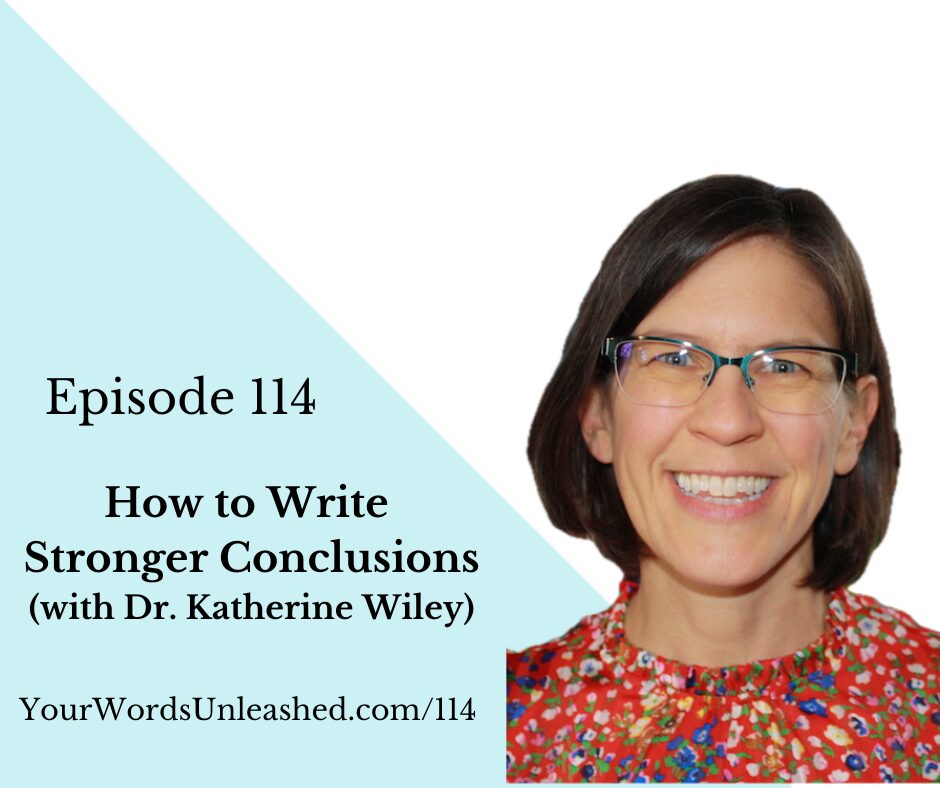
Today, I can’t wait to chat with Dr. Katherine Wiley!
Katherine is an academic editor and coach at her company, Golden Rod Editorial. A former tenured professor in anthropology and author of an academic monograph, Katherine uses her experience in scholarly publishing to help authors in the qualitative social sciences and humanities produce their best writing and thinking. She specializes in developmental editing, helping scholars work through conceptual level issues, including argument, structure, and analysis. She also enjoys leading scholarly writing groups and workshops, and in her free time, she spends time reading, writing, clogging, gardening, and keeping up with her active seven-year-old.
All right. I don’t know what clogging is, but I’m going to find out. So Katherine and I know each other from LinkedIn, and a long time ago she posted something about conclusions that was really thought-provoking. And I have had many clients who struggled with ending their chapters and also their books for different reasons.
Writing conclusions are a skill set that every author needs to learn, but often hasn’t had any guidance in how to do it. And I’ve been toying around with different ideas about this for a solo episode, but after seeing Katherine’s post, I thought it would be fun to brainstorm together about what makes a good ending. So Katherine, welcome to the show!
Katherine:
Thanks so much for having me, Leslie. I’m excited to be here.
Leslie:
I’m excited to have you here.
So like always, can you start by talking a bit about your journey through academia and how you became a full-time developmental editor?
Katherine:
Yeah, definitely. So I got my PhD and had a year-long postdoc, and then got a job at a small regional liberal arts college out in the Pacific Northwest. And honestly struggled with academia for the seven years I was there, partly because the school had some financial challenges, as so many schools do, so it was stressful. But the longer I was there, I think the more I realized academia wasn’t totally for me. I said to one friend at one point, “I don’t really like the research, I don’t really like the teaching, and I don’t really like the service.” And they said, “Katherine, that’s the whole job.”
So I got tenure, and during my sabbatical year, the school announced that they were laying off 25% of the faculty. And I was an anthropologist, and you know, often anthropologists get cut in situations like that. So I kind of saw the writing on the wall. They offered everyone severance packages, so I decided to take one to launch something different. And honestly, when I took that, I really didn’t know what I was going to do. But I’d read a lot about what PhDs do after they leave academia, and immediately when I read about developmental editing, just something clicked, and I felt like that might be right for me.
And looking back now, I’d actually been editing for a long time. I wasn’t thinking about that so much when I left, but I was a reporter in college and after college, where I did a lot of editing as well. I worked in nonprofits and edited newsletters and reports. I was always editing friends and colleagues’ works through grad school and beyond. So ultimately, it was a good fit. And I spent about half a year to nine months kind of training to be a developmental editor and setting up my business, and I’ve now been doing it for almost five years full-time, so have been really happy with this change.
Leslie:
Amazing. So what kind of training did you do?
Katherine:
I took two classes. One was an online class, and then the University of Chicago has an editing certificate, as I know you know, and they were nice enough to let me just take the developmental editing class because I knew I wasn’t going to be a good copy editor. I’ve never been good at grammar, for example. So I took that course, and then I did a lot of personal training, just reading books on scholarly writing. Scott Norton’s book on developmental editing, which is a good place to start if anybody’s thinking about it, and many other books. And then I also did a lot of informational interviewing with developmental editors to get a better sense of how they worked and did some pro bono work with friends and colleagues to practice and so on.
So kind of a range of things, but that helped set me up to start the business. I realized too, your episodes talk about this a lot, but I should maybe tell people what developmental editing is just in case they haven’t heard of it. But as a developmental editor, I help authors think through bigger picture conceptual issues in their books, so argument, structure, organization, narrative flow, and so on. So really helping authors to figure out those elements of their books from sometimes the earliest stage of the writing through sometimes I’m working with folks post-peer review, so all stages of writing.
Leslie:
Yeah, and I think it’s always important to remind people what developmental editors do as opposed to copy editors and other kinds of editors.
So what do you like most about this work?
Katherine:
Couple of things. I love that I get to deeply engage with intellectual ideas in my work every single day. I think that was something I thought I would do as a faculty member, and I certainly did. But a lot of my time was devoted to teaching and other endeavors. And so here, every day I sit down and learn so much about different parts of the world and important topics.
I had expected that when I started this job, but the other thing that I hadn’t expected quite as much is I really love being part of an author’s team. I feel like when I was a scholar, I often felt quite isolated. There wasn’t a lot of support at my institution, and while I certainly had good mentors, sometimes it was hard to find people to share work with and so on. So I think similarly, a lot of my clients feel a little bit alone in their academic journey. And I get to be there to help support them, to help highlight their strengths, right, and to help them produce the best books that they possibly can, hopefully.
So that has been really rewarding and fulfilling, especially now that some of the authors I’ve worked with for three or four years. So watching people’s careers over time is also really satisfying.
Leslie:
No, I fully agree with you. And thinking about book writing as a team project, I think is a big mindset shift, right? And like, I think part of what makes things so hard for authors is thinking that everything is on your shoulders, because it’s a sole authored book. And so knowing that you actually can build your own support team.
I have so many clients that say they don’t have anyone to share their work with, and I’m always shocked by that because I’m like, “Where are your advisors?” But I understand a lot of people graduated a long time ago or they didn’t have supportive advisors. But also peer-wise, right? Depending on the kind of institution job you’re in, you may just not have anybody that can bounce ideas off of.
And then the other piece of it is the first thing you said, like being able to engage with ideas in a really broad way. So I found as an editor, one of the most fulfilling things is how much I now know about, it almost seems like a random collection of things, but this breadth of knowledge. I think academia promotes this specialization, right? You get more and more specialized. You get into rooms with people who are doing the same kind of specialty as you. And now it’s like, you know, I can tell you a lot about like regeneration in flatworms and you know, it’s like sort of endless. It’s really interesting. So yeah, I fully concur.
Katherine:
Yeah, and I agree. And I think one thing that’s interesting about learning about a big breadth of things is sometimes there’s really interesting overlap between topics that are very disparate, which can be interesting. And one other thing I just want to say about what you said, often when people are reaching out to me, they ask some version of this question like, “Is working with a developmental editor cheating?” This sort of like it should be solo authored, but we all know, right? In like fiction and nonfiction, you would never publish a trade book without an editor, probably more than one editor. And when you look at people’s acknowledgments in their monographs, their academic monographs, there are so many names there, right? So as you said, it’s part of building your team and getting the support you need to do that work.
Leslie:
Yeah, definitely. And I think the tide is changing. I definitely see a lot more acceptance of developmental editing as part of professional development, which is great. Okay, so let’s turn to talking about conclusions. I personally am very excited to talk about this because it’s not something that comes up a lot.
So why do you think book conclusions can be so difficult to write?
Katherine:
I was thinking about this this morning, and I think of two main reasons. One is authors are often super tired by the time they get to the conclusion, right? They just want the book to be done. I’m thinking especially of the book conclusion here. You don’t want to write anything else. And that is a hard moment to write.
But I think another reason is that the conclusion’s a little bit high stakes, right? It’s what you leave your reader with. It’s where you’re making the argument for why the book matters. And so I think they’re a little bit scary as well. So I think those two things combined, like, you being tired and then having to do a hard, somewhat scary thing can be difficult for readers. Yeah, so if people are feeling nervous about conclusions, you’re not alone. A lot of scholars feel that way.
Leslie:
Yeah. And I think a lot of people probably choose to write very short ones because of it.
Katherine:
Yes, definitely. Or not at all. And some academic books don’t have conclusions. But I happen to be a real lover of conclusions, so I’m going to definitely try to make the argument that even if you’re really tired and a little bit freaked out about a conclusion, you should absolutely write one and have one in your book.
Leslie:
I agree with you. I think it’s very abrupt if something just ends.
So what do you see as being elements of a strong conclusion?
Katherine:
So I do want to first say that there are a lot of different ways to write conclusions, so you might approach them differently than we talk about. But I think in general, I was thinking about this quote from Eric Hayot, and he wrote this book, The Elements of Academic Style, which has a really good short chapter on conclusions. So if you want to read something about conclusions, you might start there. But he says, “One way to think about a good ending is that it first closes all the things you’ve opened and then does something more.”
And I think that’s a really helpful way to frame conclusions. Because on the one end, at the end of your book, the reader’s been with you a long time through many chapters, and you’ve built your argument ideally and so on. But that’s still a lot for readers to hold in their heads, and I think we can’t really expect them at the end of the last chapter to know exactly what it all adds up to. So on the one hand, I think a good conclusion does, probably briefly, not for pages and pages, but briefly summarize the argument and remind readers, like of where they’re at at this moment.
And then I think it takes them further than that, right? So that might be making a case for the book’s significance, right? Saying like why this matters in the world. Why does it matter that you read this book, and what can you do with it? It might be connecting the book, maybe it’s a historical book or an anthropology book about a kind of narrow place. It might be broadening that a little and showing how this topic is important because it connects to these broader trends. And another thing it can do is show how we use that material in the world. How do we make use of what was in the book? So perhaps it’s a book that maybe I’m just making stuff up here, but on like how immigrants navigate some aspect of the US educational system.
So maybe the conclusion’s a place where you can think about policy a little bit. How does your work suggest potential policies moving forward? So it tells the reader where they’ve been and then moves them along to something bigger. Ideally anyway, I think.
Leslie:
So implications, and I think that we need to distinguish between scholarly implications and real-world implications.
Katherine:
Yeah, both. So right, like reminding scholarly readers why it matters to the various subfields or disciplines you’re working in. What does your work do that’s important in those? And, and not every book does have broader implications, but I think more do than like actually address those in the conclusions. I think often sometimes scholars are a little hesitant to think about the broader implications of their work. But if you do, it can increase the impact of your book and maybe even the readership, right? Broaden the readership a little bit to readers outside of the academy, which is great.
Leslie:
I definitely agree that many scholars can be hesitant to think about the larger implications. Where do you think that comes from?
Katherine:
A couple things. I do think fear because it is scary to recommend policy, right? So that just feels perhaps a little bit heavy to people. But I also think we’re not trained in many programs to think about how our work connects beyond the academy. We’re so narrowly focused on scholarly conversations, which are certainly important but that kind of thinking is not emphasized. And I think this is changing a little bit but since so many PhD programs assume you are going to be a faculty member, that’s like the end of story. There’s not a lot of talk in programs just about how our work relates to other fields and jobs and so on. So I think we’re not trained to think that way always. Certain fields, of course, are more than others. Education would be an example.
But yeah, when I was a postdoc, I was lucky and I got to go to a workshop on book proposals that was led by William Germano, who many of you know, right? He’s former editor-in-chief of Columbia University Press and writes a lot of books about scholarly writing, including Getting It Published and From Dissertation to Book. It was a lot of years ago, but the one thing I remember from that workshop was he said that, “Every scholarly book should talk about the broader implications, and you should all push yourselves to do that kind of work. That’s what helps our research matter more in the world and so on.” And so that’s stayed with me, and of course, conclusions are a place where you can really do that in your books.
Leslie:
I love that. Yeah. And also I think thinking about implications as broad application, so it doesn’t have to lend itself to something as specific as policy. It can be like transforming the way people think, but those people don’t have to be scholars.
Katherine:
Absolutely. So it might be how does your book help people understand something differently? Maybe you’re writing about a kind of narrow topic, but it somehow shifts how we think about climate change or I don’t know, the way relationships are formed, something that people deal with in their everyday lives. Absolutely, that can be so important to point to and draw out, and you can’t expect readers to make those leaps themselves. They might but as academic readers, all readers often are busy. They’re reading quickly. They’re thinking about the next thing they need to do. So making those kinds of contributions explicit is really important or many readers will miss it and won’t think of that themselves.
Leslie:
Totally. I mean, I believe it’s the author’s responsibility to connect the dots for readers.
Katherine:
Definitely. I agree. And I think again, sometimes it’s a little scary to do that because it’s really forcing you to articulate what you’re saying rather than just letting someone else imagine it. But if you do that, your book’s going to have a bigger impact, and the readers are going to better understand your intentions in the book, and that’s a good thing
Leslie:
Yeah, absolutely. So bringing it back to conclusions, when you’re reading someone’s conclusion, what are some of the sort of common problems you see or weaknesses you see?
Katherine:
I would say the main weakness I see is that it only does the summary and it doesn’t take things further. So it’s perhaps quite short and it’s a few paragraphs just restating the argument. And again, as I said, that’s not necessarily a bad thing to have that in there. But just that is probably not enough for readers and just doesn’t do the exciting creative work that we’ve been discussing that conclusions can do.
So yeah, just summary and/or like just not having one and just abruptly ending the book with the final chapter. And as you said, I think that’s sort of jarring for readers and leaves you feeling a little unsettled and like you can’t quite piece the book together. The other thing that does, talking about how scholars read—often people just read the introduction and the conclusion of a book, right? Trying to pull out the main ideas and why it matters. They might then go read the rest if they feel like those make it feel worth it. But that might be all they see. So if you don’t have a conclusion, they’re not even going to see that. So those are some of the kind of weaknesses I see as an editor when I look at conclusions.
Leslie:
I think that there’s a big temptation to just summarize like, “In Chapter One, I did this. In Chapter Two, we talked about that,” and doing that through the whole thing. And again, I may have done that, I don’t even remember anymore, in my books. But yes, pushing beyond it to broader implications.
One of the other things that I was able to do because I do social science work that’s contemporary, was I was able to also give an update. So from the time that I started the research to the time that I’m writing the conclusion, and I know this is true of many authors, five, six, seven, or more years have passed. So you have an opportunity to say what is actually happening now and doing some reflection on looking back at everything you presented in the book to say, “Is this trend still going in this direction?”
Katherine:
Yeah, that’s such a great idea. And that also can help with an anxiety. I feel like often when authors come to me, a concern they have is “Hey, I did this research five years ago,” or whatever, it feels really out of date. That’s often coupled with, “I really can’t do a lot more research right now because I have a 10-year timeline,” or, “I don’t have the funding,” or whatever it is.
And so if you think of the conclusion in that way of like, “Okay, I can’t rewrite the whole book or maybe do a whole new chapter, but I could do enough research to sort of update things in the conclusion and bring it more up to date and help readers understand how the situation has changed or not,” that’s a kind of lower-stakes, easier way to update your book than to try to rework the whole manuscript.
So yeah, that’s a great idea. And also, one other thing I just want to go back to, when I say summary in the conclusion, right? I’m not implying, although you could, again, there are conclusions that do this, that like you have a paragraph for Chapter One and a paragraph for Chapter Two and a paragraph for Chapter Three, but more that you look at what all those add up to in terms of argument.
So like summarizing where we’re left with the argument now that the reader has seen all of those things. So in a way it summarizes an argument, but it’s going to look a little different than how the argument was perhaps articulated in the introduction because the reader knows so much more by the time they get to the conclusion that you don’t have to go through it piece by piece as you might in the chapter summaries at the end of the introduction, if that makes sense.
Leslie:
Yeah. So much more synthesis.
Katherine:
Yeah, exactly.
Leslie:
So I know you published your own book, so you had to write a conclusion. Can you talk a bit about how you did that and the kind of decision-making you went through?
Katherine:
Yeah, I actually got a really important lesson on conclusions by a very generous peer reviewer. So I’ll tell the story. So my book is about women who are ex-slaves or slave descendants in the Islamic Republic of Mauritania in Northwest Africa. And slavery was legally abolished in Mauritania in 1980, very recently, 1980 or 1981, so very recently. And these people, they’re known as the Haratin slave descendants, and they’re marked physically as being slave descendants, though I’m dumbing this down a little here. It’s more complicated than this. But a lot of people who are slave descendants are of Black African descent, but they speak the language and have other cultural practices of their former enslavers.
So they’re kind of marked physically and culturally. I was interested in how Haratin women are navigating their positions in Mauritania, especially through their economic activities, so selling things in markets, dyeing cloth, et cetera. Those were things women were doing in the town that I lived in. And how they were using these activities to, say, assert piety, respectability, wealth, and other markers of free and valued status. So that’s what the book was about. But then in the conclusion, I was interested in talking about other anti-slavery movements in Mauritania, and there was a particularly, like, a very visible male figure in the capital who had done a lot of organizing against enduring slavery and things and was quite controversial.
So in the conclusion, I wrote a lot about him and his movement and what that says about slavery in Mauritania, somewhat relating it to the arguments I had made in the book. And what the reviewer said in the reader report was like, “Where are the women?” What happened to the women in the conclusion? This book is about women, and they’re just sort of not there.” And this other stuff, yeah, that’s interesting and relevant to the contemporary moment, but it takes us too far away from the book. To me, that was a really wonderful lesson that, like, we’re sort of saying take the conclusion further and talk about implications and so on. But she reminded me that you need to keep the book’s subject matter centered.
So when I revised, and I do think the revised conclusion is much better than the draft, I went back. And I found a new ethnographic moment from my field notes that focused on one of the main female characters in the book and used that to organized the conclusion and kind of ran throughout the conclusion. And I did briefly talk about those contemporary moments but I used those more to help illuminate my argument and things I was saying about these women rather than to center that in the book. So she taught me keep your subject matter centered, and actually doing that forced me to push my argument a little more.
So I think I ended up taking the argument further in the conclusion than I had in the introduction, which was a good thing. But actually using my own material got me there rather than just turning to this other material.
Leslie:
That’s super interesting and useful. We’ve spent a lot of time talking about the conclusion chapter, but, every chapter, every article needs a conclusion too, and people struggle with those as well. What are your thoughts on, say, chapter conclusions?
Katherine:
I also think these are difficult for authors for the same reasons. You just want to finish the chapter, you’re tired. I think similarly, if you can pull the pieces of the chapter together for readers in the conclusion, that can be helpful. Thinking about what are the different sections doing and what do they add up to, and making that clear to readers because again, readers aren’t necessarily going to connect the dots themselves.
And then it’s also nice if chapter conclusions can kind of transition to the next chapter to help move readers along and help the book flow together. So ending with something that kind of gets readers to where they’re going next. That’s not obligatory, but it’s often a nice experience for readers if it can do that. And I think similarly to the big book conclusion, if your chapter has some broader implications that you want to like signal at the end of that chapter, you can also do that as well, right? Something that’s more specific to the material in the chapter itself, but many chapters also have that, right? Like ending it, pulling it together for readers, but maybe signaling the something more that’s doing.
Leslie:
One of the things I often see folks doing is introducing new concepts and new data and quoting from other scholars in their chapter conclusions. So how do you feel about that?
Katherine:
I mean, I think sometimes people start doing that, and it actually means that’s another section of the chapter and not really a conclusion. You might do something briefly, but like, yeah, if you’re introducing a whole new idea, that’s probably not super helpful to readers in a conclusion. And maybe that idea needs to be introduced in the main body of that chapter or maybe the next chapter. But I’d say to writers, pay attention when you’re doing things like that, because it may mean that you need to further develop the book somewhere else and not actually in the conclusion to this chapter.
Leslie:
I usually tell people to not do that. You know, I’ll be like, “Move this into your discussion,” right? “Move it into the previous section.” Or, like, “why is this concept appearing now for the very first time in the chapter? It seems important, right? So maybe you move it to the beginning and you use it to help structure the chapter.” Also one thing I notice, especially amongst junior scholars is sometimes there’s a temptation to say, synthesize your ideas from the chapter, but then cite somebody else.
Do you know what I’m talking about? And it’s almost like they’re giving credit to somebody else for these ideas. When really there’s this fear of maybe someone had said something at some point that was similar, and then it almost, like, deflates their entire point. Have you seen that?
Katherine:
I have seen that. And yeah, that’s such a good point. And I think that goes for little chapter conclusions and the big conclusion. This is a place for your voice to come across and your authority and your insights. So right, it’s not a place where you want to give credit to everybody else, that comes earlier, right? Where you’re showing the scholarly conversations you’re contributing to and building on. So speak for yourself and be brave and willing to do that, and I think I’m sympathetic. I think that’s so hard for junior scholars because we’re so used to deferring to our committee members or whoever it is. But know that now you are an authority and readers accept that you’re an authority because this book is being published and you have a PhD and so on. So own that in your conclusions and readers will respond positively to that.
Leslie:
That is a constant thing that I’m telling my authors, right, is “this is your idea. Own it!” And also you don’t have to prove you’re an expert. The proof is that you are the author of this book, right? And so if you take the needing to prove away, then what’s left? So it’s something to really consider.
Last thing about conclusions, how do you think developmental editors can help people work on their conclusions or strengthen them?
Katherine:
I do think it can be hard for authors to see their own work at the end, right? You’ve read this manuscript so much, you’ve worked on it so much that it can be really just hard to see the bigger picture, say the implications as we were talking about and so on. So I do think one thing we do often as developmental editors is help suggest implications, right? Like, you know, “It seems like to me your book might be adding up to this. What do you think?” Right? Or you know, “It does feel like you’re shifting the way we think about Y. Maybe that’s something to further develop in the conclusion.”
I think authors often are very modest and I think it also, of course, this can vary too based on people’s identities, right? Like women scholars of color are sometimes taught, right, not to claim those big ideas. And I think as editors we help say, “Hey, there’s some really big important things going on in the book. How can we bring those out more in the conclusion?” So we help authors see the threads, see where the books add up to and also brainstorm maybe possibilities they hadn’t quite thought of before.
I’m always going to be trying to help authors think about broader implications, for example, right? And of course, I can’t give them the answer to what those might be, but I can certainly brainstorm and offer suggestions and so on. So I think more than maybe some of the other chapters, a conclusion is a place where we can be brainstorming partners, sounding boards, help authors imagine broader directions that they can go in the conclusion.
Leslie:
Right. Broader directions without actually overstating.
Katherine:
Exactly.
Leslie:
So finding that balance, right?
Katherine:
Right? It has to be held up by what’s in the book, right? If you go too big and it isn’t supported by the book, it kind of can undermine your argument and so on, right? So it doesn’t have to be that you’re changing, as I said earlier, how we think about climate change, though that’s great if you are, right? It can be smaller but not being afraid to sort of make those bigger claims as well and say why things are significant.
Leslie:
Right. Changing an aspect of what we think about climate change, for example.
Katherine:
Yeah.
Leslie:
Awesome. Well, this has been such an insightful, interesting conversation.
Can you talk a little bit about the writing groups that you lead and the work that you do?
Katherine:
Definitely. Yeah. Let me just say one more thing about conclusions. If you are a scholar who does not have funds to work with a developmental editor, which I know a lot of folks don’t, here are two tips.
One, pull out four of your favorite books in the discipline or subfield you’re writing in, and read their conclusions. And read them not so much for the content, but for what the author is doing in the conclusion, and maybe even outline that. So paragraphs one to three, they’re offering like a vivid anecdote. Paragraph four and five, summarizing the argument and showing like where we end up, and then paragraph whatever. And then you pick one or two of those, you could synthesize what they’re doing as a model for your own conclusion. And honestly, it’s like totally fine to just copy how one was structured if it works for you as your model for your own conclusion.
And the other tip I’d say if you can’t work with an editor is consider having a conversation with a colleague or even friend, the person doesn’t have to be in the academy, about your conclusion and ask if you can record it. Because I don’t know if you experienced this, Leslie, but I feel often when scholars come to me, they say, “I don’t know what my conclusion is about,” or, “I don’t know what my argument is.” But then when we talk about it, they can actually articulate it much more clearly than they think they can in their writing.
So again, you could talk through implications of the book, how you might re-articulate the argument, and my guess is you’re going to say some things in that conversation that you’re recording that you could just put right into your conclusion. So anyway, just two quick tips that you could do if you’re really stressed about your conclusion and need a little support.
Leslie:
I think those are so helpful even for folks who ARE working with a developmental editor. So the idea that you have models or examples that you like or ones that you don’t like. So both of those can be very instructive to you, and then talking things out. So that’s why I think people want to meet with me is so we can talk their ideas out. And that’s why I don’t have the model of just reviewing their written ideas and sending them just written feedback, because so much gets revealed through the process of me asking a lot of clarifying questions, honestly.
Because rarely am I an actual expert in their field. But instead, I’m playing this role of an educated non-expert reader, which hopefully most of your audience will actually be, and trying to point out like, “Okay, well this doesn’t connect to that for me, so how do we fill that gap?” Or “What do you mean by this?” Or, “How do we strengthen that sort of thing?” And a number of my clients want to record our sessions, and they go back and they listen to them again.
So I think the idea of listening to yourself talk about it is very different than reading what you’ve written about something. If you can use them in tandem with actually probably all of your ideas, your writing is going to be a lot stronger. So I think those are great points.
Katherine:
Yeah, I completely agree. But yeah, let me just tell folks about my writing groups. So I’ve been leading these scholarly writing groups for about four years. I so believe in the power of writing groups, I think because writing groups got me through my dissertation and have just always been really helpful assistance with writing.
So I lead these three times a year, the start of fall semester, the start of spring semester, and basically the start of summer for many people. We meet for eight weeks for two hours a week. A lot of those two hours are devoted to quiet writing time, so they just help scholars make time for writing. But I start each group with a guided writing exercise that’s usually about some aspect of scholarly writing, so argument, significance, some of the things we’ve been talking about today. That both helps scholars increase their skills and knowledge of that area, but also just gets them going with the writing, right?
So we usually do some kind of free write and then discussion together, and there’s goal setting throughout the group as well as discussions with other scholars. So I also, I call them
“Creating in Community” because I know when I was in the academy, I often, as I already said, felt isolated. And so the groups are also a nice way, they’re by Zoom, but to connect with people in different disciplines, different institutions, different parts of the world.
So anyway and I’m not the only one who offers things like this. I like to get the word out about the different kinds of workshops and groups and so on that editors and coaches offer scholars, partly because, again, some scholars don’t have the funding to hire a developmental editor to do their whole book, but these are lower cost options where you can still get a big benefit to your writing and so on.
So anyway, if folks are interested, they can always reach out to me to learn more.
Leslie:
For sure. And what’s the general size of these groups?
Katherine:
So I keep them small because of the community idea. So I actually cap them at nine. So they’re pretty small and it’s fun. Folks get to know each other and some have even encountered each other in, in real world. My best story is two writing group members seeing each other on the dance floor at the closing party for the African Studies Association.
Leslie:
Yeah, these connections are so important both online and in real life. So how can listeners find you? How can they connect with you?
Katherine:
So I have a newsletter that I would love for listeners to subscribe to. It comes out about once a month, and I offer insights on scholarly writing and academic life, as well as, of course, announcements about upcoming programs and discounts for some of those programs as well. I’m also active on LinkedIn, so would love to connect with people there.
And if you have a specific question about conclusions or some other aspect of scholarly writing, you’re also welcome to just email me. I love being in touch with scholars and thinking about these things together. My website is goldenrodeditorial.com, and my email is katherine@nullgoldenrodeditorial.com. And if you go to my website, there’s also a contact form, and you can get in touch with me that way as well.
Leslie:
Amazing. Well, Katherine, thank you so much for coming on today and giving such useful and really profound insights about conclusions, and also helping me brainstorm my own ideas about conclusions. So this was super fun for me. I know listeners are going to come away with a lot of new strategies that is sure to strengthen all of their written work!
Katherine:
Thanks so much, Leslie. I really enjoyed talking with you and yeah, brainstorming about conclusions together.
Leslie:
Me too. So take care everyone. I will talk to you all again soon!
If you enjoyed this episode, make sure to also check out:
Ep. 92 – Become Your Own Developmental Editor (with Dr. Laura Portwood-Stacer)
Ep. 59 – What Acquisitions Editors Truly Want (with Jenny Gavacs)