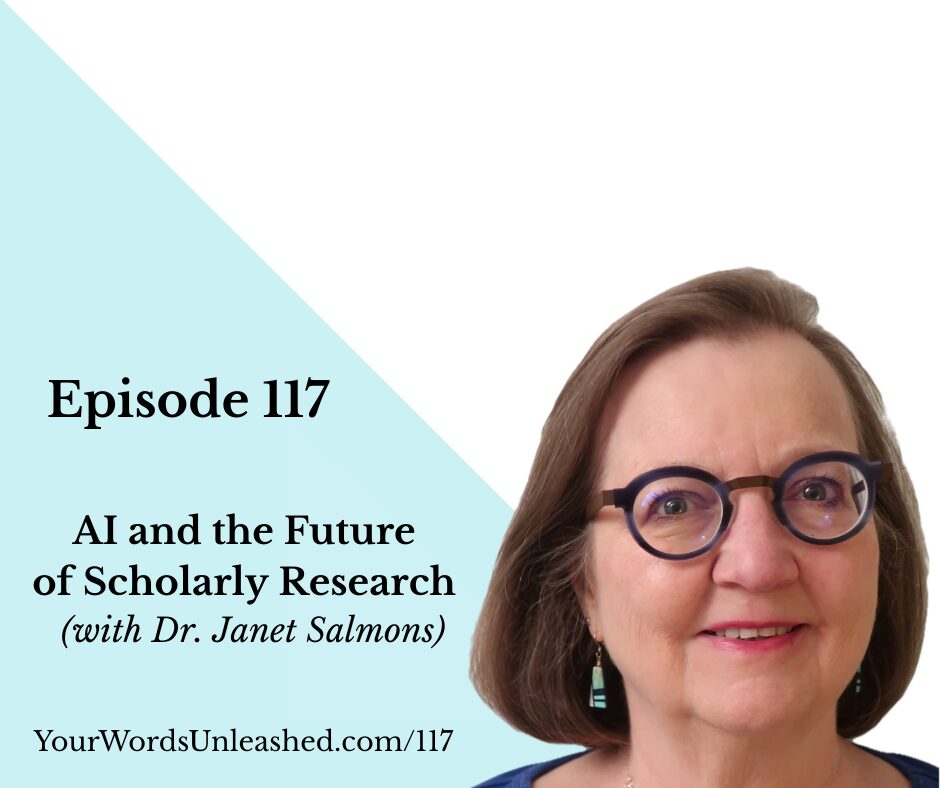
This episode explores issues of academic honesty and the future of scholarly research and writing in the age of AI.
3 ways to work with me~
1) Private book coaching through my signature Your Words Unleashed 6-month coaching program. Finally finish writing and publish your book!
2) Personalized career coaching through my one-semester Career Reset Program for overwhelmed academics. Gain clarity and a sense of renewed purpose.
3) Group workshops on a range of writing and career-related topics. Transform your relationship to your own work in the community of like-minded others.
If you’re interested, email me at Leslie@nullYourWordsUnleashed.com or set up a free 30-minute consult!
Episode transcript:
Leslie:
Hey folks! So if you’ve been listening to this podcast for a while, you may have noticed that I’ve generally avoided talking about AI. As constantly shifting terrain, I’ve been waiting for things to settle down a bit before tackling this huge topic. But today that changes. I will be speaking with Dr. Janet Salmons, a qualitative researcher and self-identified free range scholar who publishes an incredibly useful Substack called “When the Field is Online.”
It explores ways to use creativity, collaboration, and qualitative research to build new understandings in a connected world. I highly recommend you subscribe to the Substack, as she’s here because of her article about the policies that academic publishers are enacting regarding generative AI.
But before we get into this juicy topic, let me tell you a bit about my guest. Dr. Janet Salmons is a frequent presenter on topics related to qualitative research and scholarly writing. She edits the Substack newsletters, When the Field is Online and Reimagine Research. She’s authored an impressive 12 academic books about online research and education, and serves as a research fellow at the Center for Advanced Internet Studies in Bochum, Germany. Janet previously managed the Sage Publications research community, MethodSpace. She’s an honorary member of the Textbook and Academic Authors Association Council of Fellows and received the Mike Keedy Award in recognition of enduring service to authors.
So Janet and I first met back in 2022 when she was managing Methods Space. She facilitated a great webinar I did with writing coaches Michelle Boyd and Kathy Mazak called “How Academic Writing Coaches Get Unstuck.” And we did this panel to mark the publication of Michelle’s wonderful book, Becoming the Writer You Already Are.
And since then, we’ve been in each other’s orbit on LinkedIn. And a couple of months ago, I posted something about how difficult it is to edit AI-enhanced scholarly writing. And this was in regards to receiving some of this work from my own clients. I wrote about my struggle to figure out how to even comment on someone’s ideas.
When the writing has been polished to the point of obscuring the author’s original intent. And this post went fairly viral, and Janet posted a link to her very useful Substack post, “What Do Academic Publishers say about using Gen AI?” And in it, she gives a rundown of the official AI guidelines from publishers like Elsevier. I think I’m saying that right, I’m not sure, Wiley, Taylor and Francis, and Oxford University Press. And I thought that these policies would be a great way to enter into a discussion about AI and its implications for scholarly research and writing.
So thanks so much for being here today, Janet!
Janet:
Well, thank you for inviting me.
Leslie:
So I like to ask everyone at the beginning to first talk about their paths through academia and beyond.
So can you just tell us about your background, how you got to where you are?
Janet:
I had quite an eclectic academic journey, and that really has influenced the way that I think about teaching and learning. So I’ll just say I was wild in my youth. So when I started as an undergraduate, I was a single mother with three children. And that was not an easy path. And I went to Cornell University’s College of Human Ecology. And so, when thinking about this question, the points that I wanted to highlight was that that exposure in the College of Human Ecology, which as the name suggests, really introduced me to interdisciplinary thinking and to thinking about how we educate the whole person, shall we say, and how we realize that.
The learner is not a kind of living in a bubble. They are a part of a community and a society, and there are a lot of influences that have to do with the ways that they engage in learning. And in that program, it’s really emphasized the value of interactive, collaborative, experiential, problem-based, very engaging kinds of learning. And so those kind of two principles really have stayed with me through my entire career.
And then sometime later, you know, because I could talk for hours about this journey, when I was at a career crossroads, I thought I want to support other learners who are in the kind of situation that I was in of not being in the traditional student kind of persona. Because needless to say, if you’re going to school with three kids, you’re not on the party scene. And you also are bringing life experience and observations into your learning experience. And so then I was introduced to the dean at what was a brand-new school at the time. And it’s the current iteration of it is is not what it was at the time that I taught there. But this at the time Capella University was the first to really offer doctoral and master’s degrees through online learning, minimal residencies to people who were adult students going back to school.
And I found that, you know, incredibly useful. And so all of those experiences and supervised 30 dissertations, etc. those experiences of understanding the value of interdisciplinarity and of looking at questions from a variety of perspectives, of weaving in life experience and academic discipline. All of those have tied into you know really have been informed the work that I continue to do. And I think when I write, since you have a focus on writing, when I write, I think about those students who were coming to academia, you know, from other careers, and the importance of clarity in explaining the complexities of research and all of the steps that are involved.
Leslie:
Right. And then so prior to teaching you obtained a PhD, right?
Janet:
I obtained a PhD in interdisciplinary studies.
Leslie:
Got it. Okay. And so you’ve now authored many different books, a number of which are textbooks. And so a lot of people in my orbit are curious about how they could write a textbook. It seems like a natural kind of transferable skill, but no one really seems to have any kind of clear idea of steps they could take. So I know we could talk about this for a very long time, but if you had to kind of sum it up and just a couple of minutes.
First of all, how did you decide to write something like a textbook and then what did you do to make them come to reality?
Janet:
Well, when I conducted the research for my PhD, I had this situation where I knew that I wanted to talk with people all over the world, but I did not have the money to travel all over the world. And at the time, I was an early adopter for webinars and using video conference technology. And so I thought, “well, why couldn’t I use this kind of technology for interviews?” And I mean at the time this had not been widely utilized. So after I completed my research, which was about the development of collaborative skills through meaningful activities in in the classroom, I thought that that would be the focus of my work.
But when I would discuss my research, people would be like, “stop, stop, how did you do that? You know, is there anything written about it?” And so after numerous comments of that kind, I thought, “I guess I need to write a book about this.” Because really, you know, there was nothing out there on this topic. So that, you know, that kind of was my motivation. And at the time I was teaching, and I was in contact with Sage Publications around ordering textbooks as I was designing curriculum and having to select readings. And so I talked with my sales representative and she was like, “yes, this is something that we would be interested in,” introduced me to the acquisitions editor and away I went.
But I think that to me, writing a textbook is almost like putting teaching into writing, because you know, the best textbooks are ones where there is not an assumption that you already know what I’m talking about. That, you know, people are coming to this book with a variety of prior knowledge that may be advanced or it may be very basic. So you trying to provide very clear explanations and to lay things out in a way that are not only kind of reader-friendly, but learning-friendly that will, you know, give people you know a variety of ways to think through the concepts that that you’re trying to convey.
Leslie:
So would you kind of take your lectures or, you know, basically take your material teaching materials and reformat them for a textbook or do something different?
Janet:
No no, not really. I just think that it was more about the thought process behind writing. When I’m trying to explain something in writing, that, you know, I would just think about the ways that I needed to explain these topics to my students and the kinds of questions that they asked. So that teaching experience I think really helped in developing a style that that was successful with writing academic books.
Leslie:
And so when it comes to textbooks, like are they peer reviewed in the same way that scholarly monographs are?
Janet:
My books were peer-reviewed from start to finish. The proposal was peer-reviewed before you even have a contract. Proposal was peer-reviewed by academics who were in teaching positions where this kind of book might be used. And then, you know, throughout the writing process of you know, a little bit different in in my various books, but particularly in the books that I wrote through Sage, often it would be like say, you know, I would submit chapters as they are completed.
So it would be almost like an iterative process of peer review through, you know, while you’re writing the book. So I would get input from readers that would help me to think about it so, you know, particularly for my first couple of books. And I don’t know that that those practices are still you know, going in the same way, but I found that very useful. You know, I also had editors along the way who gave me a lot of feedback and they had read my books and were able to discuss them.
So if I’m saying like, “well gee, do you think that I should put another chapter in here? Does this fit in this spot?”, you know, we could discuss it. And that was that was incredibly valuable. I would say that in today’s publishing industry where a lot of that editorial capacity has been reduced, that one of the things I really suggest is to find—whether it’s a writing group or even just a few other writers who might be able to provide that kind of feedback and be able to kind of be a mutual support part. It’s the accountability piece because it’s a very big project to write a book, but also to just be that fresh set of eyes.
You mentioned at the beginning the Textbook and Academic Authors Association, and that is an association based in the US. The membership fees are quite modest. And you can find those kinds of kind of colleagues and writing circles, you know, through organizations of that kind. So, if you’re not getting that kind of support from a publisher, I think that that’s another way to kind of bring that strength to your writing so that when that book is complete, you’re confident that you’ve presented the best that that you could.
Leslie:
Yeah, I think that’s a great point. And I talk all the time about the multiple writing groups that I was in when I was an academic and those being some of the biggest reasons I was able to finish, right? Like not only improve the work and have the social support, but to actually follow through. And so, it’s great to have a writing group. It’s great to have even just a partner like that you can, swap work with, multiple writing groups. I had them in my department.
I had them with grad school colleagues. I set them up sometimes with folks that were senior to me so that I could learn from them. And I think that yeah, part of it is just about realizing that you can’t do this kind of work alone, even though the work is sole authored.
So what are some of the different topics of your books? There’s so many books!
Janet:
Well, there are kind of three main topics that I cover in my books. Primarily qualitative research methods and the approaches that you can use online. When I started, the first books were focused specifically on interview research and then as I continued to develop through the most recent one, which was 2022, Doing Qualitative Research Online, you know, expanding to include other kinds of data sources, including documents, you know, found materials, archival materials and that sort of thing, or even current posts to social media. We could go the full range from historic to in the moment. And so that’s kind of one topic area about designing and conducting this type of research.
And in those books, I try to provide the kind of theoretical and methodological foundations as well as the practical tips. And I have in mind in those books either a student researcher or the experienced researcher who now wants to try something new but need to create a proposal that someone is going to approve, whether it is your dissertation or thesis chair or perhaps even a grant funder or you know someone else someone has got to say, “yes, you can do this research.” So, you know, really trying to write in a way that would help people to think through all of the decisions that you need to make in a research design.
Then the other books that I’ve written are focused more on the teaching and learning side because as I mentioned, my dissertation research was about collaboration in our connected world. And when I say that, I mean it’s not only the things that we do when we are online. But even when we’re doing things that maybe live in the community face-to-face, we’re still writing to our colleagues and our editors and talking about them. We’re still using technology, you know, in some way, or to save, manage and analyze the data.
So the technology piece I think is relevant whether you are actually conducting the research online or not. So in in terms of the collaboration piece in Learning to Collaborate, Collaborating to Learn, in that one some years had passed from my doctoral research and during that time I used the techniques that I’m talking about in the book and discussed them, gave lots of training and webinars and things like that that allowed me to get feedback from other people who teach and learn. So I kind of brought all that updated thinking into that book to talk about how to design and teach and evaluate collaborative learning.
Now that book was originally published in I think 2019, so clearly before the AI era. But I think that it is newly relevant because from what I gather, there are many people who are tearing out their hair trying to figure out how to teach in a way that engages students in active learning and that allows them to develop what we might call the soft social skills, the practical skills, as well as to meet the curricular goals. And those are the things that I talk about in in that book.
Leslie:
So you brought up AI, so let’s kind of dive in. How was it that you came to even look up those AI policies of major academic publishers?
Janet:
Well, it was kind of interesting because I as you mentioned, I worked for Sage Publishing. After publishing books with them, I ended up then working with Sage for quite a number of years. So I had that kind of perspective of looking at how the publication process works for journals as well as for books. So I was interested in because I, of course, seeing just, you know, so many articles and posts and discussion around academic writing and AI and just wondering, “well, what are what are editors doing and you know, how are they dealing with this?”
So I had reviewed some of these policies before, like maybe, you know, a year or so ago. So I was quite surprised to see the ways that they have been updated. And that, you know, clearly there’s a real not just a problem but a set of problems that they’re experiencing now. And so apparently, you know, wanted to establish some kind of clarity about what is expected for scholarly writing. And so the article that you are referring to, you know, I was looking specifically at journal publishing policies.
Leslie:
Maybe you can start by talking about that set of problems that publishers are facing, and then we can talk about the policies that are being enacted.
Janet:
Well, some of the most kind of obvious error or you know, the one that that’s kind of the end of the ball of string, shall we say, is the issue of citations. So, you know, if you’ve got a submission, a manuscript submission, and the reference list contains references that do not exist, well, that’s a signal right away that obviously the writer did not read these things because they don’t exist. So now you know you can’t trust anything else that they have to say.
But at the same time, you still are committed to you know providing a review process. So the editors are finding they’re being flooded with material that people have just kind of spun out versus taking the time to write. So it’s kind of clogging the system. It puts a tremendous burden on peer reviewers who can’t really be expected to figure out, you know, what, you know, is this person being honest or not? Now you know from my point of view, after looking at the policies and hearing from and seeing posts from frustrated editors and reviewers is that there’s a technology issue, but really what we have is an honesty issue. So, you know, if trust is broken down, then you know that causes just a kind of ripple effect of other issues you know that we have to address.
And then, you know, it begins to go at the biggest level, at the societal level, to say, in this current world we’re in, where misinformation, disinformation, conspiracy theories, the people who are like, “I thought this today, and therefore I am an expert. I’m going to tell you about it.” And like the, you know, this is the way it’s gonna be. Like they have no, there’s no evidence, there’s no background. They didn’t study this at all, but they are an expert today.
So within that world, who do we trust? So to me, the responsibility for us as scholars is say, you can trust us. Because I just described the level of peer review that I’ve had on my writing, or people have looked at it from the minute that I sent the very first thing to someone to propose a book, it’s been scrutinized. Well, before you got to that, you had to do the research, and there were layers of oversight for the research. You had ethics reviews, you have scientific reviews, and you know that that kind of oversight that we have in social science writing is different from what you have from just the “I thought this today and wrote it and you should read it and now I’m an expert.” If you can’t trust that that work is legitimate, then who do you trust? Where do you go when you want to know what’s real?
Leslie:
I totally agree with you. And I think it’s a huge conundrum. It’s like a breakdown of a social contract.
And so when we talk about academic honesty in the age of Gen AI, what do you think that means?
Janet:
I think that academic honesty means the same thing that it meant before. If you are a scholar, and I use that word intentionally, if you are a scholar, then you need to be a trustworthy person, an honest person, and to take that role seriously, to assume that identity with pride. And to have some pride in the work that you present. We all have, you know, moments where we lose confidence and you think like, “my gosh, is this really any good?” But what I’m talking about is we’ve done the best that we could. We’ve done our due diligence.
We’ve studied this topic, and now we’re sharing what we’ve learned that was created, you know, not just out of the blue, but within the discipline of the of research, of empirical research, whether it’s our own research or the research that we have studied, you know, from other researchers. And so I don’t see why that should change.
And to me, that is something that we need to really emphasize with new researchers to say, you know, this is a calling. If you don’t like this kind of work, if you don’t like reading and writing, like you are in the wrong job. So that’s what this is about. This is about reading, writing, thinking, evaluating, analyzing, synthesizing. If you don’t want to do those things, then this isn’t the job for you. This is the role that we have, and we need to, I think, really affirm that. Because it is so needed in this time.
It’s not only that we need trustworthy writing, you know, that we can say, “okay, I’ve read this peer-reviewed article, I can see that you know, there’s something I can take from this that is of value. I can, you know, I might criticize what that person does, or maybe I would have done that study differently, but I can assume that this is something of value.” That you know, that we need to be the truth tellers. So to me, you know, that’s something that we need to stand up for right now and to celebrate.
Leslie:
Yeah, and I agree with you. And I would say that many times what people are responding to or scholars are responding to is the structural pressure, right? Of publish or perish. And so these folks that are like, “I have to get three articles out this year for me to pass my annual review,” right? Like it’s there’s, you know, everyone has their individual choices, but we are all embedded in a larger system that is determining, you know, what sort of external standards people are going to be held to.
And so I think that’s where you get a lot of those folks that are like, I mean, I see sometimes on on LinkedIn, some person has been publishing like literally an article a day. You know? I mean, maybe they’ve got a lot of co-authors or whatever, but you have to just question like, there’s no possible way. And in what world is that seen as a good thing, right?
But then this idea of due diligence too, I think is really important to kind of unpack because I think that it’s now seen as a spectrum of decisions or actions rather than you did it or you didn’t do it. And I think that’s where things are really fuzzy and that’s where publishers are probably trying to enact policies that are getting at some of that.
So can you state like what are some of these policies, for example?
Janet:
Well before I do that I wanna just go back for a moment. So, you know, the two issues. What one is, you know, the question about speed. I personally counter that. I mean, I don’t know that when you and when we get in a moment to talking about the policies, you know, the amount of effort that is involved in verifying, double checking, redoing all of that. I’m not sure that this is really speeding things up. I mean that that’s something that I would question to begin with.
Certainly, you know, there’s the pressure to produce, but perhaps it’s a different mindset to be thinking about to be thinking about an evolving body of work. So instead of thinking like, “okay, I’m doing this module done. I’m doing this done. I’m doing this, done.” That these are steps we are building on. At the beginning of this interview, when you asked about my academic journey, and I talked about my experiences as an undergraduate, which was a long time ago. I’m still drawing on the things that I read at that time. I’m still thinking about the ideas that were discussed in that time in those classes with those professors.
I go back to things that I wrote about in my master’s thesis. I’ve done like a whole two times now I’ve gone back to those and done like another series, I’ve done interviews and brought that work up to date. So you know if you’re thinking about you know there are two ways of thinking about time of like, “let’s get it done right now.” And there’s the taking the big picture of saying, “the work that I’m doing by doing this well is going to now set me up to do the next thing well.” And that I’m now building a body of work that starts when you are an undergraduate.
For some people, maybe it starts in high school, where you’re finding the topics that interest you, you’re finding the writers, the researchers, the thinkers who you resonate with. And that, you know, you’re going to continue to follow and perhaps even exchange ideas with as you become more experienced in the field. And to me, that is lost if you’re thinking I can just read an AI summary of this and plunk this citation in because I need this many citations. Well, maybe you got done this little, you know, paper or whatever it may be, but you haven’t done anything in terms of building your body of work that is going to evolve throughout your career.
Leslie:
Yeah, no, I definitely see that. And yeah, I think a longer-range vision is really important. I think there’s also just the daily life pressure of trying to get a job and get tenure and all of that. And I think that’s honestly, I think that’s what a lot of people are facing when they choose to run something through Chat GPT or whatever, is running up against feeling like they don’t have the time. And so versus like the moral ethical standard that they might have is “I don’t want to have to use it, but I feel like I don’t have time to not use it.” And I definitely hear what you’re saying is like, I think slower is better too, obviously. It’s just hard within the structure.
Janet:
But I would say that I don’t know that it’s slower. I think that the concept of speed is a false premise. Okay, there are a couple of things to unpack here. One, if you upload something that has not been peer reviewed into Chat GPT, you’ve now defeated the entire purpose of peer review. Because now that unreviewed paper may contain false information, perhaps inadequate, incorrect findings that would have been surfaced in a careful review process. That’s now out there in the world and you can’t take it back. So you’ve defeated the purpose of the oversight that that is central to scholarly work. So if you’re doing scholarly work like that, that is just absolutely in inappropriate from my point of view.
Now, you know, in terms of the ethical side, maybe a sidetrack but when I taught, in addition to teaching about research, I taught in the program about there was a business school. I taught leadership, ethical leadership, social responsibility, empowerment, team leadership, and things like that. And so I look at you know, the companies that are behind these tools do not kind of fit any kind of definition of corporate social responsibility!
You know, whether you’re looking at the fact that they’ve stolen all of this material, including my books, which I’m not amused by because I, you know, as an academic writer did not have fat advances or book leaves or, you know, any kind of thing like that. I was doing this on top of a full time job and a family and life. but somehow it’s fair game for them to just take it, but also the exploitation of workers. If you think you are a decolonialist scholar, if you would call yourself a decolonialist scholar, a progressive social change advocate, then how can you use something that is built on the back of exploitation of not only other writers, but of workers around the world who are being treated absolutely horribly?
So, you know, to me it’s a non-starter. I can’t be complicit in that. I won’t be. Sorry, I don’t care what it takes. I will do it myself. So maybe not everyone either has been exposed to that kind of information to understand what is going on, especially people outside the US, because in the US we get to see it–
Leslie:
Not to mention the environmental harm.
Janet:
–up close and how these companies work is being used in conjunction with authoritarian policies. And so i’m just like, no, I don’t care how even if it was perfect and did not generate slop I wouldn’t use it just on the basis of sorry it doesn’t pass any kind of basic level of morality. So I just have that as a starting point.
Leslie:
Right. Yes, yes. And can we bring it back to the policies? So what are the policies that–
Janet:
Yes. So when I looked at the policies, I mean one of the things that was interesting was that they’re fairly consistent across the major publishers. And some of them are much more detailed than others, but they’re all organized in a similar way, where they have kind of three categories.
So the first category is: “this is acceptable. You don’t need to disclose it or tell us about it. And so this would be the items that were consistent across the publishers in that category were translation and basically kind of spell and grammar check that kind of thing, you know, so it’s just kind of copy editing software.” You know, that that those would be acceptable. You don’t need to explain that you use those. That’s okay.
And then you have the category of prohibited. And then you have the category of you need to disclose and explain. And so I’ll go to that one first. So in there are a lot of gray areas. And so basically what I could see, you know, across the publishers is that if you… Let’s start at the point of doing the research, because that is was one of the significant breakthroughs that I saw in this set of policies that changed from the past is that they were not only talking about how do you report the research, they are talking about how did you do the research.
So if you are a student listening to this and you were thinking, “well, I’m just doing my research proposal. I’m writing papers for a class and I’m using large language models to help me with this.” Well, if you are, if you accept the premise of what I was talking about earlier about developing a body of work, well, the smart student, while they are in school, is thinking, okay, this is just a paper for this course. However, maybe later on, I’m going to build on this and write an article based on this. I’m going to keep using this material. So that work, even at the student level, is significant.
So what these policies are saying is that you need to document every single thing you do. What tool did you use? What prompt did you use? How did you verify what you found? How did that change your thinking? So this is where you start to go like, “mm, maybe this isn’t faster after all, because I could just sit down and write this paragraph myself. And I wouldn’t need to explain like how did I do this?” Because they don’t ask that. But that level of detailed description, starting with the research that is the foundation of what you’re writing about later on, that that would need to be for some publishers, that would need to be submitted with the manuscript.
So I am submitting my article and I’m submitting this disclosure statement that says how I used AI. So now you have the situation where who receives that? That editor, those reviewers now have to make a judgment call, you know, were the uses legitimate? Does it, you know, pass their standards depending on the type of journal it is? And, are they even going to send it out for peer review or is it just going to get a desk rejection? So, you know, but that becomes much more difficult.
Now under the prohibited category, there’s some amount of variation. Again, with Sage’s policy was the one that really went into detail about things at the research methods level. For example, having AI conduct the interviews, having bots interview people or bots interview other bots or any kind of thing like that, like no, that’s not considered scholarly work. Entering questions into an LLM and then reporting on that as research data, no, that is not considered research. One that I thought was perhaps more controversial was in the data analysis. And I corresponded with the person who developed this policy and said so “you know a lot of the qualitative data analysis software programs use AI.” And she responded and said, “Data analysis is a human activity.” So those were some very specific guidelines.
What I would suggest to anyone who is thinking like either someday I want to publish or next month I want to publish is to really look at those policies and see you know what is acceptable and what is not? And you know, even if you’re someone who is inclined to use AI, where what’s going to cause a greater obstacle to getting published, when and where might I think that it’s something acceptable that I can make a case for using it in this particular circumstance.
But going back to the question of academic honesty, in my opinion, and obviously the world does not follow my opinion, but in my opinion, going at it with the attitude of, “I can get away with this” is not a scholarly attitude to take. So, if you decide that you are going to use AI tools in your research or in your writing, start right now with documenting every single thing that you do. And then you’re going to have to look at the policies from the various publishers and the specific journals to see whether are you closing the door on yourself by approaching it in the way that that you’re thinking would be like quick and dirty.
And if you’re thinking “they won’t be able to tell because the detection tools aren’t good enough,” for one thing that’s dishonest. For another thing, it’s disrespectful because editors and peer reviewers are generally volunteers. You know, they’re people who care deeply about the value of scholarly work. And they’re doing this, you know, on top of everything else in their lives. So they are our colleagues, they’re our friends. We should treat them that way. Don’t expect them to sort through your mess because you’ve got Frankencitations to things that don’t exist or that perhaps, you know, there’s a real scholar’s name, but the article does not was never written.
That’s not only dishonest because you’re lying that you read something that doesn’t exist, but you’re also not respecting the people who have the responsibility to provide that that oversight through the review process.
Leslie:
I agree with you. Yeah. It’s not respecting their time in particular, right? And so a lot of interesting points to unpack there. I think your idea about actually keeping track of all the ways you’re using AI for every project is not only important when it comes to having to tell publishers, I think it’s also something people can use as a reflection tool for themselves. Looking back and seeing, “okay, I used AI in all these different ways. Number one, like why did I use it? Am I over reliant? Am I letting AI think for me? Was it easier and faster and better to do it this way versus to struggle through it on my own?”
I think everyone should be reflecting on how they use it if they’re using it, not just sort of hoping, like you’re saying, that they can kind of squeak by. And so I think with the folks I’ve worked with who have sent me work that’s very clearly not in their own voice, because I’ve read multiple iterations of other things that are written in their own voice. I can tell it’s coming from a place of not feeling totally secure in their writing style, thinking that maybe they’re just sort of doing a light copy edit. Whereas from my perspective, I’m like, “this thing has totally wiped away any humanity and any originality and uniqueness that you brought to it, even with the grammatical errors or maybe even conceptual errors, those things I can’t help you fix anymore unless I can see them.”
And so I’ve actually had to implement my own AI policy in my contracts. And I talk to my clients now about “you cannot use it in any way that is in any way that’s noticeable to me,” right? Which is even down to the copy-editing level because I realize that AI can absolutely alter your meaning with one change of a phrase or one word, all of a sudden, your findings are different. All of a sudden the theory is not accurate anymore. And I’m not sure if that’s what you meant. And so I think that that’s where it comes down to like, you know, your point about it might not be faster. If you have to go back and triple-check every single thing just to make sure it lines up with your original intent, that seems like not a great usage of time on the back end.
It seems faster. Maybe in some cases it is faster. I feel like with my own writing, when I’ve experimented with AI, it’s taken like three times longer just to clean it up and figure out like, does this sound like me? I’m like, forget it. I’m just gonna do it myself. So yeah, a lot of interesting points you made there.
Janet:
Well, I think there are two points that I draw from what you just explained. One is self-confidence and the pride that goes along with that, and the other is basic academic scholarly skills. So with the first, in terms of that confidence piece, earlier we talked about the value of writing groups, of colleagues, friends, or you know, joining a group that’s run by a an established writing coach such as yourself or through a group like the Textbook and Academic Authors Association, where you have people who can help you to say, like, “yes, Janet, you really got it with that. That’s great. You know, like I really understand what you’re trying to say here and this this is important”.
You know, because when you’re sitting there by yourself, like on your computer or like writing this thing and you’re thinking, “gosh, is this like going to change the world with earth-shattering success, or is it going to be like, you know, only my mother and my sister are going to read it?” So that’s one thing is that confidence piece and the pride in your work to say, “when I put my name on something, I’m standing behind it. It’s my representation in the world through my voice, my cultural background, my lens on the research and why I felt that this was something important to study.” That there’s some something real, you know, behind it.
The other part is the skills. And from my point of view, having worked with many, many doctoral students, and as I said, people who didn’t necessarily come from a rigorous academic background before or had been out of school for a long time, that there are, you know, kind of straightforward skills that you can learn. I mean, how do you read a scholarly article? You know, how do you comb through the references to find more background? You know, how do you understand theory and you know, concepts? You know, how do you write a literature review? You know, these are kind of basic scholarly skills. It may seem intimidating up front, but once you acquire those, you can keep using them.
Then some of these tasks that you’re thinking, “this is insurmountable to be able to read the number of articles I need to read to provide this literature review.” Well once you have the skill to understand how to do that, you know, it’s not only is it not so hard, but then you start saying like, “well wait a minute, this is an article that I can use somewhere else, you know.” So I’ll find in my crazy hard drive, you know, where I’ve saved all these PDFs. I might save something in multiple categories. But maybe this article had amazing figures. You know, maybe this person used stories in a really interesting way. So it’s not even about say the methods or the topic that was studied, but I learned something about how to write something really interesting. Like, “wow, maybe I could try this.”
And you’re missing all of that, you know, if you’re just relying on some AI summary. Or throwing the article into a large language model, which brings up other things about, was it copyright protected? Did the author actually want to give their stuff to AI, maybe not. But aside from that, like, you know, I don’t know that you’re really saving that much time. Maybe it would be better to put the time into learning those skills. And that’s something that working with a coach like you, where you can say, “hey, I noticed that this paper has this big chunk that doesn’t sound like you. You know, let’s talk about how to develop your own voice. Let’s just step back and step away from this this big thing you’re trying to get done, and take a little time to just write something from your own voice, just about the personal experience that you can start to say, like, let it something that would just flow, that you don’t have to think that much about, that you know, just to start to say, like, what’s my style? What’s my voice? What’s going to characterize my writing so that when someone reads this, they’re going to say, you know, that’s Janet’s style. You know, that’s there’s a person behind this.”
There’s a person who cares about this topic. Why? Why is this so exciting? If as I used to say to my students back in, which was luckily before the AI era, if you aren’t excited about it, how do you expect the person who reads it to be excited about it? Why are you excited about it? Let some of that juice come through. So, you know, to me, there are those two pieces. Maybe it’s three, because it’s the honesty piece of going like, “I’m just not going to be a liar and I’m going to be a respectful person. I want to be a scholar. I want to be seen as a scholar. And that means I need to be credible, trustworthy.”
The second is, “I’m going to build my confidence. That is an aspirational role. And so along the way, I’m going to build my confidence that I have something to contribute, not only to the literature, to the field, to the world, my research, whatever my little piece that I can give, I’m going to stand behind that. I’m going to be confident in that. I’m going to build my circle of support and accountability that will help me to develop the confidence that I need to be the scholar I aspire to be.”
And then the third piece is just like anything. You know, if you were going to build a house and you’d say, “gee, I’ve never held a hammer, but, you know, I think I could build this house,” you’re like, no, no. First you need to, you know, learn some practical skills that go into this. And then once you’ve learned it, or to say, I’m going to sew a quilt, but you know, I’ve never held a needle in my hand, well, you know, maybe they’re like they’re basic skills and people have done this for years and years, so they can’t explain those skills to you. You can find them. And then once you’ve acquired them, you don’t need someone to do it for you because you know how to do it for yourself.
Leslie:
And it’s okay to be imperfect, right? It’s okay to make mistakes along the way. It’s not like this linear process of “I’ve got the skills and now I can just do the thing.” You know, I think so much of my coaching is with people who are tenured already and they’re still working on the self-confidence piece. And I might even call it self-leadership. How do they feel like what they are working on is important to the world is actually a lot of it is about your mindset about the work itself. But we could go in so many different directions with this.
I’ve really enjoyed this conversation, but we do have to end it somewhere. So Janet, thank you for being here. How can listeners find your writing and connect with you?
Janet:
Well, at this point I am focused on my blogging. I’m not working on another book. I made a conscious choice to be more immediate in my writing and hopefully somewhat more conversational with my readers so that I could be more responsive to things that are coming up. and also to share the updates to my published work. I’ve continued to do kind of another level of research of kind of what I call curating my own work, of going back to the work that I’ve done before and you know, thinking it through, adding to it, updating it, et cetera. So I’m able to do that in this informal way on Substack. So I think that would be the best place to find my writing.
Leslie:
Can you again repeat the name of your Substacks?
Janet:
When the Field is Online is a blog and newsletter. So as a subscriber, you get all the new posts through email. And that one is focused on qualitative research methods intersecting with technology, not only about doing it online, but you know, we’re in this connected world.
The other one is called Reimagine Research, and this one I’m collaborating with Eleanor Pritchard from Oxford University. And we are trying to provide some support and guidance and ideas for people who are in an in-between state thinking about their careers as researchers and scholars. And so both of those are on Substack.
When the Field is Online is completely open access. My archives are open access. You can look at everything that I’ve written. But I do also have a paid level where I provide some additional resources, particularly instructional materials and some kind of background about what I’m thinking about right now. Kind of little behind the scenes option. But really, it’s available to anyone. You know, I hope that you’ll use it, find them valuable share with your students. It’s a lot of material.
Leslie:
Wonderful. Thank you so much for sharing all of that with the world and for sharing your opinions with my listener. I think there’s so much food for thought. This is obviously an ongoing, ever-evolving situation. Thank you for weighing in on it as you have because like I said, it’s well, I don’t know if I mentioned it. It’s hard to get people to talk on a podcast about AI, at least AI in academia. So I really appreciate your time and your ideas and listeners go subscribe to her Substacks, you will not be sorry. I will talk to you all again soon.