Leslie:
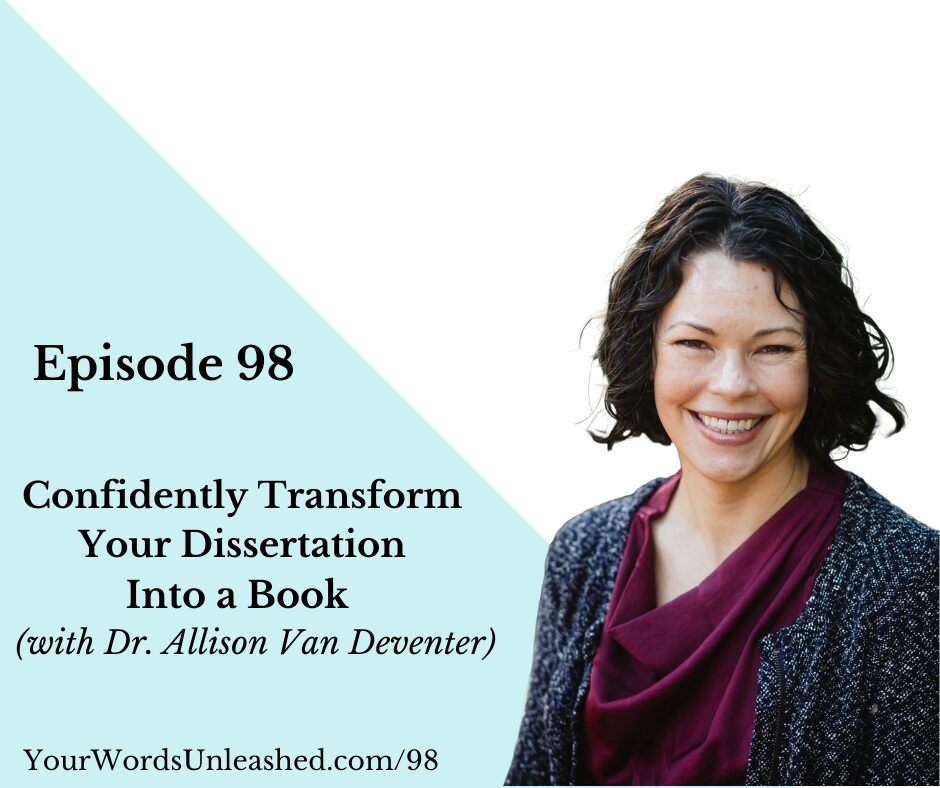
So please join me in welcoming Allison Van Deventer onto the podcast today. Allison is a developmental editor for academic authors in the humanities. She received her PhD in comparative literature from UCLA. She’s the co-author with Katelyn E. Knox of the Dissertation-to-Book Workbook: Exercises for Developing and Revising your Book Manuscript, which was published by University of Chicago Press in 2023. Allison and Katelyn run workshops for book authors, including the Dissertation-to-Book Workshop and the Book Chapter Shortcut.
So Alison and I are both in the Boston area and have been in one another’s networks for a while, and I have used parts of her workbook with my own clients and have found the exercises to be super useful. And as anyone who’s written a book based on their dissertation knows, it is a very complex, sometimes quite harrowing experience.
I actually talked about this all the way back on Episode 8: Why Transforming Your Dissertation into a Book is So Hard and Episode 9: Tips to Revise your Dissertation into a Book. But since Alison and her co-author wrote this amazing workbook on this very topic, I wanted to ask her for even more specific tips and strategies.
So Alison, welcome to the show!
Allison:
Thank you for having me, Leslie! I’m thrilled to be here. It’s really fun to get to have a conversation.
Leslie:
Absolutely. So, of course, I always ask everybody to talk about your own path through academia, and also how did you become a developmental editor?
Allison:
Right. Well, so as you mentioned, I got my PhD in comparative literature from UCLA and it’s sort of a classic story in some respects. I followed my partner out to the East Coast, just as I was finishing my PhD, for his postdoc at MIT. And I adjuncted for a while around the Boston area. I taught in the History and Literature program at Harvard, and I taught writing at Tufts for a little while.
And after a few years of that, I had a baby and my husband got a full-time job. Things happened, all at once. And then, long story short, I ended up being a stay-at-home mom to this baby who was taking really long naps for a while, and I was really bored! I had decided at that point not to pursue a job in academia for reasons that included the two-body problem, but that was definitely not it. I just felt like a bad fit for me personally, and so I decided to take some time, stay home with my baby, and figure out what I was going to do next. And so he was sleeping for these long stretches of time and I decided to email someone I knew at Harvard and say like, “Hey, do you have anyone who needs their work edited?”
Because I’ve done work off and on as an editor over the years, and I know I can polish people’s sentences and make them sound better. So she said yes, and she started sending me people. And time went on and I started doing more and more of this. And crucially, an old friend from grad school, Katelyn Knox, reached out to me and asked if I wanted to help her run an online workshop for people turning their dissertations into books.
And Katelyn and I had been writing partners back in grad school and so we knew that we worked well together. And so I joined her in running this program that she had developed. And through helping her with this program, I learned a lot about what makes books work as books. And gradually I learned to do a lot more than just polish sentences. It was really through working with people on their books through this program and then through clients that I worked with one-on-one that I learned a lot about how the pieces of an academic monograph fit together, and that’s how I became a developmental editor.
Leslie:
Amazing. So how many years has it been now?
Allison:
I started out doing the very, very part-time line editing in 2016. And I would say that I transitioned to developmental editing around 2021 or so. So this is 2025, so four years of my focusing on developmental editing. And before that, I was honing my skills by doing a lot of line editing in books and working my way up toward making more big-picture edits.
Leslie:
Got it. So let’s talk a little bit about the book that you and Katelyn wrote together called The Dissertation-to-Book Workbook.
So first of all, what made you decide to write it and how did you decide to structure it?
Allison:
Yeah, great questions. It was tremendous fun to write! I’ll just say that upfront because I love working with Katelyn and I love bouncing ideas off of someone else. And we work really well together. So we had been running this online workshop for a couple of years. It was primarily a summer program, a four-day intensive where people would show up and go through this online curriculum that Katelyn had developed based on her experience of writing her first academic monograph. So as we ran it, we took notes and gathered data about how well the exercises seemed to work, where people had trouble.
We tweaked things to try to help them understand the concepts that we were getting across better. And at a certain point Katelyn said, “What if we made this more accessible to people? What if we tried to publish this as a book that would cost a lot less than our online workshop and that people could do at their own pace?” And I thought that was a great idea. It was a little scary because it was during the height of the pandemic and I had no childcare at the time. I was the childcare.
But I worked things out with my husband, got some time on Sunday afternoons, did a lot of working after the kids went to bed. And so Katelyn and I revamped the whole curriculum and added some new parts to try to deal with problem spots that we had noticed and came up with a draft of this book.
The way it’s structured is you begin in Chapter One by taking stock of your book manuscript as it is now, which may mean essentially the unrevised dissertation. Or you may have done some work on that manuscript since you graduated and got your PhD. You may have done significant revisions. And I will say, too, that this works even for a book that is not based on a dissertation, as long as you have a significant body of already drafted material that you’re working with. So you begin by taking stock.
In Chapter Two, you talk about the organization of the book, thinking about the logic of the table of contents, which some people have never thought very much about because their dissertation just sort of evolved chapter by chapter. And it’s useful to think about how the chapters might be structured otherwise, whether that means putting them in a different order or tearing them apart and redistributing the material, or just thinking of another way of prioritizing what’s in the chapters.
And then Chapters Three through Five of the workbook are all about articulating the book’s big questions that it asks about, its body of evidence, which is crucial. Not big questions about why the book is significant, but questions about its specific body of evidence. Then chapters Six throughEeight, which was new material that we drafted for the workbook, it hadn’t been in our online curriculum. At least not, not in that form. Chapter Six through Eight are about looking at your various chapters as units, and then thinking about what the narrative arc is.
Chapters Nine through 10 are about actually answering the questions that you came up with in chapters Three through Five. Chapters 11 through 13 are pulling things together, wrapping things up, drafting the argument and dealing with background material, and then chapters 14 and 15, which we also wrote new for the workbook, are about how to go about actually making revisions within the chapters.
And then we have a little one-off chapter at the end that I wrote brand-new for the workbook on how to eliminate the kind of language that tends to get read as “dissertation-ese.”
Leslie:
Oh, can you talk a bit about that? What tends to be read that way?
Allison:
Yes. So I have, opinionated opinions about dissertation-ese. And my first opinion is that this is not the most important thing when it comes to turning your dissertation into a book. People tend to think of it as the most important thing, but really it’s not. And once you understand the issue, it’s actually fairly straightforward to deal with.
So a major thing that tends to get read as dissertation-ese is extensive citations of other people’s work, particularly in a defensive or deferential tone.
Leslie:
Oh my gosh, totally!
Allison:
Right. So, like in a very practical sense, you could take the places where you cite other people’s work and just spend less time. So still cite other people’s work, but literally give them less space on the page. Condense those things. Really minimize direct quotes from other scholars’ work. And if you are going to do a direct quote, think about doing maybe just a phrase or half a sentence, rather than quoting entire paragraphs or entire sentences, just condense, condense. And also try not to cite people to show that they’re wrong or to prove that you’re right.
Because that’s the kind of work that you might have done in the dissertation, and it may have been necessary then because you were literally proving yourself in the dissertation. That’s the function of a dissertation. But when you write a book, your readers will encounter this published object as something that is written by an expert, like you’ll appear, right on the back cover of that book or on the back flap, as someone who is an expert and who knows their stuff. You don’t have to try to earn your place anymore. Like, you already belong to the community of scholars. And so the readers who seek out your book will very largely do it because they want to learn about your topic. They’re not going to hate read you, for the most part.
And so when you cite other scholars, you can cite their work because it’s useful for your argument in some way. Like “this is an example of what scholar X calls” or cite a concept to clarify what you mean to say, not to show that either they’re wrong or to prove that you’re right.
Leslie:
Yeah, that makes so much sense to me. And I think I encounter that a lot with my clients who are very, they’re like either at the postdoc phase or very newly in a tenure-track position where there’s pages and pages of lit review that don’t mention anything about their own project yet.
You know what I mean? So it’s like that proving of, “let me show you how much I know about this field” is not necessary when you broaden your audience, right? So really I think, citing folks and citing other research that is in service to your own, it’s like this huge shift, but I feel like a lot of times that’s not discussed.
Allison:
Yes. I have so much to say about this…
Leslie:
Do it!
Allison:
I mean, it’s nothing, nothing different from what you just said. You put it so beautifully there. But really, you don’t have to prove yourself anymore, I promise, and you don’t even have to prove yourself to the peer reviewers. They will be ideally trying to make your book better, but they are not your ultimate audience. The audience is the people who are going to read the published book. Really just because they’re interested in your topic.
And so along those lines, a pep talk that I’m always finding myself giving is, “your primary sources are important and interesting, and they should really be what shines in your book. So you no doubt find this body of evidence, the book’s corpus interesting and important to yourself, or you wouldn’t be writing about it. And so see if you can communicate that interest and enthusiasm to your readers and really give space to those primary sources. The analysis of those sources is central, and when you begin with that and prioritize those sources, the rest tends to come.”
You can find ways to explain why the book is significant to scholars who are not working with those specific sources. You can find ways to bring in scholarship, but the evidence yourself, that’s the center.
Leslie:
Right. I think that that is like a very common challenge that first time authors face.
What other ones have you seen in your own work? What other major challenges do people have when they’re turning their dissertations into books?
Allison:
Well, I see two main buckets of challenges. And the first one is the whole set of emotional and mental challenges, including not knowing where to start and feeling overwhelmed. And maybe having gotten a bunch of feedback and input on first the dissertation and maybe the in-progress book manuscript or parts of the manuscript and not knowing how to put this advice into practice, or maybe some of it is conflicting advice.
And so there’s just this feeling of being overwhelmed and not knowing how to break this down into manageable pieces. So there’s all of that.
But then I also see challenges in the book itself. Because I’m a developmental editor, I’m not trained as a coach, I am always interested in going to the book manuscript to see where are the difficulties there that may be making it difficult for the author to really figure out for themselves what needs to be done.
One major challenge that I see is that the stated argument of the book is not actually the one that’s developed-
Leslie:
Totally.
Allison:
Yeah. Katelyn and I were chatting recently and she put it this way: that there’s a difference between the argument that the book says and the argument that the book does.
And this is particularly common in dissertation-to-book projects, I find, because the argument may have evolved over a long period of time. Years probably. And so authors may have a way they’re used to talking about the book, but that may not have kept pace with what the evidence actually says. And there may be pockets of evidence that the author hasn’t gone in and really delved into again, and just for whatever reason, there’s some sort of discrepancy between what the book is promising to do in the argument that you’re used to giving and like what the actual evidence allows you to demonstrate. So that’s a big one, and it is not easy to find. It can be quite subtle.
Another difficulty is at the level of the chapter arguments. So maybe big-picture there is correspondence between the book argument and what the evidence can say, but in the chapter arguments as stated in the chapter introductions, they might be vague, more like topic statements rather than interpretive claims. Or sometimes the chapter arguments actually turn out to be about different actors than the ones that are featured in the book argument. So the book argument is about how, I don’t know, different texts did different things. And then in the chapter arguments, you actually have authors and readers doing different things, so there’s a discrepancy of that sort. Or maybe a key piece of the book argument is left out.
Maybe it’s actually supported by the evidence, but when you look at the statements of the chapter arguments, they are not addressing this piece of the book argument, or maybe just the chapter arguments seem to be adding up to something different. And something that I do sometimes for clients is pull out all of their chapter argument statements and put them in a separate document, just one after the other. And then at the top I put whatever book argument they have given in the book introduction, and we just look at them together and say, “okay, do these chapter arguments seem to be telling a consistent story? Or is it really just sort of jumping around from topic to topic and set of actors to set of actors, and if it’s telling a consistent story, is that the same story that you’re pointing to in the book argument? Where are the discrepancies?”
And one of the things I say over and over is that difficulties and discrepancies are information about your book. So I actually get really excited when there are problems in these chapter arguments and in the fit between the chapter arguments and the book argument because I say, “okay, now we’ve learned something. Now this is something we can work with. What is this difference telling us? Why is it there? What are some different ways we could handle it?”
Leslie:
No, I think that’s super useful. Having someone help you take a step back from the material because it’s so easy to get lost in the weeds and the details of what you’re writing about and to not be able to see like the forest for the trees. So I think that that’s really, really helpful.
One of the things I see a lot in people’s chapters is multiple arguments. You know what I mean? So to be like, “well, I contend this” and “I’m arguing this,” and it’s unclear which of those is like the actual chapter argument and sometimes, which of them is the actual book level argument. Do you see this often?
Allison:
Definitely. I see that often. And I will say that I’m very firm about using the phrase, “I argue” only once-
Leslie:
Me too. Me too!
Allison:
Per chapter once in the book introduction, right. But taking out the actual words. “I argue that” is not going to fix the problem if what you actually have are different argument statements scattered throughout the chapter introduction, right? So what we have to do at that point is figure out what the chapter is actually saying. Or let’s say what, the chapter is doing. What is the argument that the chapter is actually making in its body and compare that to the argument that it says it’s making in the chapter introduction so that we can really get some clarity and figure out what it is that needs to be adjusted if we’re going to have one clear chapter argument that’s developed in the chapter, right? Because maybe it’s the statement of the argument that needs to be changed, but maybe it’s what’s within the chapter that needs to be changed.
It’s a matter of framing. Maybe there actually is more consistency than there seems to be. So there are different ways this could go, and the intermediate step is to really take stock of what the chapter is doing in the body of the chapter. So practically speaking, the step that I go to next is I list the titles of the sections or the headings of the sections, again, on the separate piece of paper. And I look at them and I say, “all right, so what story are these headings telling? What do they seem to be about? The same set of actors, or if they’re different actors, are they different in a consistent way? What is going on in each of these sections?”
And because I don’t want to rely just on the headings, which may have been written in a hurry or casually or a long time ago, I look and see what is actually in those sections and I put a little tag, or a little summary for every section. Alright, here’s what this section is doing, here’s what the next section is doing, here’s what the next section is doing. And by looking at them together that way, sometimes by myself or sometimes in a Zoom conversation with a client, depending on their preferences, we start to gain clarity about what the chapter can actually realistically prove with its evidence.
And then we think about how that chapter is moving the book argument forward. What is the unique layer that this chapter is adding to the book? And via all that work we tend to arrive at a version of the chapter argument that works. And of course, I will say if we’re using the Dissertation-to-Book Workbook, we can get to this point via an exercise that I call “Book Questions and Chapter Answers.” But that is of course not the only way to do it.
Leslie:
Well, that actually raises a question for me because I have used various exercises from your book because you’ve been super generous in talking with me about how to use it. And one of the things I always give to my book coaching clients is something that I call the “book assessment exercise.”
And I think you call it something else, but can you talk a little bit about what this is and why you think it’s useful for people to do before they really start revising?
Allison:
Right. So this exercise is in Chapter One of the Workbook. And actually, I don’t know if we’ve even given it a name, but it’s a table in one of the early steps in Chapter One. And it just asks you to list the book’s topic and what kind of work the book is doing in its field and what it’s not doing in its field. Crucially, because your book can’t do everything and you do have to choose and what question the book is asking and how it’s answering that question via its evidence and so on and so forth. And so I think this is a useful exercise to just take stock of the way that you’re currently thinking of the book. And I tend to think of it as part of this information gathering exercise, and not only information about the book, but about the way you are tending to describe the book at this moment in time.
So you can do a little meta reflection on this exercise actually. How do you tend to describe the book? What do you tend to prioritize and what do you tend to leave out? Because of course, books say many, many things. They have many, many threads and a lot of things they could talk about. And so, when you are pinned down and asked to fill out a small table, what is it that you tend to go to?
And that can be a useful awareness for you as a starting point. And actually, though, we have people return to this table in a later chapter of the Dissertation-to-Book Workbook I think it’s in Chapter 11. After they’ve gone through our many, many exercises to think about things like the logic of the table of contents and the two or three key questions that the book is asking. And crucially, the answers to those questions because books have to actually give answers, and the answers should be different in the various chapters.
Otherwise, if it were all the same answer, it would be an article. And so at the end of all this work, we have people go back and fill out that table again without looking back at their original version. And it almost always changes for people. They find that they have a better grasp of what the book is actually able to say, given the evidence available and what they want to prioritize in analyzing that evidence.
Leslie:
Yeah. So the reason I always give it to people to do is that I can see on one page exactly where they’re at in their process with their books. So what I really like about it is that it forces people to put some parameters around their project and make it finite. And I think especially when something was a dissertation, which often dissertations are very broad, and with a book, you’re trying to get something much more focused, right?
And so it’s more focused, but also legible to a wider audience. So it’s like you’re making all of these changes while you’re doing it. And I think a lot of first-time authors don’t know how or don’t know that they should make a whole bunch of decisions before they ever start revising. And I think the more kind of clarity they can find on what do they actually think that this is about? And, of course, that changes over time.
But if they can make certain decisions around, say, like the major claim, the primary questions, what it’s going to do, what it’s not going to do, why this needs to be a book, versus an article, like some of that pre-work is just going to save a lot of time and I think effort and heartache later.
Allison:
Exactly. That’s how I use that assessment too. And I’m going to tell you in just a minute about a sort of expansion of that for the next step. But first I just want to say that yes, it is crucial to make these decisions and think about them because it really gives you confidence and a sense of ownership over the book. Like you can say, I am choosing to do this and I’m choosing not to do this other thing. And here’s my well-reasoned rationale for making that choice. And it helps give you a reference point when you get this feedback from reviewers or from a manuscript workshop or mentors where they’re saying, “Oh, you could do this and that.”
And so you need to have some sort of framework for being able to assimilate that feedback and say, “yes, good idea. I could do this,” or “no, this is not fitting with my vision for the book, so I will address the spirit of these comments, but not do this other thing.” So it’s really essential and tends to give people a lot of confidence. And what I do, personally, when I am starting out with a client who is doing a dissertation-to-book project, I work with this idea of book questions and chapter answers, which is going a step beyond that book assessment in chapter one. And actually, I start with an exercise from Chapter Two, which is to fill in the blank in the sentence.
Each chapter in this book discusses a different –fill in the blank. Recognizing that not all books fit this schema, and they don’t have to, but it can be useful to just take stock of how someone is thinking about the logic that’s organizing their table of contents. Maybe they’ve never thought about these things this way or maybe they have, and it’s an easy question to answer. But it tends to open up a great conversation about how the chapters are conceptualized as a set. And then I ask the author to come up with a question that the chapters are answering by analyzing this evidence.
And then I pin them down and I say, “All right, what’s Chapter One’s answer to this question?” What’s Chapter Two’s answer to this question? And this is not easy, but we sort of hammer out a set of question and some answers, and then we come up with another question and a set of answers. And really in this exercise, the questions are standing in for pieces of the book’s argument. But the point of putting a question mark after it is so that you can give chapter-level answers, and so see how the chapters are interacting with the book as a whole. And it tends to bring up a lot of interesting questions.
And again, in the spirit of gathering information about the book, because sometimes you find that one chapter is not in fact answering the question at all. What do we do with that then? Is it that sometimes if you cut out half of that chapter’s evidence, you all of a sudden find that it’s able to answer the question. Or sometimes it’s actually answering the question, but in a really non-obvious way that you wouldn’t have thought about. Or sometimes it’s a chapter that could be spun off into an article and the whole book makes more sense without it. There are all kinds of solutions that are possible.
Leslie:
Yeah. And so, in the spirit of thinking about things that will maybe save you some time or timing of things, I’m wondering when do you recommend that people start writing their book proposal in this whole process?
Allison:
Right. That’s a great question that has two possible answers. And it depends on what you want the book proposal to do for you. So some people use the book proposal as a way to think through these big decisions about the book. Do this big-picture thinking and planning, and look at the chapters as a set and think about how they all fit together and pinpoint the book’s argument. And that is fine. If you’re using the book proposal form to do that kind of work, then I recommend doing it early on in the process as early as possible.
Maybe practically speaking, after you have worked on a couple of chapters if it’s been a little while since you defended your dissertation, so that you’re able to revisit that material and see what you actually have, do that big-picture thinking. But I have another opinion, which is that the book proposal is not necessarily the best genre in which to do that kind of big-picture thinking. If it’s working for you as an author, that’s great.
I wouldn’t want to disrupt your process, but the book proposal is a genre with very specific conventions. It has parts. Each part has certain expectations and ways of doing things attached to it. Laura Portwood-Stacer’s The Book Proposal Book is all about that, of course. And I’m constantly recommending her book and blog post to my clients. It’s a very like, highly scripted genre, right?
And so the question is whether people want to be doing these two things at once. The big-picture thinking, and also working within the conventions of the book proposal genre in order to present that big-picture, thinking in the best possible way to the readers. And it’s Katelyn’s and my contention that you can do the, big-picture thinking more freely with fewer constraints if you’re not simultaneously trying to present it within the constraints of a book proposal, which is really what the Dissertation-to-Book Workbook is all about.
It’s about how to do that big-picture thinking through various exercises that we lay out. And at the end we have people write up a book narrative, which is sort of like the raw material for a book proposal. You describe what the book’s argument is and why it’s significant and what each chapter is doing, and what the narrative arc is like so that you have it all down on paper in about two pages. And then in a second step you could take that material and shape it into a book proposal as for example Laura Portwood-Stacer describes.
I would say that when you’re writing a public-facing book proposal, the one that you actually want to send out to acquiring editors, that should come quite late in the book revision process. After you’ve touched and done some significant work in most to all of the book’s chapters because it’s really only after you’ve done the big-picture planning and revisited the evidence that you have at hand that you will be familiar enough with your book to write a good public-facing book proposal. So if you write one early on to sort of organize your thoughts, just keep in mind that you’re probably going to, at a minimum, have to come back and significantly revise it later on. And also, you might consider doing the big-picture planning early on without trying to make it a book proposal.
Leslie:
I 1000% agree with you! I mean, personally I think that writing a book proposal first is a usually a big waste of time. And that’s, what I tell my clients because oftentimes people will come to me and the only thing they’ve written is the proposal. They’ll be like, “I have this proposal, but I’m having a hard time getting started on the book.”
And I’m like, “Well that’s great because you’ve got something, but we’re going to have to go back to it like multiple times and revise it hugely. So you could have waited, right?” And then, so for folks who don’t have one yet, I’m like, “don’t worry about yet. Don’t worry about it. Write a couple chapters, make a lot of decisions, there’s a lot of decisions like to create something that is streamlined and coherent that you’re really taking a stance, an evidence-based stance on, and it also fits the tone in which you want to be writing the book.”
Because a lot of times those things like tone changes over time too, as people get more, confident I think, in the writing process. A lot of times that first proposal may sound a whole lot like the dissertation. But the book is not really going to sound like that in the end, so you have to make a lot of things match later. So I’m all about efficiency. If things can save time, I’m going to go that way. So that’s what I always tell folks.
Allison:
Yes, I a 1000 % agree with that. Right? But the problem is that people want to do this big-picture thinking and they often realize that they need to do it, but they don’t know what to do other than write a book proposal.
Leslie:
Right, right. Yeah. And that’s why your workbook is so, so helpful. Another thing, you know, academics have no time. They’re always pressed for time. They’re having a really hard time creating the time for things like long-term writing projects, right.
So if someone has got a full course load, they’re doing all this service, they’ve also got a personal life, how do you think they should approach their revisions?
Allison:
Right. So I always advise my clients and workshop participants to work from the biggest chunks inward. So the biggest chunk of all is the book. And so you could begin by doing some of this big-picture thinking, like how are the chapters laid out? What is the logic of the table of contents? What do I think at this point is the book’s argument? What order are the chapters in and what would happen if I put them in a different order? Might not have ever thought of that before, but it could be kind of interesting. So big-picture planning first. Then I would look at the chapter arguments because the chapters are the next biggest chunk in the book.
So that’s where I would do the exercise where you pull out the chapter arguments as stated currently, the closest thing that each chapter has to an argument. And look at them all together and see if you can make them look like more of a set or make them tell more of a story. And also compare them against the book argument and sort of do any work that you can to make everything seem more cohesive. And this should be serious work. It’s not work to be done in 15-minute chunks. So maybe think about giving this an hour or two hours of your time, maybe on several days to really do some deep thinking here. But I would say don’t try to get it perfect. Don’t try to get it even close to perfect because this is an iterative process and you will be coming back to these chapter arguments later.
Then I would say spend a little bit of time going back to your evidence, dip back into it. Just sort of immerse yourself in it again, and remind yourself what it actually says, both to generate some like enthusiasm and motivation, and also so that you are reminding yourself of what you actually have to work with. Because it’s very tempting when you are doing the big-picture thinking to get lost in what you hope the book says, or what you wish the book could say. But when it comes down to it, what you have is the evidence you’ve probably already collected, and chances are you don’t have the funds to do lots of research to gather new evidence. So, revisit the evidence that you actually have.
Then I would say lay out the sections in each chapter. Just list out the section headings and look at them together with each chapter argument so you get a sense of how the chapters are currently organized. And, look at the section headings as sets. Think about, “okay, is this an organization that actually makes sense with the chapter argument, which I’ve looked at? Could the sections be improved, is there anything that seems superfluous? Is it just there? I don’t know because I felt that I needed to prove something or because I thought I had to talk about gender because otherwise, what would my committee say?” To try to streamline those sets into a more cohesive set and note that you’re still not, at this point, you’re not doing revision really to sentences within the chapters. You’re just looking at the big chunks.
So we’ve moved from book to chapters to sections as chunks here, and we’re looking at how the chapter organization is supporting or not supporting the chapter argument. And so with that in mind, I would see if there are any sections that need to be cut or combined. And I would say go ahead and do that work, but we’re still not mucking around within the paragraphs. We are just working with the sections as far as possible.
And then from that point, then I would read all of the chapter introductions. Together, one after the other. Update the argument. Update the roadmap paragraphs. If you have those that say, “first I do this, next, I do that.” So if you have those paragraphs, update them so that they correspond to the current organization of the chapter. And if you don’t have paragraphs like that, you might consider writing one just as a drafting tool, even if you take it out later. And see if you can get the introductions to look not strictly parallel, but as though they belong, as parts of a set, you know, because the monograph is not a collection of essays. Each chapter is not just doing its own thing. It’s supposed to be contributing to the book as a whole.
So see if they look like sort of variations on a theme here. Streamline them in that way. Then I would say like, gosh, you’ve done a lot of important work right there. Then maybe if you still have time after that, muck around in the paragraphs of the chapters a little bit more and consider whether you might be able to get someone else’s eyes on one or all of these chapters now. Could you do a low-stakes writing exchange with a colleague, or could you send it out to a mentor? Or maybe it’s actually time to write that book proposal and pitch it to a press?
Leslie:
Yeah, I think that rundown is so useful because I feel like otherwise people, and by “people” I mean thinking about myself when I was doing my first book, I would get caught in the same few paragraphs, just line editing. Because it felt like I was doing something, but it also kept me from actually doing the bigger-picture things that you need to do first, right? So I think that this structure is, going to be really, really helpful to people.
So Allison, thank you so much for offering all of this extremely wise advice today. What would you say are the best ways for listeners to connect with you?
Allison:
Oh, thank you, Leslie! This has been a fantastic conversation. If you would like to get news about upcoming workshops that Katelyn and I give, then you could go to dissertationtobook.com and sign up for our newsletter. There should be something on the right-hand sidebar that allows you to put in your email address and you’ll sign up for our very low-key newsletter that will give news of upcoming workshops.
And I actually have one coming, starting at the end of January that is called The Book Chapter Shortcut. And it’s a 10-week program that will guide you to assess your evidence and think about the chapter argument and plan out these sections and then start working within the sections to make sure all the paragraphs are in line.
Essentially, it’s operationalizing this, working from the big chunks inward thing, but going beyond just playing with the sections to actually keep track of the paragraphs and eventually work it within paragraphs too. So we have lots of resources, video clips, live zoom calls, discussion board, all kinds of things. So if you want to hear news of that sign up for our newsletter. You can also follow me on LinkedIn or connect with me on LinkedIn. And I am also on Blue Sky if you’d like to connect with me there.
Leslie:
Amazing, amazing. I’m, so grateful for you doing this work. I think it’s really helping so many people in a really accessible way. So everyone please go out and buy The Dissertation-to-Book Workbook! And trust me, it is very useful for any book author–not just those who are revising dissertations.
I will talk to you all again soon.