Leslie:
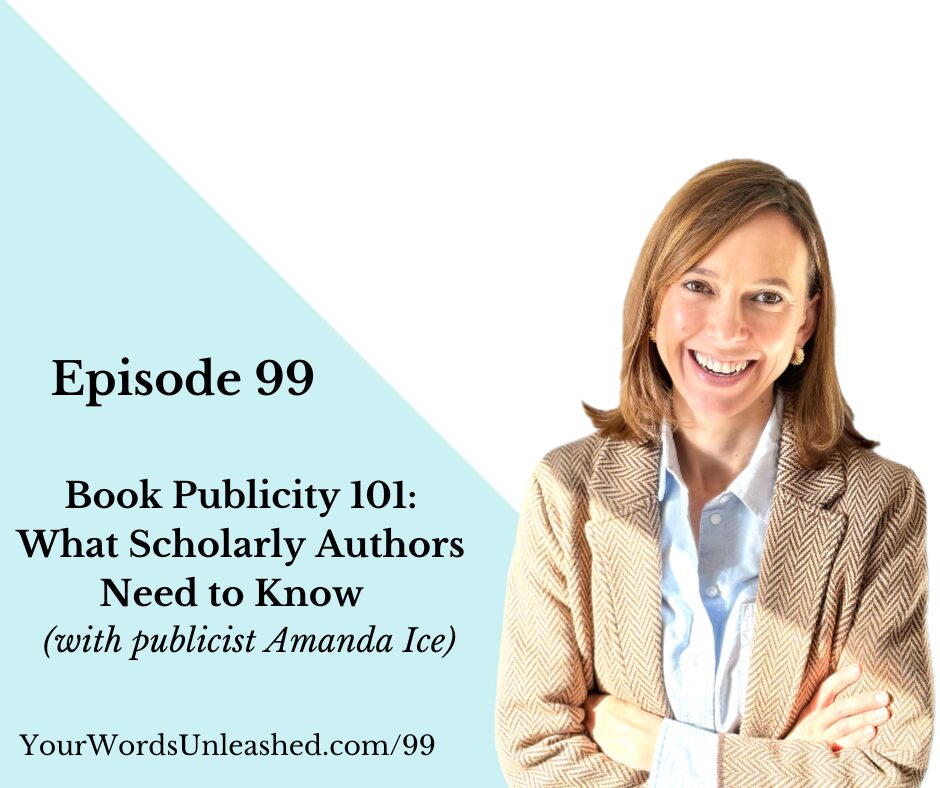
I am so happy to welcome Amanda Ice onto the podcast today! She’s a senior publicist at Harvard University Press (or HUP), with nearly 20 years of experience in arts and culture communications. Her career is rooted in book publishing with previous roles at Penguin Random House and across the architecture, design, visual and performing arts and media sectors.
At HUP, she secures national mainstream media coverage for books across major print and broadcast outlets. She crafts strategic publicity campaigns that connect authors and readers by translating complex ideas into compelling narratives. Amanda has led campaigns for New York Times bestsellers and for authors ranging from Supreme Court Justices and Pulitzer Prize winners to leading public intellectuals.
Amanda and I know each other in a pretty unique way. Our sons have been good friends for years and see each other pretty much every day at school, and ever since I met her, I wanted to ask more about the business side of academic publishing. I think most book authors and especially scholarly authors have no idea what happens behind the scenes when it comes to things like marketing and publicity. So I invited Amanda on to demystify some of this stuff and to give her expert insights into what authors can do to make sure people know about their book.
Amanda, thank you so much for being here!
Amanda:
Thank you for having me, Leslie. This is really exciting! I think it is really amazing that you’re offering this podcast to authors as a resource. I think it’s great. There’s so much that, like you said, goes on behind the scenes that people don’t know about, and I’m so happy to talk about it all.
Leslie:
Amazing. Let’s get into it, but first, can you talk about your trajectory through publishing and how you ended up becoming a publicist for Harvard University Press?
Amanda:
Definitely, happy to. So I’ve always been a book lover. I was editor-in-chief of my college literary magazine. I grew up in a family of big readers of literary fiction, history, philosophy, religion, things like that. It was kind of baked in to the family. So books are definitely my first love.
So after college, I got a job at Random House–what’s now Penguin Random House–in the publicity department. This was an incredibly formative time for me professionally and personally. And from there I went on to pursue other publicity and communication jobs within the broader kind of arts and culture space.
And then actually when the pandemic hit, I feel like this happens to a lot of people, some major shift in their life. I was actually working in public art programming at an arts organization here in Boston, and we were totally shut down. And a friend of mine from my Random House days–shout out to the brilliant, savvy Sonya Bonczek, who is now actually the publicity director at UNC press. She was at HUP at the time and they had an opening.
And she called and asked if I’d consider kind of boomerang back into the book world in a less commercial setting. And honestly, I was really excited to jump back in. I had a lot to learn about the differences between commercial and academic publishing, but it really felt like coming home in a way.
Leslie:
So interesting. I’m going to start with the kind of questions I have. I feel like I know a lot about books and yet I don’t know anything about the differences between marketing and publicity. I know there are differences. Can you explain them?
Amanda:
Sure. Absolutely. You’re not alone! This is kind of a question we get all the time, which I totally understand. It can be confusing. So first things first, I should say that today across most presses, the two departments are typically fully integrated, so marketing and publicity, and they really work hand in hand.
So oftentimes marketing is really amplifying the publicity that’s secured and we’re always excited to use their work to supplement what we are doing. At Harvard, I can say we have a really, really creative and talented digital marketing group that we work really closely with. But in the simplest terms, kind of a key difference to think about is publicity is what we call “earned media.” So you’re not paying someone to review your book or paying them to interview the author–although you pay for it in blood, sweat, and tears, so to speak. But marketing on the other hand, can encompass everything from advertising, social media, email campaigns. And all those efforts kind of typically come with a budget attached, but I will say it all originates from the same well, so to speak.
So finding creative ways to talk about and present the books to the right readers, but the methods and the channels are different. Does that make sense?
Leslie:
Yeah. As a publicist, what are the primary things you do for a book?
Amanda:
Yeah. So the way we think about it, at least at HUP, and I think this is common, after the book is done, it’s gone through all the editorial process, right? It’s totally baked. Everything is done. We sort of become the main contact for the author going forward.
So what we’re primarily doing is we’re trying to secure reviews and interviews for the author. We’re trying to help them place op-eds, help them work on op-eds, working with them to cut down excerpts to get those placed. So we’re really trying to get the book in front of the media with those methods, versus the marketing side of the team are doing kind of the fun social media stuff. They’re buying lists to do academic marketing. Their methods are a little bit different. We’re a little more front facing. It’s more personal. You become very close to your publicists. I have authors I’m talking with all the time throughout the campaign of the book, and I think that’s a little bit different some of the other departments.
We will staff them at events. We will be the person that kind of handholds through interview prep or goes with them to different events or different things, helps coordinate where they’re going to travel, things like that.
Leslie:
So, and I know through our conversations that you mostly work on trade books with some academic books in there. So can you talk a little bit about maybe some of the differences that might be part of publicity?
Amanda:
I know you’ve already talked to some people on the podcast about the differences in the way we designate books. So what kind of the differences in publicity is that I would say, we think of the really scholarly books primarily are driven by journal attention, right? We’re trying to get really scholarly reviews. We’re trying to advance the scholarship in the field through those methods. It can be a lot of trying to position the author as a particular expert in that field in hopes that their research could be tapped for a larger piece.
So kind of thinking almost beyond the book a little bit in that way versus on the trade side. I would say a lot of that is true too. We still do our seeking journal reviews and kind of academic attention for those books, but we’re going after more mainstream things. We’re really pushing, you know, think Wall Street Journal or the New York Times, Washington Post, we’re trying to secure those traditional types of reviews.
Some of the really scholarly books, they’re just not appropriate for that kind of audience. However, there’s a lot of other ways to gain visibility for them. So, it’s a lot about trying to find those more niche publications where they can do stuff, getting creative, trying to find, sometimes what we’ll do for really scholarly books is we’ll try to find another scholar and put them in conversation together and try to pitch that interview for somewhere so it can kind of broaden the audience a little bit.
So it’s just a matter of where we think the readers are going to find the content best.
Leslie:
And so, can you walk me through like a timeline? Because I know that a lot of scholars, they want to talk about their books, they want publicity, they want to market, but they have no idea how to approach it or when. So they do very little. And so is there sort of process that they can follow?
Amanda:
Definitely, definitely, definitely. So the truth is publishing is such a journey. Of course I think everyone knows. But sometimes I think authors, there’s a tendency for some who aren’t aware of the process as much to think that like, “Okay, great, my book is publishing in January. January one, I’m going to be ready to go and I’m going to be doing all these things.” When in reality, it really needs to start way before that.
So this is a little bit of a more complicated answer, but I do think it’s important. So I hope you’ll bear with me here. So, we typically meet with the authors as a publicist, whoever is assigned to the book, we usually are meeting with the authors about six months before their book goes on sale. But prior to that, we’ve been working on the book much longer than that. So we’ve been having internal meetings, planning strategy.
We’ve been probably at that point, pitching the book to our sales reps, our sales and distribution team. So we’re already really familiar with the book and we already kind of really have our teeth into it, so to speak. So that’s just something that you should know. But about six months out, especially if it’s a trade book or an academic trade book, we will have galleys at that point. For our scholarly books, sometimes we don’t print galleys. It really just depends.
And part of that reason is that if we’re going primarily after journal reviews for a really scholarly book, that’s what’s been identified. That’s what important to the author. That’s where everyone is identified. Then they don’t want galleys, they want a finished copy of the book. It’s really important, I think, for the integrity of the journal that they don’t want what we would call uncorrected proofs. So if it’s an academic trade and trade book that’s a little bit different.
We’ll have galleys, we’ll begin our long lead kind of media outreach. So we’ll want to be putting the book on the radar of major book editors.We’re going to be really pushing to get reviews in places like Publishers Weekly, or Kirkus, or Library Journal. These are all trade publications that really help us as we continue to go back to the media because these are what we call pre-publication reviews. So we’re chatting with people. We meet with the author, we kind of talk through their goals. We share our media list everywhere we’ve identified where we think the book would be of interest.
If events are something at bookstores that authors want to do. So this is a little bit separate than academic events. That’s also the time period that we begin that outreach. Because those calendars really fill up. So this is kind of where this is all happening. That’s at about the six-month mark that continues over the next four to three months. We’re really putting our pedal to the metal, trying to secure those reviews.
And then about two or three months out we shift and we start to focus on broadcast. So NPR or podcasts, TV, where it makes sense. And then again, this is kind of simultaneous in this process. We’re really trying to convert any interest we had at that six-month mark into confirmed reviews. And then I would say, about a month before the book goes on sale, and then about two months after is ideally when we’re confirming interviews, we’re sharing reviews that run. We’re really trying to amplify the coverage the book is getting and build momentum for discovery of the book. Now, like circling back to the more academic side again, journals want to finish copy.
So we might put the book on their radar and ask them to start thinking about who might be an appropriate reviewer for it. But they won’t want it till it’s a finished book. So we get finished books about a month before and that’s when we’ll start push mailing those out to the journals. Sometimes they’ll have a reviewer, we’ll send it. That reviewer changes their mind, we’ll send it to a different reviewer. So we’re working together for a long time. But as for kind of the crucial time that authors should really think about in terms of their own academic schedule and their personal schedule, like what’s the sweet spot?
It’s definitely a month before publication through about two months after is when we would really want you available for interviews, to do events, commentary if breaking news connects to a book’s topic, things like that. So it’s a long journey, but I would say if they’re trying to plan out their calendar, it’s really good to think about that three-month span, right? Or even four months, the month before, the month of, a couple months after. So that, can be really tricky. I know with a lot of academics when they’re teaching, they have committee commitments, things like that. So it’s something that your publicist will talk to you about early on, like, what does your semester look like, the semester that your book comes out, what does that look like for you?
So that’s something that they should really keep in mind as they plan.
Leslie:
Yeah, that’s super helpful. And you’ve mentioned things like interviews a lot. I know that there are a lot of academics, I think especially senior folks that move into writing trade books, right?
Amanda:
Definitely.
Leslie:
What are the biggest challenges you found in terms of academics? Being able to talk about their books and promote their books?
Amanda:
That’s a great question. That’s a really great question. I think the biggest challenge is that academia trains you to write. To talk about your work in a very specific way, right? And that’s just not the same language you would use to publicize the book to a more general audience beyond your field.
So breaking out of that mold can be really difficult, and I completely understand why there’s a lot of training that you spend going into that. There’s a lot of years. I totally understand that. But, there’s often a lot of jargon that needs translating. Answers can tend to be a little bit more long-winded. I think in a more academic setting, because people, they understand the content already. It can be more detailed versus in an interview or an article beyond your own field that will have to be a little bit more concise, a little more efficient, you know, kind of the economy of language, so to speak.
Another thing that I see as a challenge, especially with historians, which we work with a lot of historians is a hesitancy to connect their work to current events. Which I also get, you don’t want to oversimplify or force connections that aren’t there. And again, it goes back to their training. Like so many historians, “we don’t have enough evidence or time, I can’t comment on this, there hasn’t been enough time.” And again, that kind of goes back to which I totally get. But sometimes those bridges to the present moment are exactly what makes your work resonate with a broader audience, with a trade audience, and it’s going to bring attention to your scholarship.
So for publicity, a news hook is like our bread and butter. We’re always looking for a news hook. But something that I, I think might be helpful to point out here too, in terms of those thinking about moving over to a more trade like style book. And this goes same for doing interviews in that same way. Is that something that I come back to? That was really a kind of a revelation when I first started working in this space, is that most academics are teachers at heart and I love that about them. And I like to remind scholars to think back to their undergraduate teaching days, you know, how would you explain this to a room of curious 19-year-olds who don’t have any of your expertise?
And sometimes when I have found that, when I frame it that way, it’s really helpful. And I’m, I’m so pleasantly surprised how they can kind of make that mental shift a little bit and understand.
Leslie:
That’s so interesting because I feel like as a book coach, that’s exactly what I’m trying to get my authors to do in their writing.
Amanda:
Yes.
Leslie:
Oftentimes, I think, especially like new authors, like junior scholars, everything is jargon. And they don’t even know that it’s jargon because they assume everyone knows these really specialized terms. And so I’ll be like, tone-wise, “maybe it’s better if you kind of shoot for that 19, 20-year-old undergrad who’s taking your class because they’re curious about the topic, but they are not an expert by any means,” there’s pushback on that sometimes.
Amanda:
I know it’s really hard to break out of that, and it is such fundamental training. And the other area that I see it come out in actually is events. So a lot of times, with scholarly books, there’s a tremendous amount of academic events that we’ll do, which are great and it’s a great way to get attention for the book. Kind of like built in audience, but on the academic trade and trade side. And when we’re doing bookstore events. Or if we have even a scholarly author who really wants to do a traditional bookstore event for the public, I’m always, and we’re talking about who they’re going to be in conversation with, right?
Because I always say it’s, you know, “you’re not, this isn’t your novel. You’re not going to stand up there and read it, and that’s going to be the event. You really do need to be in conversation with someone that really gives you a more dynamic event.” But I’m always saying to them, and I can say this after being at a lot of events that have not gone well, which is that number one, you cannot pick someone to be in conversation with who’s right in the center of your field. Because what happens, and I’ve seen it happen so many times, is that although they’re a good colleague, so there’s like a natural rapport, which is really critical and important. It gets inside baseball like immediately, you know.
The conversation starts. I look over at the audience, and the public audience, and they have no idea what’s going on. So I always have to tell them, “okay, you’re going to do this event. You have got to start at the basics. You have got to have someone that’s maybe like familiar with your field or on the outskirts of your field, still someone you know personally, but who’s really going to help you remember kind of that you have to, you have to think of that sort of undergraduate class to really get those ideas across.”
It’s really critical and it’s not a dumbing down. I want to make sure to say that that’s not what it’s about. It’s about making connections, right? It’s about planting those seeds and really getting people to feel confident enough that they can invest in this scholarship, that they can understand what’s going on.
Leslie:
Right, right. Yeah, no, I think that’s so useful and people need constant reminders of that. but I think it can also be, I don’t know, I think for some academics, the idea of simplifying can feel risky.
Amanda:
Absolutely.
Leslie:
Whereas it’s really about clarifying your ideas, right?
Amanda:
Yes. That’s such an important distinction, yeah.
Leslie:
So yeah, definitely. Let’s push back against this idea that like simplifying is dumbing down. I mean, simplifying is opening up.
Amanda:
Absolutely. And I believe people want to stretch, you know? I think that people do want to be challenged. But again, it’s just the way we want to get the book reviewed or get someone in. You have to kind of get your foot in the door. You have to make people feel like it’s something that’s accessible to them.
So I think it’s such a good point that you make Leslie about the kind of idea of simplifying versus clarifying, which is really an important, I’m writing it down. It’s an important distinction.
Leslie:
Yeah, no, that’s when I get on my soapbox. It’s all about that particular point.
So when it comes to what authors can do to get their books noticed, what do you always suggest for people?
Amanda:
So what a question! This is a biggie. This is a big one, so I want to say, you know, if one of your goals is really wanting a lot of big attention for this book, you want it to go beyond your particular academic community. You really see this. You have ambitious goals for it. I would say first things first, beyond all marketing and publicity efforts. What your book is arguing or proving is the number one way it’s going to get covered. Are you writing something significantly new and groundbreaking? Is it controversial? Is it a landmark study? That foundation matters enormously.
The second part of that is that it really does go beyond the book itself. Authors need to realize that. Their platforms and reputations are critical. So often who you are is what brings people to the content. So even before the book comes out, they need to really start thinking about raising that profile. And, and one thing I always say to people, that means saying yes.
That means saying yes to things. You know, publishing opinion pieces, accepting more speaking engagements, making genuine connections in your field, being social, going to cocktail parties, spreading the word. Have you been asked to be a panelist on a book event? Say yes. Have you been asked to blurb a colleague’s book? Have you been asked to review a book? Definitely say yes. If these are things you’ve been declining, opportunities you’ve been declining, it’s time to turn that around because this is absolutely a two-way street, and it’s such a competitive space. There’s so many books out there, you know, and it’s really, it’s really difficult. So these are what I would call the foundational things to really start thinking about.
The other essential thing is to stay engaged with the book media landscape. So sometimes I’ll have authors, “this book needs to be reviewed, you know, I know it, it needs to be reviewed at this outlet.”And my first question is always, are you a reader of that outlet? Have you read those reviews lately? Do you kind of clock who’s writing those reviews and where, and by whom your topic is really being discussed right now? So understanding all that allows you to work more collaboratively with your publicist.
And that can make all the difference, because the more informed you are, the better way we can position your book. So I think it’s really important to educate yourself about that. So think about your media goals. Even sometimes we’ll have scholarly authors who will say, well, give me a huge list of journals where they want their book reviewed. And we’ll start to do our research on them and half of them don’t even do book reviews! So think about if you’ve got goals and ambitions or expectations for your publicists, for your marketing department. You’ve got to come to the table with some knowledge about it. Otherwise, I don’t think it’ll be as good of a process if you don’t.
It’s just a way to let you know the expectations can kind of be too high, or maybe they’re not the right way. And it’s something that’s really important to start to think about. But just, the idea of saying yes is really, really important.
Leslie:
I know. And that’s a tough one because I feel like in academia, everything is about saying no. Like what can I say no to? What can I take off my plate? Because there’s like 50 trillion things that are competing for attention. And the things that people typically say no to are the ones that don’t get them promoted or they don’t count towards their record.
That includes things like interviews, public engagement. And so, how do you kind of break people out of that, mindset?
Amanda:
Yeah, it’s really hard. Unfortunately, it’s difficult for me to break them out of it, right? Because by the time they’ve come to me, they already should have done it. They already should be, you know, at that place. And again, sometimes we’ll be working with someone and let’s say it’s not their first book; we’ve worked with them before and so we’ve had a little time to really think that.
But it also sort of ties into social media too. Social media is a question that comes up a lot. And I so many times have authors say like, “I hate social media, but I’m going to do it for the book.” And what I say is that the number one rule to remember is social media inherently is driven by organic content and organic engagement. So if you have never been on BlueSky or Instagram or Twitter and you create account solely to promote your book, this is not going to work. It takes a lot of time and effort to build up a social media presence. I mean, we’re talking years and it can feel like a full-time job. It has to be authentic. It has to be engaging. And you really have to put in the work to build that community there so that when you do have something to promote, then that community is going to rally around you. So having said that, if it’s not something you’ve done, then I would say put your efforts towards something else, right?
So your publisher will have great social media channels that will be robust to promote your book, but there’s lots of other ways to build the visibility. So forcing yourself to do something you hate rarely has good results. So I think, again, if it’s just not something that you can do, like you’re not in a position to say yes to all these things, then that’s just something to be upfront with your publicist about. But also be upfront with yourself about. Like, “okay, I haven’t been in a position, I’ve been saying no to reviewing books or blurbing books, or doing these things. Now my book’s coming out.” Again, it doesn’t mean your book’s not going to get any coverage, but it’s something that you need to be honest with yourself about.
It’s just, it’s a really crowded, competitive space. The scholars whose books I have seen do the best in the mainstream media and the scholarly community who have gone on to be pundits. Even those people kind of were already naturally like a self-promoter. They were doing things, were saying yes to stuff, so they kind of have a leg up for sure. But it’s not to say if your scholarship alone, again, going back to like, it all kind of starts with the foundational stuff. If the scholarship alone is so good and the book itself, the content is great, the cream is going to rise to the top. But it’s just something to think about. We’re always looking for an edge, a way to get our foot in the door.
So really it’s something just to think about. And sometimes authors, their books are for different purposes, right? Some people are academics, but they really want to be an author. They want to write many books. They want to do this. Some, I feel like I’ve found they kind of have to do it for tenure. They have to do certain things. So again, it just comes down to what your goals are.
And so I think if you’re in that first category, you’re an academic, but you’re also just really consider yourself a writer and want to go on to write a bunch of books. This is advice you really need to listen to about this kind of community building and like really thinking about saying yes to things and putting yourself out there, building your connections.
Leslie:
Yeah. Yeah. Yeah. I mean it really is about engagement, right? The goal of many people’s first books is like, “I just have got to do this because this is going to secure me tenure.” Other folks–I think I was in this camp when I was writing my first book–was if I’m going to put this much work into something, why wouldn’t I want it to go beyond the academy? And I took a totally different approach. Like a much more storytelling style. Like, I had to do all the things to make it scholarly, but I wanted it to ultimately not just be limited.
But that said, I did not have any goals for publicizing. Nobody walked me through these steps, so–
Amanda:
Yeah, well, hopefully this will be useful to other people that were in your position.
Leslie:
For sure, and I think also considering the fact that I think a lot of scholars get into this mindset of like, “this is my book” versus “this is the first of my books.” You know, so “what do I want if this is one of a series?”
Amanda:
I totally agree. From, again, demystifying things like from a sales perspective. And I know this because publicity is oftentimes very involved in the communication and the presentation to the sales force who’s actually like, boots on the ground selling the book to the various channels, to the indies, things like that. Something to think about is that oftentimes we’re looking for comp titles, we’re looking for metrics. So we’re looking for other books that are similar to see where they sold and how they did and what that author did.
That’s another piece of it. Like a lot of times authors get, so I find scholars especially like they have been in this world. They’ve been in the archive. They’ve been living in this kind of siloed space with their book and believe in it, which is important. And we believe in it, but sometimes it’s important that they open up a little bit and also see what are other people saying and argue what other books are about this. And it’s not to be critical of the scholarship, but it’s just to have an awareness so you can set your goals. And I think we oftentimes have scholars, which is really helpful to me in publicity, who we often ask them to list books that they think are similar that they would compare them to.
We do our own kind of work on that side, but we kind of want to know what they think too. And what is really helpful to me is I have scholars, you know, who I give a gold star. who are often like, “here’s this book and this is how my book is different from that book. This is what this book was doing.” And they’ve read them all so they know. And I think that that’s really important to, again, it just triggered me when you said that thing about like my book, it’s something that I totally can empathize with. You work so hard on it, it’s your work, but it’s important to really think about it in a bigger landscape too.
Leslie:
Oh, totally. Yeah. Like where’s my book going to be, placed on a shelf with other books. Will someone purchase my book? So I think, yeah, I think also reminding folks how crowded the marketplace is.
But I think also like how crowded people’s minds are. Like, there’s so much information there. So what is it that’s going to make your book stand out from every other temptation?
Amanda:
That’s it! Yep. That’s it. It’s a big process to get someone, we get siloed in our own way and publicity about getting that review and getting that interview. And what we also forget about sometimes is, it really takes a lot to get people to read about it, hear about it, be interested, and then to actually ultimately buy that book. It’s hard.
Leslie:
Yeah. Yeah. So, in my research on publicity, I’ve now learned that there are sometimes academics who hire outside publicists to help them. So how does that work and how does that work in conjunction with the work that you do at the press?
Amanda:
Yeah, this is a question that also comes out a lot, so I’m so happy that we’re going to talk about it today. And I have to say it’s a bit tricky. And I’ll say it’s really case-by-case basis for a lot of reasons. So let me try to break it down a little bit. So here’s how I think about it. Both an outside publicist and your in-house publicists are working towards the same goal.
So typically I say, you know, the more the merrier. Because it’s become increasingly difficult to get books coverage. So having another team member can genuinely help because they might have stronger or more different contexts. They might have just a fresh idea about how to pivot the pitch if something’s not working. I think all hands on deck is a good thing. Again, it’s like we’re just really trying so hard to get that coverage and it’s coming increasingly challenging.
Especially if your ambitions for the book are really high when it comes to national media exposure. So I’m thinking again, to that author that’s like, “I want a New York Times review.” You know, if that’s kind of where you’re thinking, again, then that can be helpful. Outside publicists also I think are incredibly valuable if they specialize in your field. So there we have worked with ones that specialize exclusively on religion or music for example.
And that kind of expertise is really helpful because it can really supplement the work we’re doing in a more significant way. That said, outside publicists are really it’s a significant financial investment. Like it really is. So you have to be honest again about your book and your goals. If the book is solidly academic and really is not something where there’s a trade potential and you’re not concerned about any of that. Like you really want journal attention, you want academic talks, different things like that and you don’t really envision a main street audience, then you’re going to be fine with your in-house publicist for sure.
And even the trade books. There are truly fantastic university press publicists, so it’s really not something you have to do. What’s tricky, and this is something that I hope is good advice for really practical, kind of pragmatic advice here is that an outside publicist will work on the same timeline that we do. So they want to have the contracts, they want to begin working with you six months before publication. So that becomes really tricky. Because sometimes you haven’t met with your in-house publicists yet. It takes time to have those conversations with the outside publicists and get on their calendar, figure out their right fit, that kind of thing.
So if you’re thinking about it, I would say to ask your editor really early on, like really early on, kind of even nine months to a year before and chat with them about how is the publicity team structured? Because sometimes there are some university presses that have huge lists and a really small staff and in those cases, I think outside publicists can be really helpful. So chat with your editor about the structure of the department, and also ask them to connect you with someone in publicity for an informal chat really early. And so they can kind of help guide you, does this make sense for your book? Because we, again, we all have the same goals and they’re definitely going to give it, they’re going to give it to you straight.
I actually have a call like this next week for an author way down the road, whose book I’m not, going to connect with them yet on their book, but they’re thinking about it. And so I want to make sure. That we connect so that they can begin having those conversations to make the decision. The scenario you don’t want to get into, because again, the investment can be really high, is that you meet with your book publicist six months before and all of a sudden you hear from a colleague that you should really hire an outside publicist.
You start to chat with people and then it’s like three months before your book comes out and you’re like, “oh, I’m going to do it” and it’s too late. A lot of those publicists won’t sign on because they can’t do their work efficiently. Or some would, but it won’t end in the kind of result that you want. So that timing is really tricky and I do think it’s something people won’t talk about as much. And I really wish they would because again, we’re really open to working with outside publicists.
And so I think, again, if we’re going to do that, we want it to work well too. So that timing is critical in terms of how it works at the press. Again, totally case-by-case. Like I have worked with outside publicists who have really big trade experience that really want to take the lead on a project. And so then we kind of work in tandem together. But they’re doing a lot of stuff. I have some that really just kind of supplement the work we’re doing. But we work really closely and we’re very welcoming to it. So we kind of think, “oh, they’re just like, there’s another member on the team.” So we support them. There’s never any kind of territorial things going on.
I think that’s an old preconception about how those things work. But in this marketplace, in this era where email is so saturated, where there are so many books out there. We’re no longer worried about that. We’re like, if someone gets two emails about your book, that’s fine. So it’s definitely, we welcome it. It’s something that I think is fine, but again, it’s not something you have to do, but it’s really something to kind of a conversation you might want to begin to have as you think about your goals early on.
Leslie:
Yeah. Yeah. So I think moral of the story is you need goals around publicity. Really clear.
Okay. So just a final question for you, what thoughts do you have or suggestions for authors in terms of what you want them to know about their publicist or publicity team?
Amanda:
Yeah. So I think what I really want authors to know is that getting book coverage these days is really, really hard. Every day I get another email about a book section closing, a reporter leaving, a show shuttering. And if you’re publishing with a university press, you’re already up against stiff competition from the commercial nonfiction that’s out there. So we’re constantly pushing a rock up a hill for coverage and we do a great job of it. I will say there’s a really strong university press community out there. Publicists from, I’m always clocking what other publicists, what attention they’re getting for their books. Like we do a really good job, but it’s not easy and it’s certainly not without its challenges.
So I think what’s important for authors to know because I know sometimes there’s been frustration. I’ve heard it from various authors. You have got to understand that your publicist wants all the media. They want all the media for you. There’s nothing that you want that they don’t want to they want it for you, your scholarship. They want it for their own internal capital. It’s really important. So they are always working towards that, and they have your best interest at heart. Sometimes that work is invisible though, so it’s happening a lot behind the scenes. So just because you don’t see every pitch or follow up does not mean it’s not happening.
And just know that we’re in your corner always. And something that I like to do when I meet with authors is I say from the beginning, “the best success that we have with your book from a publicity standpoint is when we work collaboratively.” So when you’re engaged, when we’re brainstorming together, when I’m sharing materials with you and you’re writing back, when you’re engaging your contacts, you have to realize that like, we really need your help as well.
And I think that that’s something, I always say just because you’re at Harvard, for example, which we have such a tremendously talented group of publicists and a really great strong creative marketing team. But it’s not a machine where you flip on a switch and the author gets to sit back and watch all this come together. It really takes your involvement. And that’s not because anybody’s not working hard and not doing their job. That’s just the reality of it.
Leslie:
Okay, so goals and collaboration.
Amanda:
Yes.
Leslie:
Big take homes. Awesome! So Amanda, thank you again so much for being here. What are the best ways for listeners to connect with you?
Amanda:
Yeah, I mean, I think email’s probably the best way for me. So I’m just Amanda_ice@nullharvard.edu and I’m always happy to answer questions. Again, the university press community is really such a lovely community and I think everyone really wants to help each other. So I’m happy to answer any questions, connect people to anyone. So that’s probably the best way to reach me.
Leslie:
Cool. Cool. Thank you again for being willing to answer all of my questions about publicity works. I think that this has been so helpful both for me and folks tuning in. So thanks again and I talk you all again soon!
**If you enjoyed this episode, make sure to also check out:
Ep. 28 – 6 Ways to Promote Your Book
Ep. 64 – Publishing with a Trade Press: Is It Right for You? (with Dr. OiYan Poon)