
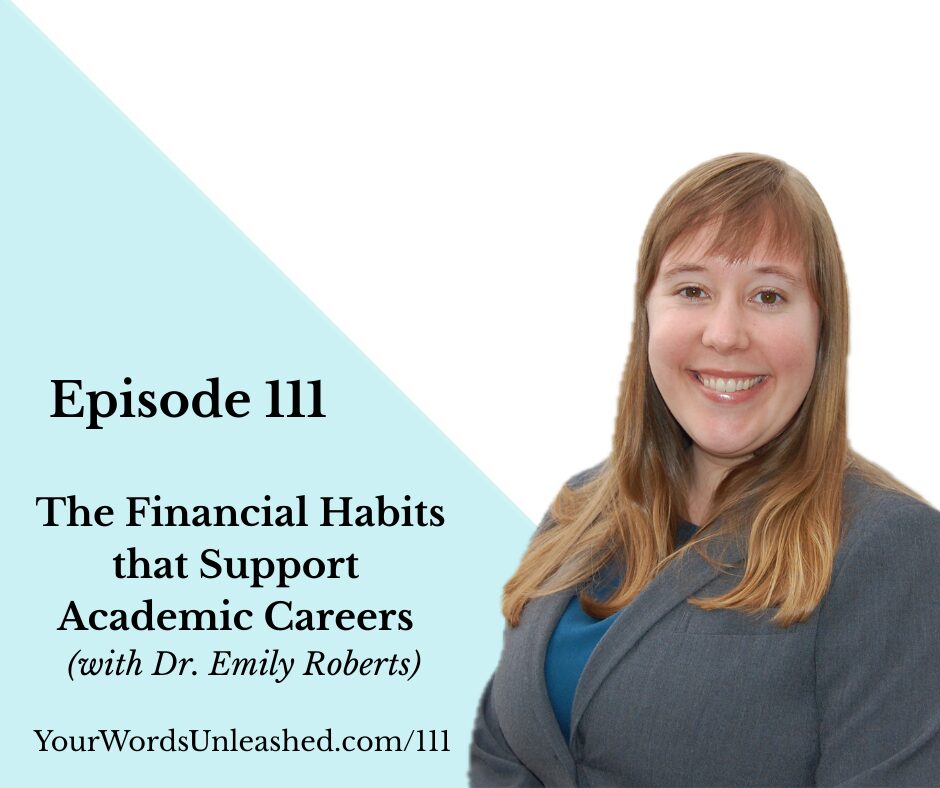
This episode will help grad students, postdocs and PhDs learn financial habits that will support their careers in the academy.
Leslie:
Today, I’m happy to be speaking to Dr. Emily Roberts!
Emily is a personal finance educator specializing in early career PhDs. Through her business, Personal Finance for PhDs, she equips graduate students and postdocs to make the most of their money. She gives seminars at universities and for associations, interviews graduate students and PhDs on her podcast, and creates courses and workshops on taxes, investing, and more. Emily holds a PhD in biomedical engineering from Duke University and lives in San Diego with her husband and two children.
So I first met Emily back in 2022 when I appeared as a guest on her excellent Personal Finance for PhDs podcast. At the time, I was still in my faculty position and taking serious steps to become a full-time coach. When she interviewed me about building my business, I didn’t even know that I would be leaving academia just a few months later. Then we reconnected again just a few months ago when I appeared on her podcast a second time to give an update about my business and approach to finances now that I’m almost five years in.
I really believe that financial literacy is one of the most important skill sets that academics can have, but money can be an extremely taboo topic that many people try to avoid thinking about altogether. Junior scholars in particular need to learn how to handle their finances, and since Emily specifically helps grad students and postdocs, I thought it would be great to talk about financial habits that can set people up for success throughout their careers.
So Emily, thanks so much for being here today!
Emily:
Well, thank you so much for inviting me. It’s great to be a guest after having you on my podcast, and I’m really looking forward to this conversation.
Leslie:
Me too. So can you describe your journey through academia and how you decided to become a full-time personal finance educator?
Emily:
Absolutely. So let’s see. I graduated from college, and I did a one-year post-bac fellowship at the NIH because I knew I was heading into graduate school with a slight field change. And basically, that was like the first time that I was living completely independently. You know, financially independent from my parents, receiving a stipend that was not all that generous in the DC area, relatively high cost of living area.
And I’m very responsible. Like, I’m an oldest daughter. I have that personality. And so I kind of knew, like, “Oh, wow, I have this sort of paycheck coming in. It’s not very big. I have no idea what to do with this.” My parents had never really intentionally taught me anything about money, budgeting, or anything like that, and so I sort of embarked on a journey of self-learning in this area, reading books and so forth. And so I started learning about money at that time, continued on with my PhD at Duke. And kind of about halfway through that, just this area was growing in interest for me, and I started blogging about personal finance. This is back during the Great Recession when blogging was, like, the thing.
And so I kind of realized through doing that, that whenever I wrote about financial topics that were specific to graduate students, those posts were getting Google Search traffic that my other posts were not getting. And I was like, “Oh, wow. People are seeking out this information, and they’re finding their way to my little, tiny, nothing blog. So there’s clearly not great resources out there for them if they’re finding their way to me.” And continued on in that vein until I defended.
And I knew that I wasn’t going to continue in academia in terms of a faculty position. That was never my goal. I had explored some other career options. “What can I do with this PhD?” I was interested in some other areas, but simultaneously, this interest in personal finance was growing and growing. And so after I defended my PhD, I volunteered to give a seminar on personal finance for graduate students at my university, and I just had the best time preparing it and delivering it and answering everybody’s questions.
And I was like, “How do I make this my job? That would be amazing if I could do this as a career.” And so after lots more experimentation and learning from other people, I figured out there is such a thing as a professional public speaker, and universities have budgets for professional development to bring outside people in. And so I kind of put those things together and started Personal Finance for PhDs. So for more than 10 years now, I’ve been giving these workshops and seminars and so forth for graduate students and postdocs sponsored and facilitated by the universities. And yeah, I’ve grown a lot more in my understanding of personal finance and how it applies to this population.
But yeah, basically, I was in academia for as long as it took me to get a PhD. And I have been out since then.
Leslie:
Okay. That’s a really interesting path. And so I’m curious, at the time when you were a graduate student, what was it about finances that you found interesting?
Emily:
What I found interesting about talking and relating with other people about finances is how revealing how you use your money is about who you are and what you value. You can really actually get to know someone’s priorities if you look at how they’re using their money. I find that very, very interesting. And I also find that it’s an area of great potential for self-empowerment, yet that potential is not often realized, especially in our community, right? And I’m sure we’ll talk about that today. So, like, having control of your money to the degree that it’s possible, putting your money where you want it to go, that can give you a lot of agency in your life.
And what I found very interesting … I’ll just take as an example my own transition as I was just talking about, kind of out of academia into this world of self-employment and so forth. So I’ll back up. I’m putting these personal finance practices and stuff into place during the time that I was in graduate school. I also got married during the time I was in graduate school. My husband is also a PhD. We defended at the same time. And so we were living on two stipends together in Durham, North Carolina. And so we were saving and investing kind of a lot for graduate students as those things go.
And by the time we defended, we had a combined net worth of over $100,000, which was a lot for that stage, right? And what I didn’t realize, that’s all kind of good if you’re just looking at numbers. That’s a milestone, that’s cool. But what really mattered is that having that nest egg, those investments, the cash savings, the lack of debt that we had at that point, it enabled us to make that post-PhD career transition in, I think, a really fulfilling way. I got to take a pay cut from what I would’ve been doing, had I gotten a regular type of job with my PhD and continue on the self-employment path, which I obviously find very fulfilling and the income increases over time. My husband similarly probably was going to go for more stable positions, I would say, but he ultimately was hired by a startup, a biotech startup, where they were doing exactly a great application of his PhD research.
He really got to stay in his same research area, which he loved, and it was so rare to find that. Going into a startup, we would’ve been really nervous about that had we not had any emergency savings to weather an unemployment situation, right? So having that financial nest egg enabled us to sort of go for it, like in both of our careers. And I just want that for all PhDs who have put so much into their career development. Wouldn’t it be a shame if your finances were the thing that was holding you back from your dreams, right? In your career and in your life. So that’s why I’m so passionate about this subject.
Leslie:
Thanks for sharing that. That’s a super empowering story, and I do think finances are the thing that holds so many people back.
So what do you think is unique to academia when it comes to financial challenges? What do your clients struggle with the most?
Emily:
Okay, first and foremost, it has to be said that academia itself imposes and teaches you unhelpful mindsets regarding money. Whether they’re true or not, I don’t know. That’s for you to judge. But some of these mindsets can be really hindering when it comes to managing your own money. And that’s mindsets around well, money is evil or money is beneath you, right? You should not care about money because you have these lofty thoughts or whatever. It certainly involves limiting beliefs around how much you can make and what you can do with that and what kind of lifestyle aspirations you can have.
Certainly involves scarcity mindset. I want to draw a little bit of a distinction here because scarcity is real in our world, in academia, in funding. It’s absolutely real, and sometimes limits are real, and sometimes we have things that are higher priority for us than money. All those things are true, but the real external, like in the world barriers that you face to having success within your money can be compounded by having a negative or unhelpful mindset.
So at least working on your mindset to be more empowering around money can help you to navigate around or overcome or avoid those actual real barriers that you face. Does that make sense? Because just quick example, if you believe in scarcity everywhere and always, you’ll never apply for funding. So like you have to have a mindset that like it’s possible for you to win that grant or win that fellowship or the award, whatever. You have to have that mindset to even try to be successful in that area, even though scarcity is real, right? So like you have to kind of balance those things.
Leslie:
And I think also on top of even trying, I think sometimes people try, but they don’t try 100%. And for example, when I taught at UMass Boston, there was an internal grant of $7,500 that most faculty were sort of guaranteed every three years. And I remember there was a senior faculty member who told me she had applied for this, but she asked for something like $6,500. And I asked why she didn’t ask for the full amount, and it was something like, she didn’t want them to think she was greedy or asking for the full amount meant something about her character. And it never had crossed my mind to not ask for the full amount.
So it seemed like it was more about worthiness in that moment. And I think that that can also be one of the limitations that academics can face when it comes to finances. What do you think?
Emily:
Absolutely. Totally agree. Even just keeping within that area of applying for funding. Yeah, if you don’t have confidence that you’re a good contender for that award, like you’re not going to put your hand up, you’re not going to put your name forward for it. And actually, I had a really interesting interview with Dr. Sam McDonald on my podcast several years ago, who at the time was a graduate student at UC Irvine. And she talked about how based on sort of some snide comments and chatter from her peers in her program, she actually started self-limiting on what she was applying for. Because she was winning all these fellowships and grants, and she had all this funding. And she started thinking and sort of hearing from people like, “You shouldn’t apply for more. You already have enough.”
Her advisor had to really guide her through that moment of convincing her that it was still worth applying for more. Even though she, sure, she was funded enough, but like the awards mean more than just the money. Like the money is great, but also the CV enhancing is great and it was really important. And so her advisor had to kind of guide her to not listen to the voices around her that were discouraging her from applying for funding.
Leslie:
And sort of the mindset of if you take too much, it’s taking away from others, like a zero-sum game.
Emily:
Yeah, and it’s interesting because, like, that’s legitimate sometimes, but also not because the pie can expand and does expand at times. So yeah, there’s a tension there.
Leslie:
Yeah. So when it comes to mindset, how do you reframe some of the scarcity mindset or some of the limiting beliefs?
Emily:
So I think it can be about breaking out from the sort of circle of voices that you’ve been listening to and expanding your mind and the realm of possibilities. So like listening to other people, maybe it’s even in a slightly different field, something adjacent to your own that have a more positive mindset about this. So yeah, having other voices around you, looking for counter examples. If you think you have this limiting belief about something, challenge yourself to find an example that counters that limiting belief. Because if there’s one exception out there, maybe you could be the next exception, right? And specifically in the area of money, I would say following, listening to people who are not in academia.
Okay, so I’m like a bridge for you, right? Like I talk about money, but my audience is academics. But even going beyond that, finding other authors or creators within the realm of money that, are inspiring to you, that you relate to in some way, who are not in academia, and listen to them. I think this was really transformational for me in my own journey because I, again, was reading books and consuming content, not specific to academia within money at all. And it totally taught me about things I didn’t know anything about, like about entrepreneurship. Like I was not getting exposed to that in my graduate school journey and so forth, so it can really open your mind to other possibilities.
So yeah, getting other sources, finding counter examples. And honestly, like at different times in my life, I’ve used like affirmations. Like some people think they’re really cheesy. I think they’re kind of cheesy, but I also think that they worked for me at different times in my life. So just like doing a little bit of that self-talk of pumping yourself up and encouraging yourself to go after, naming what you really want and encouraging yourself to go after it.
Leslie:
Oh, for sure. For sure. And I think that question of “what do I really want?” is one of the most challenging ones for maybe anyone to answer, but I think especially academics where it feels like there’s always a ceiling on what you can want. And when it comes to things like affirmations—I credit affirmations with much of my success in the first couple of years of my business because I had to instill certain new beliefs around what was possible so that I could actually have some milestones to work towards that felt really inspirational to me. They didn’t feel like pie in the sky. They felt like if I was able to do that or feel that or be that, I would be so pleased with myself, and listening to those over and over again made a huge amount of difference for me. So I second that.
So thinking about grad students, I think a lot of junior scholars really put off dealing with money until they have a, quote-unquote, “real job.” And that was 100% where my mind was at when I was a grad student and a postdoc, honestly.
So what do you think that grad students can do now to start instilling good financial habits even though they don’t have a ton of money?
Emily:
The first thing would be: if this is an issue for the listener, pulling your head out of the sand. Don’t do that ostrich behavior anymore, like really face up to what’s going on in your finances. And there are a couple like specific ways you can do that. One is to create a balance sheet. So a balance sheet is like a written record of point in time record of all of your assets, which is all the things that you own. So that’s like balances in your savings account, your checking account. If you own a car, like the value of the car investment account balances, those kinds of things. And then all of your debts or all of your liabilities, all the current balances on those. The credit card balances on any given day car loans, student loans, medical debt all the kinds of stuff on that side of the ledger. So you kind of put that together, and the sum of all of your assets minus the sum of all your liabilities is what’s called your net worth.
And the first time you do this it might be a little unpleasant or scary especially if you haven’t been looking at all these components together before, because you may find that you have a negative net worth. That is really common for people who have student loans, right? Super common. And even if you don’t have student loans, if you’ve been very tenuously funded during your graduate journey, you may have racked up some credit card debt or something similar to that. So it’s really common to have a negative net worth or a very small positive net worth at that stage of training. But you know, it brings me back to this phrase, this is a common one, “What gets measured gets managed.”
If you look at this and then you have a little bit, again, just raising your awareness. “Okay, how could I increase this account balance just a little bit over the next year?” “How could I decrease this debt outstanding by a little bit over the next year?” So looking at that full picture. It can also be really great if you have forgotten about any of your accounts or debts or anything. Like just having this one time where you really look hard everywhere. All the little nooks and crannies and corners of your financial world and figure out, “oh, okay let me pull this over into an account that I use more commonly.” Or “oh, I forgot about that debt and I really need to just erase it. It’s tiny.” I don’t want it to go into judgment or anything. So kind of an awareness of all the balances going on in your life.
And then I would say tracking spending is pretty important for a graduate student or a postdoc. Anyone living on that like constrained income relative to the local cost of living. I think it’s a rare person who can get through graduate school in good financial shape without some intentional practices around tracking and budgeting and so forth. But the good thing that you can use kind of like tracking or again, awareness around your finances during graduate school you can start to determine for yourself what you value. Like what do you really want to have in your life? What do you prioritize spending money on? And even if that’s not something that you can totally fulfill on your graduate student stipend or your postdoc salary, it can give you an idea of where you want your spending to go in the future.
So I’ll give you an example. When I was in graduate school, again, I lived in Durham, North Carolina, which is like sort of a medium cost-of-living area. But my husband and I determined that we wanted to move to Southern California, which is where I live now. So that would happen at some point in the years to come. And so I kind of knew “okay, to have the kind of life in suburbia in Southern California that I want to have, I know it’s going to be really financial challenging because it’s such a high cost of living area.” So I kind of knew like, I’ve got to be on my game financially to make it in a high cost of living area like that. So that kind of helped me look forward to being like, “okay, all this budgeting and saving and stuff that I’m doing, there’s a bigger vision here, which is being able to move to this high cost of living area.”
So kind of sorting out what you value. Do you value travel? Do you value your living space more? Maybe it’s privacy or having lovely surroundings, or maybe you really value spending time with your friends and family, and you’d love to express that in a certain way. You can’t do that right now during graduate school because you don’t have enough money. But later on, you want to spend on being able to spend time with your friends and family. So you can kind of start to figure that out. Even if you can’t have a full embodiment of all those priorities at the moment, you can start looking in that direction and figuring out what you want to do later.
And then the other thing that you can do, no matter kind of what amount of money and level of expenses you have, is you can set up the structure of your finances to support what you ultimately want to have happen with them. So for example, if you do not have a savings account, I can almost guarantee you’re never going to save any money because it’s so difficult to build up a balance in a checking account. Again, very rarely will a person do that unintentionally, right? So like if you want to eventually have savings, open a savings account. Even if you can only put $5 in it in the first month, that’s okay. Like you have that structure there so that you know, “hey, whenever I have the ability to save money, boom, there it goes. Easy transfer right over there. I already have it set up.” Similar with getting started with investing. If that’s possible for you early on, open that Roth IRA or similar type of tax advantage retirement account.
Even if you can’t put that much money into it or can’t do it on a regular basis, having that structure there means that at the point when you are ready to invest, you’ve already made some decisions. You already have a brokerage firm that you’re working with. Maybe you already have investments chosen, like a certain index fund or a target date fund or something like that. You’ve set yourself up to be able to really accelerate your growth in those areas later on when you’re more able to because you’ve sort of done that pre-work of setting up the structure. I love automations in your finances. Automate as much as possible. That can help a ton. And of course, I already mentioned budgeting. You can start budgeting even if you have, you know, a very low income.
Leslie:
Yeah, I think those are all great suggestions. And, it’s also, I think, so tough for folks who are not yet on the job market or they’re thinking about the job market because so much feels open to forces greater than yourself. So whether you’re going to end up in a low cost-of-living area or high cost-of-living area. Some folks are very willing to move wherever there’s a job. Others are really grounded in one place. I think if you are committed to one area, it probably is a lot easier to set your finances up in such a way that can sort of flow into the future.
But dealing with that uncertainty is really hard, and so I think having some of those structures would be really useful. But how else can people kind of manage that uncertainty?
Emily:
So there’s kind of an old trope, which is “cash is king.” And I do believe that when it comes to uncertainty around moving and career and job transitions and so forth, it is very helpful to have cash on hand. By cash, I mean, like, in your savings account. In your brokerage account. Money market, that kind of thing, accessible to you when something changes. If you have a lapse in employment because you’re changing jobs or you’re moving or what have you, or you need a bunch of money to put down deposits and moving expenses. And, oh yeah, maybe they’ll reimburse you, but that’s a couple months down the line, and I need the money right now to facilitate this move.
So having a certain amount of cash available to you like, it would be an amazing goal for a graduate student or a postdoc coming up on one of those career transition points to have just a transition fund. And is it a few thousand dollars? Maybe if you have a family and stuff, maybe $10,000. Like, somewhere in that range would be enough to kind of get you through that hump probably. So cash is really helpful. And I would say in addition to cash, assets that will move with you. And by this, I mean investments. Even if you’re not ready to set down roots and buy a home and put a bunch of money into building up home equity or something investments will go with you.
You can start on that stuff, your tax-advantaged retirement accounts or just your general taxable brokerage account kind of investing. That’s going to help you very flexibly no matter what you do in your career and later on. And about starting a family, the earlier you get started with that investing, it can be okay to downshift when you have huge expenses like daycare in those early years of a child’s life. If you’re accustomed to investing, 15% or 20% of your income, wow, that’s incredible! But then when those daycare costs come in, it’s got to drop down to 5%, you’re still okay because you did that stuff up front. So think about building up assets that will move with you no matter where you end up going. Cash, investments, that’s really what I’m referring to.
Leslie:
Got it. And all of this I think is going to be such a process for students who have not yet thought about finances whatsoever, right? So I imagine it can take a couple of years really to get yourself on track, but once you are, you’ve got those structures, it’s much more easy to stay accountable to those.
Also having a vision of the kind of life you want to have, right? So that it’s not all left up to chance. But that no matter where you go, you want to have a certain kind of life—like you were talking about—like priorities and values.
Emily:
You might end up compromising on the career side of things, right? Like if you want to have a tenure-track faculty position, yeah, maybe you’re going to move anywhere for that. But, as you said, you can still have standards and still have ideals for what your life will look like, even if you don’t know some of the elements. Like you don’t know what sector you’re going to be working in, but you want a job that’s similar, has these attributes, right? No matter if it’s in, academia, government, private sector. Or you want to have certain people with you. No matter where you move, you have these people with you. So having some more concrete elements to the vision I think is helpful, even if others have to stay flexible.
Leslie:
I mean, I feel like if grad students were encouraged to really prioritize finances—not like money is the top priority, but money is an important thing to consider in all of your life decisions—that people may end up making a lot of different kinds of decisions when they graduate or just prior to graduation in terms of, “Oh, maybe I do want to stay here. Maybe I’m not willing to move just anywhere. Maybe I really like the life that I’ve set up here.” I just feel like finances ties to so many different kinds of ways that we as people can feel empowered in our own choices, as you mentioned before.
And so—I’m actually wondering, I know that a lot of my clients are very interested in creating a side hustle business creating their own business, potentially pivoting from academia to solopreneurship. Can you talk a little bit about, I don’t know, maybe how you did it and also some of the financial lessons that you learned along the way?
Emily:
I was reflecting on this in advance of this conversation, and the biggest thing that you might lose tangibly, if you leave academia for a different sector, especially for self-employment are the benefits. So like there’s a lot of negative stuff about finances in academia, but the benefits are usually pretty good, like at the career level. Now, at the graduate student level, basically it’s just okay. But later on, you probably have an employer contribution to your retirement account or a match or something like that. You probably have pretty good health insurance. Like you probably have low-cost investments available to you. Some things are rosy on the benefit side. And so you really have to be careful when you’re transitioning out of that sector to look in detail into what benefits the new position will offer you.
And if we’re talking about self-employment, it’s nothing nada unless you set it up for yourself, right? So one of the things to really watch out for, and probably all too many people get caught off guard with this, is that when you’re self-employed, you have to pay both sides of FICA tax. So you have to pay the regular FICA tax you were paying as an employee, which is 7.65% of your income up to a cap. But your employer is also paying their half of it. And so once you no longer have an employer, or rather you are your own employer, you get to pay both sides of that. So there’s like an increased or surprise tax burden there.
I actually just want to warn all graduate students that you are currently not paying FICA tax probably. And so going into any other job afterwards, you are likely to start paying it. So watch out for that little extra tax that’s coming. But I would say health insurance is the major thing. When you go to self-employment, you have to figure out what your health insurance situation is. And I benefited from, as I mentioned, my husband has a proper job, so like he carries the insurance for our family, so that’s incredible. And I was just looking at how much his employer values that at, and it’s like really high.
To do it on your own can be really tough to go through your local ACA marketplace or that kind of thing. It’s possible, but it’s just something you have to be aware of. Those hidden things that your employer is doing for you that another employer might not, or being your own employer, you have to set it up for yourself.
Leslie:
Yeah. But any like, other kinds of financial advice for folks that are just starting to dip their toe in maybe starting their own business? So they’re in another position, but they’re just starting to think about it?
Emily:
So my first suggestion for an action step is to set up a separate checking account for your business. And I know we talked about this on my podcast. But I would say set up a separate checking account that’s for all of your business income and expenses, and really create a separation between your personal finances and your business finances.
That is very helpful at tax time because all of your business expenses running through one place is really helpful for record keeping. But I find it’s also very helpful to be able to very intentionally think about paying myself. Do I want to pay myself? Do I not want to pay myself? If it gets mixed in with your personal stuff, you’ve already paid yourself, right? It’s already available to you on the personal side. So especially when you’re starting out and the income might be inconsistent. Maybe you have different seasons in the year when you can generate more income and others when you can’t, for example.
Or like, it’s a low amount of income at first and it ramps up slowly over time. I think that’s much easier managed when there’s that separation between the business and the personal. And I, at the point that I am in my business, I have very irregular income throughout the year. It’s very seasonal, and so I like to pay myself a salary. I like regularity in my own personal financial life, so I want my business to pay me a regular salary. And that means that I’ve set that salary below the average of what I expect to make in the course of the year, and then I can think about paying myself a bonus, once or twice a year, something like that.
So I really like having that separation. And at first, when you’re starting out with a business, it probably makes sense for you to, in a sense, reinvest a lot of your revenue into other kinds of expenses or help that will help you grow that business. And so it’s also helpful in a sense to maybe not be paying yourself at first and just assume that all the money that’s coming in is eventually going to go out to other expenses as you can grow the business to the point that you want it However, if you are generating a profit in your business, like at the end of the year, there’s going to be something on your Schedule C that shows that you had a profit in this business, you do have to be prepared to pay taxes on that. And so maybe it is a good idea, to set aside a certain amount of money for taxes, whether you consider that in your business account or in your personal account. Whichever way you want to do it, you should be preparing to pay taxes on that.
And also think about, like if you are taking money, you’re paying yourself, you’re taking your money into your personal life from this business, I love the idea of kind of having a set breakdown of where that money is going to go percentage wise. So like a certain percentage is going to go towards taxes. Maybe you have a certain percentage that you like to save for retirement, maybe it’s 10%, 15%, 20%, something like that. You could put that towards that purpose. Maybe there’s a certain percentage that you want to spend on your everyday lifestyle or on regular expenses in your life. Like, “Oh, I brought in $5,000 that’s available for me to spend wherever. I’m going to put that towards my vacation fund. That’s really what I want to augment this year.”
So having some of those, again, kind of structures in your personal life to help you direct that money to really where you want it to go when it’s still considered, I would say, like extra money that you’re not necessarily counting on for your basic living expenses, which is often the case for like a side hustle in addition to a main job.
Leslie:
That’s super helpful. Thank you for that. And I really like how you’re talking about the nitty-gritty of things like taxes, right? Things that are really, for lack of a better word, I think boring to some folks or scary. The exciting part is building the business. The exciting part is the ideas, the creativity, fixating on something new and your contribution to the world.
But there is that, the business side of running a business that I think academics in most fields probably other than economics and business are probably taught. So I do think sort of getting the word out there about there’s certain steps to take, there’s certain things to keep in mind while still dreaming of a future where you’re doing something really cool is super important.
So as we wrap this up, I’m just wondering, in terms of just practical things, what would you recommend for a listener who’s anywhere in their academic career? What’s an action they can take this week to improve their financial future?
Emily:
I’m going to repeat what I said earlier, which is set up that balance sheet. I think that is the number one action to, again, have better awareness around where all your money is and where it’s going. And if you already have that in place, then it’s tracking spending.
I do actually have a little quick guide of five action steps you could take today to improve your finances. It’s actually like a giveaway for joining my mailing list. So if you go to my website, Personal Finance for PhDs, so pfforphds.com/subscribe, that’s what you’ll get when you join my mailing list, is five actions you could take. I actually give time estimates for how long will this action realistically take you. I think they’re all under two hours, and some of them are like 10 minutes or like 30 minutes. So it’s really, really easily actionable stuff that you could do like literally today if you wanted to. And the net worth, the balance sheet, that’s one of them
Leslie:
Awesome. Thanks so much. Do you want to talk a little bit about the workshops that you do or the various kinds of offerings you have?
Emily:
Yes, thank you for asking. So I kind of said this earlier, but my clients are actually universities, you know, administrators within universities. I actually don’t really work with individuals. I’m not really a financial coach. I’m a financial educator, so I teach, right?
So I do a lot of one-to-many communications. So yeah, usually it’s people who work in professional development within graduate schools or postdoc offices. That’s like the typical person who I work with. So if you’re at an institution and you haven’t seen me there you know, seen a webinar, you know, something from me come through, I would absolutely love it if you would recommend me, again, Dr. Emily Roberts, Personal Finance for PhDs within professional development and sometimes financial wellness, if you have a robust financial wellness office at your university where they do serve graduate students, because a lot of them don’t really primarily serve graduate students. But if they serve graduate students and postdocs, then that’s another good place to potentially recommend me.
But yeah, most of my clients work in professional development within graduate schools and postdoc offices. So the workshops that I do are on all kinds of topics, but like I would say the most popular one right now is on setting financial goals. So when you have, you know, you have a graduate student stipend or you have a postdoc salary and it’s pretty limited, but you have a little bit of an ability to save, like I can save $5 a month or $50 a month or whatever it is where should you direct that? Because I think answering that question is so crucial for people who have that very limited ability to save. I think you should really want your money to like, work hard for you. So where is that money going to work the hardest? And the answer could be, it could be an emergency fund, it could be targeted savings accounts, which I just touched on a bit, but didn’t use that term. It could be investing. It could be repaying certain kinds of debt. And so like that workshop helps you figure out with my guidance what you should prioritize in terms of your next financial goal. So that’s the most popular one that, that people are booking right now.
Another popular area is taxes. As you mentioned earlier, it’s boring. It’s like a difficult area, but graduate students and postdocs have different questions around taxes that aren’t typically very well supported or answered by like commercial tax software, for example. Or like your run-of-the-mill garden variety tax preparer wouldn’t be able to handle questions around fellowships typically. So that’s the kind of stuff that I specialize in and I really try to translate and apply this general personal finance, you know, knowledge and education into the specific scenarios that graduate students and postdocs encounter.
Leslie:
That’s so useful. I wish you were around to give me advice when I was in grad school, so I’m, I’m so glad you’re doing this work.
And so how can listeners connect with you?
Emily:
Yeah. Honestly, the best way is to join my mailing list. I’m not really present on social media these days. So the page that I mentioned earlier, pfforphds.com/subscribe, that puts you on my mailing list. That means that you are notified when I put out new podcast episodes, which I do about every other week, or have new articles or new offerings, or just any news that’s going on within the business. You’ll get that through the mailing list. So that’s the best place.
Leslie:
Yeah. And also your podcast!
Emily:
Yes. If, I mean, if anyone’s a podcast listener—I mean, you got to be a podcast listener if you found me here, right? Please subscribe. The podcast is also called Personal Finance for PhDs. And so, yeah, just please subscribe on whatever podcast platform. And I do almost all interviews with either, PhD students or postdocs or PhDs later on in their careers.
And I really love it, and I learn a ton from my guests. And I incorporate what I learn from my guests into my teaching, so it’s really this wonderful feedback cycle.
Leslie:
I really, really highly recommend Emily’s podcast. I think that it is an incredible resource, and at this point there’s so many episodes. I feel like you probably cover every single possible topic when it comes to finances for grad students and postdocs.
Emily:
If you search the episodes and you don’t find something that you wish I were talking about, volunteer to be a guest, because I’m always looking for more guests and different perspectives.
Leslie:
Awesome! Emily, thank you so much for providing such important financial insights for listeners. People go to her website, listen to her podcast. She’s going to give incredibly useful tips and strategies that will help you whether you’re a junior scholar or much further into your career.
Emily:
Leslie, thank you so much for having me on, for giving me this opportunity to speak to your audience, for asking these wonderful questions. I had a great time.
Leslie:
Me too. Thanks so much, and take care until next time.
If you enjoyed this episode, also check out: