
Leslie:
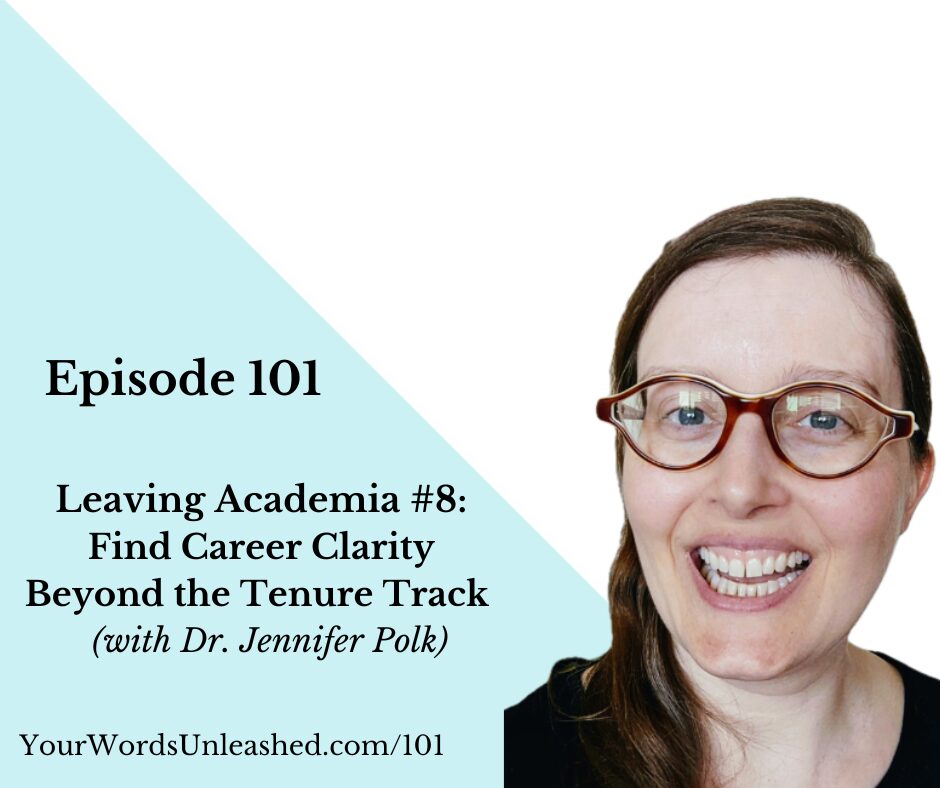
Today, I’m excited to be speaking with Jennifer Polk, PhD. She’s a career coach, educator, and recognized expert in PhD careers. She regularly facilitates professional development workshops and delivers keynote presentations at institutions across the US, Canada, and internationally. Jen created her PhD Career Clarity Program to help PhDs navigate their career paths with confidence.
Her writing has been published in University Affairs, Inside Higher Ed, The Chronicle of Higher Education, The Globe and Mail, Academic Matters, and in three books. She earned her PhD in history from the University of Toronto.
So Jen’s been helping PhDs transition out of academia for a number of years now. She’s worked with so many different kinds of clients who want to leave academia but aren’t sure how to approach the job search. I wanted to pick her brain about what academics need to be aware of when they’re starting to consider pivoting to another career path, especially when it comes to things like mindset and aligning the search with their values.
This is the eighth episode in my series on leaving academia. Tune into the other ones if you haven’t already. They are a mix of solo episodes and interviews with coaches.
So welcome to my show, Jen!
Jen:
Thank you. I’m so excited. Good topic.
Leslie:
I’m excited, too. So first things first, can you talk about your own path, your own experiences in academia, and then also how you decided to become a career coach?
Jen:
Yeah. I’m laughing. So someone called me a few years ago, “the OG career coach for academics leaving.” So I went straight through, I think that makes sense to many of your listeners, and I finished my History PhD. You already said it. And I flailed. I flailed around after that. My initial way of earning some money after I finished my PhD was I worked freelance for some independent consultants.
And that was a really interesting experience because it taught me that you didn’t have to be a super genius to have your own business. That’s not a slight against them at all. It’s just that I was highly intimidated by the business world and then I was less so. So that’s, I think, that’s a positive outcome.
In the period of flailing, I was like, “this is cool, but this is not a long-term career strategy. This freelancing is not a long-term career strategy.” So I hired a career coach. Shout out to Hillary Hutchinson. She’s awesome. Reach out to her.
Anyways, I worked with Hillary for a few months and it blew my mind. It really blew my mind because on the one hand she was like, from the very first conversation, “Welcome. You’re exactly in the right place.” Oh, phew. Amazing! And the style of interaction that I had with her was unlike anything that I’d experienced before coming out of an academic environment where there’s generally a hierarchy and there’s generally a right answer and a wrong answer. Someone to tell you what to do.
Long story short, I got inspired to learn coaching skills and I took a coaching course. And a few months into that, the instructor was like, “all right, go get practice.” At that point, I already had a budding online community on Twitter. This was back in 2012, 2013. Yeah, so I started to get practice with the people that I was chatting with online who were leaving academia and turned out I ended up starting a business.
And here I’ve done a few different things over the years. But it’s always come back to, it’s always been focused on what do you do when you earn a PhD or you spend a long time in academia, even if you don’t quite get there and you have to do something different?
Leslie:
Or you maybe want to do something different, but don’t really know what your options are.
Jen:
Well, yes, and that is really the most common type of client, I would say, is the folks that have… they’re doing something, they’re working as a professor, they have a postdoc. They maybe have a job elsewhere that is tied to what they study or research, but it’s not right for whatever reason. And there are lots of reasons– it’s not right, and they don’t know what would be right. And at a certain point, it’s like, “okay, so what I’m doing is not getting me anywhere I need help.” That’s where I come in.
Leslie:
Okay. Amazing. So talk me through how you would approach working with a client like that?
Jen:
Yeah, so the main way that I work with clients these days is they join my program, and that is essentially a self-paced online course. So folks do the work themselves was one way of putting it. But the program involves regular small group coaching sessions and live workshops. So there is a community to be with you as you do this work on your own. And that is a really crucial aspect to me.
I’m not answering your question, but yes, the program is my main thing and I put it together because when I was working with individuals one-on-one a few years ago, I was realizing I’m having the same conversations over and over again, and I love that. But is there a way to help more people at less cost? And so that they could also benefit from the wisdom that they’re sharing with me. But can we all share it with each other? And I think that’s really the beauty of group coaching. I know a lot of academics are really hesitant to be in group spaces, but trust me, it’s amazing.
Leslie:
Yeah. So what are these conversations you would have over and over again?
Jen:
Yeah, so let’s divide it into two main types of conversations.
One is tactics strategy, like “what should I actually do? Here’s a scenario. Tell me what to do. What’s your advice?” Maybe I’d flip it back on them. Okay, what advice do you give yourself? But that’s like more practically focused stuff.
And then there were more conversations that I would say veer on the emotional, on our thoughts, on the stories that we’re telling ourselves and others. Maybe it’s more creative. Anyway, these obviously overlap, but I think does that make sense, putting this into two different categories, practical, emotional, both are important.
Leslie:
Absolutely. You know, I talk a lot about the emotions of leaving academia, which I think not as many people focus on. I think there’s a lot more prioritization of strategy.
So, how do you help people manage, first of all, what kinds of feelings have you seen people have and how do you help people manage them?
Jen:
Yeah, it’s really interesting. Okay, before I answer your question. I mean, I just wanna say these days you can go on ChatGPT and it might tell you lies, but there’s a lot of information that you can get online for free. And irrespective of that being the case, or whether it’s not the case, I don’t want to be in the business of just providing people with information in exchange for money. That’s boring for me. So I much prefer these conversations, whether they’re about strategy or emotions. And now I forget your question because I was rambling.
Leslie:
Yeah. About the emotions, the emotional side of things.
Jen:
Yeah, yeah, yeah. I think some people don’t realize that they need to work through some stuff if they haven’t yet before they can take action. Because often you kind of know what you have to do. You have to make some decisions about what path you wanna pursue, what kind of job you want to get, be more clear about that, to be clearer. You have to put together application packages, whatever that means in your particular case. And you probably have to talk to people in various different ways along the way.
And in some ways it’s like this is a thing that every grown up person in the world does in some capacity, and it’s something that you also have done as an academic, as somebody with a grad degree. One or two or three or however many. You are familiar with these kinds of activities in general, but if you’re not doing it, I’m not here to berate you, but it’s like, okay, what’s going on in your own thoughts that’s getting in the way, and that’s what we end up talking about.
I’m being vague. You want specifics?
Leslie:
Yes, I’d love them.
Jen:
Yeah. So I have one program member now, she’s said a few times in our group meetings. She’s the one who gets in her own way, she gets in her own head about all of this stuff. Like, “why would anybody hire me and I don’t have the skills that I need?” And those thoughts that I think are so common, or maybe “I know that I have skills, I feel confident about it, but I don’t know how to communicate those to employers.”
And then they also might get in their head like, “so do I have to totally change who I am as a person in order to appeal to these folks?” It’s just so easy for folks to talk themselves out of doing things and talk themselves into doing things in a way that sets them up to fail.
If you are convinced on some level that everybody out there is a corporate drone, in it for the money, is not an intellectual, I mean, you’re sort of manifesting that into existence, aren’t you? That’s not going to appeal to the folks around that might be in a position to offer you truly meaningful, fulfilling, fun opportunities.
Leslie:
Yeah. That’s one of my primary questions for you is what would you say are some of the major misconceptions academics have about jobs outside of academia and also just people outside of academia?
Jen:
So here, I want to say that a lot of the times when people join my program, I think they’re past some of these things. They’ve done the work on their own, like good. So I’m not trying to make comments on my own clients necessarily, but folks who are thinking about leaving, I think there can be fear of the unknown, right?
Fear of the unknown and misconceptions about what it’s like to have a different type of job. And some of those can be based on evidence from their own lives. So for example, academics used to do this occasionally on Twitter where they would go around and they would all talk about the jobs that they had before they pursued their academic careers.
And the jobs for the most part were kinds of shitty jobs that you might have in your twenties. And one of the points of these conversations, I felt like was for them to all gather around and pat themselves on the back that they weren’t stuck in those horrible, demeaning, low-paid, low-status jobs. And like, “good for us,” and like, “oh my goodness, and pity everybody else.” But yo, you ain’t 20 anymore! You’re not 20 anymore.
So I would encourage academics to say to themselves, “okay, I’m somebody who values learning. I’m somebody who values curiosity, who wants to be a curious person in the world? I’m somebody who values perspective taking, right? I’m somebody who values honesty and authenticity and whatever. Whatever these good values and strengths of yours that you do have that I’m claiming that you do in fact have, and then draw on those and go and investigate your options by reading things online with an open mind. Don’t be a judgmental asshole at every single second, right? Go and have conversations with people.
Of course, many of these people are just not going to be on the same page as you, but many of them will be. Does that make sense?
Leslie:
Yeah. Yeah. Alright. So the misconceptions are like,” the work will be tedious. I won’t feel intellectually stimulated. I might feel, I don’t know, stuck in a nine-to-five,” that sort of thing?
Jen:
And so many others, right? That “if I leave academia, I lose the stability of the tenure track, or I won’t have the freedom of expression that I do now. I won’t have the freedom to choose the projects I work on.”
So there’s a sense of freedom or independence that they might lose, and I’m like, “okay, I can meet you halfway there, but maybe we could redefine what this word means and also rethink what we see and experience as academics in 2025.” So freedom, independence is one. Stability and security, I would say is another kind of big category. Like what are we talking about these days? What is the security of tenure these days, and what are other ways to think about security and stability. And flexibility, I hear this from so many folks, I would say especially women. Folks in caregiving roles. “I really require the flexibility of academic work. “And I’m like, “well, but every Tuesday for 16 weeks in a row, you’re teaching for six hours.” I mean, okay.
Leslie:
Right. You’re working at night, you’re working on weekends.
Jen:
You have the flexibility to choose which 80 hours a week you work. Right. I’m sounding like a jerk now, but I think there’s some rethinking that we could do, the royal we, about how we are interpreting academic jobs and the lens that we are putting on non-academic jobs, and there’s maybe some meaning in the middle there.
Leslie:
Totally. I feel like the thing about stability and security comes up so much in the folks that I work with as well and this risk aversion. Be like, oh, “I so admire that you left the academy, you built your own business, but I could never do that. I’m so risk averse.”
I feel like it’s very risky to stay in academia too. So how do you talk people through that?
Jen:
Yeah, I mean, it’s really interesting, right? My style of working with folks is, “I don’t want to tell you what you should think, right? But I can ask you questions and we can work through what you think and you can learn from other people.”
But let me answer your question. I would drill down, okay, metaphorical shovel, here’s your shovel. What’s underneath this? What exactly, specifically, precisely, do you value when it comes to security, stability, freedom, whatever these things are, what exactly do you value? So we’re not just dealing with amorphous things. We can’t have a discussion about something that’s so nebulous. Right? So what specifically is it important to you? And, okay, if there are certain things, I mean, there will be everybody, each one of us is going to have certain things that really are true priorities for us. Great! Know what those are, and then you can seek opportunities that fit within that reality of your own life.
As you said, it’s also a risk to stay, and I would, at the very least, I would offer like, “well, how about we consider this equal weight to both of those perspectives?” You might think, “well, if I could stay in this job for X number of years and probably the college is like not in financial trouble and I’m generally in a blue state.” I mean, there’s some big ifs here, right, right. Some big ifs. You know, in my country, we’re more liberal, whatever, whatever.
So there’s some big ifs, but okay, let’s take you at your word and say that you could do that. The alternative to going elsewhere is, sure you might end up job searching a few times during those 10 years. You wouldn’t have the same type of job security that you might (big might, big if) in academia, but you would have the ability to much more easily switch out of a bad situation or just a situation that’s not doing it for you anymore.
You would have much more, what I would call, career security. You might have less job security, less sense that you have a job for life the way that academics sometimes have that. Of course I recognize most academics don’t, but there’s a certain set that has experienced that. But you might have the ability to, you will have the ability, generally speaking, much more easily, switch jobs.
Suddenly your manager sucks. Okay. It’s not the end of the your world, right? You can go and get a different kind of job, because you know how to do that and you have a network of people who have done that and it’s no big deal. So you have stronger career security, even as you might have less job security. And it might be more fun. It’s fulfilling and interesting and meaningful to flip and do different kinds of things. Let’s not forget that.
Leslie:
Yeah, I think that that’s a huge thing, this idea of doing meaningful work. I think academics are often like, “well, my research and teaching is the most meaningful work that exists, so if I leave this situation, I will give that up.”
It can feel like a zero sum game. So what kinds of meaningful work do people find beyond the academy?
Jen:
Yeah, I love that. So first of all, I would accept what that person says at face value. Like, cool, great. So this is the most meaningful work that you have experienced. Fantastic. Sure. And then it’s like, okay, what exactly are we talking about here?
Because I know that you don’t love a hundred percent of what you do. So what specific bits of it are we talking about? And I don’t want you to say teaching. That’s much too big and vague and broad and nebulous. What specific bits of teaching? Grading? What kinds of grading? I’m laughing because there are some people who love the grading, but most people that’s not what it is. Answering emails at 9:00 PM from your 60 students, that’s not what it is, right? I mean, dealing with the new LMS at your different colleges as an adjunct, et cetera, et cetera, et cetera.
What exactly are you talking about for you that makes this your dream job? So once you have that clarity, what really specifically are we dealing with here? Then you can go out in the broader world and ask yourself and others, where does this thing that lights me up, where does it exist elsewhere in the world? And what do other people call it? It smells and looks and is shaped the same way as the thing that I enjoy.
I’ll give an example for me. So when I was a PhD student, one of the things that I really enjoyed, and I’ll give you the big category here, was working as a TA. Now the more specific bit is I really enjoyed when I was in a position of leading group discussions. There were maybe like 15 students in the room. I was the one who was meant to lead that group discussion, and it was very open and up to sort of me and the group what we ended up talking about that day. That hour, I really enjoyed that.
It turns out that outside of the context of academia, you could call that group facilitation. Take a slight step one or two away from that, and you could call it group coaching. Another step in a different direction, same direction. Oh, suddenly we’re talking about workshops, right? And those are the kinds of things that I incorporate in my business. So, I don’t wanna go on and on and on, but once I could get much more specific about the exact scenario that really lit me up, I could say, okay, what is this called elsewhere? How could I pursue this? Do I need more training in it? What else is it called?
Leslie:
Yeah. And I think also one of the things that I notice a lot of academics’ minds immediately go to is “I need more training, I need more skills. Before I can even start talking to anyone I need, like another certificate, a degree, or whatever, should I become a nurse?”
So how do you deal with that, this idea that people aren’t enough yet?
Jen:
Mm-hmm. I know, and you caught me out because I also mentioned training.
Leslie:
Yeah. Well, but that’s what I mean.
Jen:
Yeah, yeah, yeah. I know exactly what you’re talking about and I’m sure that people listening are nodding their heads as well. So I would say let your default assumption be that you do not need anything else. That what you have now, who you are now is exactly what you need to move forward. You might want to come to talk about it differently. You might want to label it differently. There’s some storytelling around this. There’s a communication challenge to take on here potentially, but you don’t need more skills, you don’t need more credentials. You’re good!
Now, if you at some point end up deciding, “no, really I am set. My life will be over if I don’t end up working as a librarian. An actual like capital L librarian.” And you are totally set on that. And you will not entertain jobs that are like that, that are called different things. Okay, fine. It’s your life. You can do the MLIS. I’m not going to stop you, but please, let’s take a few steps before you get there.
Leslie:
Yeah, so that also means people need to recognize the skill sets that they have that they are discounting or they think that aren’t going to be valued outside the academy.
So what are some of the things that people already have besides their actual subject matter knowledge?
Jen:
I love this. I remember a professor in my program a few months back. So she was working on what I call the “everything resume.” And that is an exercise, other folks might think of it as like your master resume. It’s the document that you would put together where you would just dump everything that you’ve done.
And it’s different from a CV because it includes things that aren’t valued and recognized in academia as well. You put all the things. And I remember her saying, “oh, so I should include my committee work on my everything resume?” And I was like, “yes, please. All of the committee work.” And what exactly did you do? What was your role here? How did you interact with the other people? What was the context? What was the outcome?
So yeah, everything that you’ve done. Because there were some real gems as she then described briefly some of the things that she’d done in the context of committee work, and that she wasn’t even thinking about including that stuff. But in conversation with other people, it occurred to her, “oh, I actually do have this experience that was never valued.” It would never be on the first page of my academic CV, but might in fact be the thing that gets you your next career, your next job.
Leslie:
Yeah. Yeah. No, absolutely. It’s like taking a step back from the incentive structure and priorities of academia where research, then there’s teaching, then service at the bottom.
And so, how is it helpful for people to reframe that if they haven’t actually left the academy yet? How can they do that?
Jen:
No, I think it’s so important to make the distinction between, “here’s the thing that academic culture in general, or my institution’s culture or my employer’s policies, culture, here’s the thing that that institution, that structure those people, here’s what they value, here’s how they would rank it. Here’s their perspective on who I am as a professional and what counts as success for me.” I think it’s really helpful to say, “okay, so here’s that perspective.” And I’m not saying trash it. It’s just know what it is, and then, yeah, as you say, take a step back or above or whatever, what do I personally value?
When I do workshops and without context, I ask the question: “what do you most value?” No one has ever said back to me “first-author journal publications in high impact factor academic journals!” That’s not what people say. Nothing against that. That’s awesome. Amazing. Good for you. But what are the things that are actually important to you? And I think once you make that, and there might be some overlap of course, but you have to figure out for yourself what’s actually important for you and respect that. Respect that.
And part of it is reflecting what are the choices that you’ve made in the past years? What are you putting your energy into, whether or not it’s valued by other people around you. Take a look at your own self, your own experiences, the choices that you made, and embrace that. And that will give you so much information about what’s actually important to you and then you can make decisions about, “okay, so yeah, I do want to value these things. I do want to be in spaces where those are valued by other people, my colleagues, and the person cutting my check every week.”
Then you can go from there.
Leslie:
Right. Right. And I also think during that audit of where people are putting their time and energy, it’s super important to consider the fact that much of that time is going towards stuff that you might not personally value that much. So it’s also paying attention to what is lighting you up. What fills you up, what actually rejuvenates you, and it’s NOT going to be a lot of the stuff that you do.
Jen:
I think it might surprise some folks to consider in your this quote, “dream job,” this quote unquote, “the best job you’ve ever had.” Of course, I think many people don’t think of themselves that way, but there is a set that actually do. And in a large percentage of your day, you don’t get to do those things that really do light you up.
And maybe there’s opportunities to do those things. They might be called different things. They may not have the same social status, although once you move in different spaces, you might discover social status means different things to different people.
Leslie:
Right, totally. So I think that this has been super helpful. I also wanted to ask you though about this area that I know a lot of academics are really uncomfortable with, which is networking. That actually holds a lot of folks back from even considering other options beyond the academy.
A lot of people within the academy don’t network well with other academics, so how are they supposed to network outside the academy? What are your tips?
Jen:
Absolutely. This is a big thing, and I think part of it is that networking is a big, scary word that is undefined. When people say, “oh, you just need to network more,” what are we actually talking about here? It’s too nebulous and vague. I also like to make a distinction when it comes to networking between activities you will do primarily for your own education. So for you to learn things for yourself, which I think we could categorize that as capital G good, right? I think we can embrace learning is good versus other kinds of networking activities. Let me not label it right now. This is a kind of a blunt distinction, but let’s go with it.
And so, the first and most important kind of networking that I would encourage folks to do, I would say, is the educational kind of networking. So you don’t have to call that networking at all. Career coaches, we talk about these things as informational interviews. Informational interviews is kind of a weird word, but it’s literal, it’s descriptive to put it in terms humanities academics will be familiar with, or social scientists. This is you doing primary research. The folks that you are in conversation with, asking questions of gathering data from, they are your primary sources to help you figure out what kind of job, career, employer, et cetera, would be most suitable for you.
So that’s the learning side of this.
Leslie:
But how do people find folks to informationally interview, and then what do they ask them?
Jen:
Yeah, yeah, yeah, yeah, yeah. So many people will start with saying to me, “I don’t know anybody.” And that is not true. You are not hermetically sealed in as an academic. I mean, you’re just not, you interface, that’s such a weird word but anyways, whatever is what I said, you deal with other people in your personal life and in your profession. There are other people around you and you can start to have conversations with folks around you.
And if you’re more comfortable talking with people you already know, great, you can start there. Alternatively, if you’re more comfortable having these conversations with total strangers, you can also do that. I will also say that you can start getting yourself into this without jumping straight to doing informational interviews. You can start to follow people online. You can start to comment on LinkedIn posts. You can start by chatting with folks on social media and Facebook groups, whatever it is, to get more comfortable conversing with people.
And then yeah, go have a conversation. Get yourself sorted. What questions do you want to ask? And the questions that you want to ask don’t come from ChatGPT, they come from you thinking on your own. “What is the information and what are the insights that will help me move closer to a decision that I want to make?” And then you base your questions on that and it’s fun. It’s fun because you like to learn and you’re curious. And you can just take it one conversation at a time. And if you don’t know anybody, I promise you the people that you know know people.
Leslie:
Yeah. And I think it’s also folks getting comfortable with revealing to even a few trusted folks in their circles that they are considering leaving. Because I think there’s so much attached to like, “am I a traitor to this profession? Am I a failure if I can’t hack it?” So it’s not just about who you know, it’s about overcoming these internalized kinds of judgments.
Jen:
For folks that are really stuck on that, let me say that without judgment, if that’s where you’re at. One tip, if you’re, let’s say you’re working as a professor in your discipline, you can always start this process and your position can be, “I’m a professor, I teach students. I want to have more information about what my students can go into after they graduate.”
I think that is a great kind of initial setup where you don’t have to say “I’m thinking of fleeing the academy.” It’s like, “I’m a linguistics professor. The world changes fast, it’s been a while since I was poking around jobs outside of academia, but I really want to be helping my undergraduate, masters, doctoral students, whatever it is, be well equipped for what comes next.” So, “hey linguists who work in industry, I’d love to chat with you.” You can reach back to your own former students, et cetera.
So I suspect very quickly you might feel more comfortable being vulnerable about what you’re actually thinking.
Leslie:
Yeah. No, I think that is a really useful thing. Don’t make it about you at first. Because I think that’s also part of what keeps people from doing it is it feels like it’s all about you. And it’s okay actually for it to be all about you, but getting comfortable with that idea can take a while.
So imagine that there’s someone, oh my gosh, academics are so burnt out right now, right? They’re so, it’s just this onslaught. They’re overwhelmed. A lot of folks are just wondering, “is there something else out there that would just be easier and better and more humane for me?” If they’re at that spot where there’s no clarity, what’s your advice about where to start with all this?
Jen:
Yeah. It’s a great question because where to start is not going to LinkedIn, typing your discipline in the search box, clicking on jobs, and clicking “apply.” That’s not the first. No, no, no. Of course, if you happen to find something amazing, sure. But the first thing is some of the exercises that we’ve been talking about is “what’s going on for you? What are your priorities? What are your values? What are the moments that really light you up? What are the choices that you’ve made that make you different from all the other postdocs in the lab, in the discipline, from the other professors in your discipline?” To really get clear for yourself on who you are as a person now and who you wanna be going forward.
I had a professor client of mine say to me last week that the most important part of the program was the work in the focus section. So there’s this focus section of my online course, my program. I always feel a bit uncertain about it because there’s very few videos. There’s very little instruction from me in that section, and it’s mainly a series of workshops. He’s like,” no, Jen, but that’s perfect. That’s what we need to do. We need to do that reflection.”
So give yourself permission and allow yourself some headspace, a little at a time, 10 minutes, 20 minutes. It doesn’t have to be a big thing. One thing at a time. One open-ended question. One reflection that you want to do step by step, take it from there.
Leslie:
Amazing. I think this has been so super useful and I know it’s going to be really, really helpful for my listeners. So what are the best ways for them to connect with you?
Jen:
Yeah, thanks. You said at the very beginning, y’all can find me on the internet. My website is FromPhDtolife.com. That’s all spelled out in words all together, no spaces. I am on LinkedIn. I have a much maligned YouTube channel. I’m on Blue Sky occasionally, and folks can reach out to me directly at jen@nullfromphdtolife.com if they want to get in my inbox.
Leslie:
Wonderful. Jen, I so appreciate your time and your insights today, and anyone who is looking to leave the academy or even just starting to think about it, I really think you would benefit from chatting with Jen or taking one of her programs.
Jen:
Thank you.
Leslie:
So I will talk to you all again soon.
If you enjoyed this episode, make sure to also check out:
Ep. 45 – Leaving Academia, Part 1: Assess Your Situation
Ep. 66 – Leaving Academia, Part 4: Grieving the Loss of Identity (with Dr. Chinasa Elue)
Ep. 94 – Leaving Academia #7: What You Only Learn AFTER You Leave