Here are 3 ways to work with me~
1) Private book coaching through my signature Your Words Unleashed 6-month coaching program. Finally publish your book!
2) Personalized career coaching through my one-semester Career Reset Program for overwhelmed academics. Gain clarity and renewed purpose.
3) Group workshops on a range of writing and career-related topics. Come away with a transformed relationship to work.
I’m booking for the fall, so if you’re interested, email me at Leslie@nullYourWordsUnleashed.com or set up a free 30-minute consult!
**********************
Leslie:
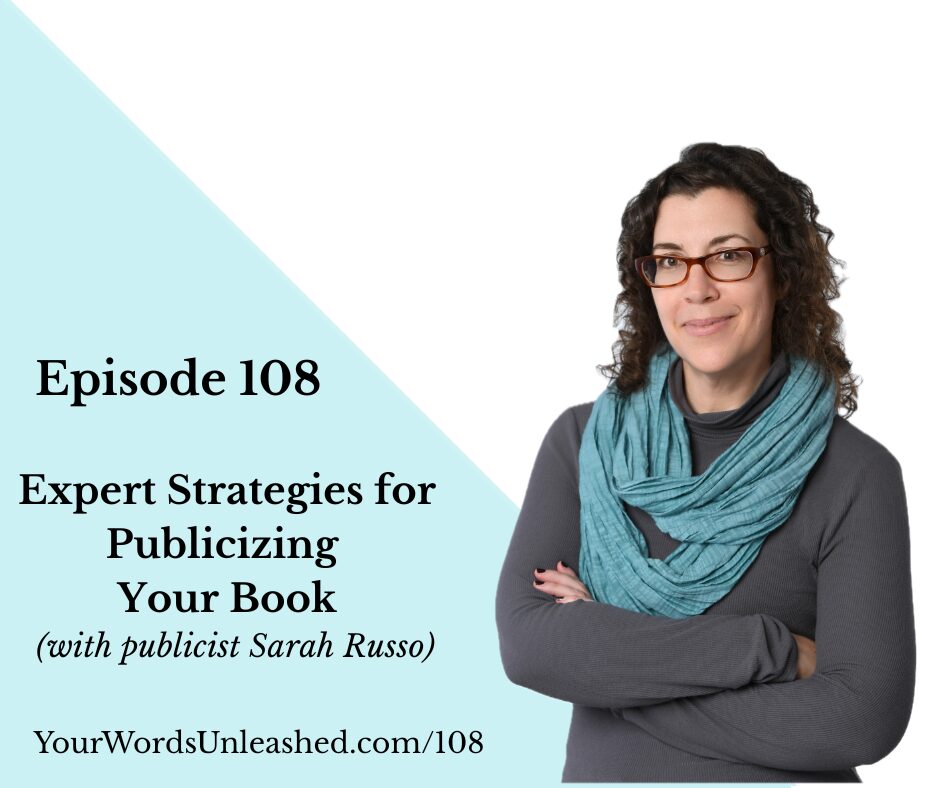
Today I am very happy to welcome Sarah Russo to the show. Sarah is the founder and CEO of Page One Media, a literary public relations firm. She’s a publishing professional with over 25 years of experience working across the spectrum of publicity, marketing, social media, branding, and business development.
Sarah has worked in-house for Alfred A. Knopf, Doubleday, Farrar, Strauss & Giroux and Scribner. She’s also been a consultant for literary organizations, including the National Book Critic Circle, Association of University Presses, American Booksellers Association, and the Dayton Literary Peace Prize. Most recently, prior to founding Page One Media, Sarah was the global head of audience engagement for Oxford University Press where she led the publicity, social media, trade marketing, and corporate communications teams. So impressive!
So listeners might recall that I interviewed Harvard University Press Senior publicist, Amanda Ice, back on Episode 99, and she talked about in-house publicity. Today’s conversation with Sarah is going to address the other side of that equation, which is publicity campaigns run by outside publicists. And these folks are hired directly by individual authors rather than working for a press. Sarah has an incredibly wide breadth of experience with both academic and trade presses, and she really has her finger on the pulse of what’s happening in the world of publishing and how to make your book stand out from the crowd.
So I’m so excited to talk with you today, Sarah!
Sarah:
Thank you so much for having me. I’m really happy to be here.
Leslie:
Awesome. So let’s get into it. What is your background in publishing? And how did you decide to start your own PR company for authors?
Sarah:
Yeah, so I got started in typical sort of trade books. I started at Knopf and worked at Doubleday and Scribner and Farrar, Strauss & Giroux. And I did the typical things. I was in publicity my whole stretch. I call my time at Knopf my PhD in publishing. It was a really phenomenal education and a great way to start the way that things are “traditionally done,” I’m air quoting. And that was great for me, I really loved that time.
After FSG, the head of Oxford University Press reached out to me and they were looking to build what I think of as mainstream press outreach. So Oxford always had phenomenal reviews. They did really, really good work in that space and they’ve had award-winning books across history and politics in the rest for years. But they were looking to build in NPR. They wanted more television news. They wanted more cable news. So I came in really to try and help build that and also do a little bit more of what we call externally expert positioning. We had authors across every area of expertise at OUP, and they were looking to do more of that, more talking-head sort of placement for their biggest authors.
So I came in as the associate director and really did a big build there. We were also, at that time, we had launched the OUP blog just shortly before I came. So we were really building that. So the owned media component of what we were doing we were building on Twitter. There were a lot of new things happening then. This is like 2006, so it’s a good long time ago. A lot of change was happening in the media environment at the time with social media, so we were really at the very forefront of that. And that was transformative for me to be in a space where I could do something new where we were experimenting. Where we had a blog that was, at the time and actually still is, I think, the most widely read publishing blog on the internet. So it actually gets more visitors a month than the New Yorkers’ Book Bench.
So I haven’t been there in several years now, but at the time, it had maintained for many, many years as the most widely read publishing blog. That’s partly because of how frequently they publish, right? They publish multiple posts every single day. There’s a blog editor, there’s a whole social media team now. It’s very different than it was when we first got our start in that space. So, it went from trade publishing to academic trade publishing and working in a whole bunch of different spaces at OUP, including the dictionaries program and journals publicity. So individual publicity for journals, articles, online platform publicity, so things like the African American National Biography, right? We did PR for those types of things. So really an incredibly wide breadth at OUP was a phenomenal experience for me. I learned so much.
Sign up for Your Words Unleashed Newsletter for writing strategies and updates!
Leslie:
Thanks for sharing that. And I just want to apologize for mispronouncing Knopf. And I think that that shows how unfamiliar I am with trade presses that I did not know that!
Sarah:
No, you know everybody does that, so you’re not alone. It’s totally fine.
Leslie:
But now I know and I will never do it again. Before I ask you more of like the details about like publicity campaigns, what is it that you love about publicity?
Sarah:
Oh gosh. I get to work with the smartest people in the room. It really is amazing. Both here at Page One and at OUP and everywhere from Doubleday to Knopf, every day, I got to work with just the smartest people. And you know, I say that within the context of both fiction and nonfiction and memoirs, right? Like all of these individuals, I think we forget how competitive it is sometimes to get through that initial door to get a traditional publisher. And a lot of people get left out of that process. The people who make the cut are genuinely, are the most elite of writers in our world. And it’s a special thing to get to talk with these people and communicate with them.
I worked with an author named David Kilcullen, who Oxford published and still publishes his books. And he is an anthropologist, an Australian, but also a military strategist and worked in the Australian military for years and was on loan to the US military during the Iraq war. And I remember as, years went by and, we had the 2016 election and I got to have these very nuanced conversations with him about what was happening. Whether Trump was a Russian asset, right? What the tea leaves were saying about those things, like what the networks were saying. To be able to like, ask questions of some of the smartest people in a one-to-one way, that is by far my favorite thing.
I mean, I love reading the books, like it always goes back to the books, but being able to have those conversations because we need to understand as publicists. In this space, we’re very much generalists, right? Every single book I need to become an “expert.” And again, the air quotes, an expert in that subject to the best of my ability for the time that I’m working on it. So we do have these really deep conversations with the authors so that we can transfer their ideas and synthesize them in a way that the media will understand quickly and easily.
It’s very different than the writing of the book, right? That’s 300 or 400 or 1400 pages, right? Of a book that we need to make a soundbite out of, so that someone’s going to open our email, right? They’ll look at that subject line and then they’ll actually read three sentences of it and be like, “oh yeah, I want to read the rest of this email.” So that’s, you know, having those conversations is the way we do that. And I love that. I think that is just so fun and such a phenomenal part of my job.
Leslie:
Yeah. And so now you run your own company. What inspired you to go out on your own and then how do you run these campaigns?
Sarah:
Yeah, so I’ll say, I forged out on my own because I was a little bit tired of being the “party of no” in-house. You know, in-house we have limited budgets, we have limited staff, we have lots of books. Knopf publishes almost 300 books a year. Oxford publishes over 300 books a year, right?
That’s a lot of books for a very limited number of people and a very limited number of campaign dollars. And I had the most creative team at Oxford, like they were phenomenal. A lot of them are still there. They’re still an incredible group of people. Very bright, very creative, and I told them no all the time. Like they would come with some idea or some opportunity or one thing or another. And no was the word of the day all day long for me. And I was really tired of telling my really creative team no telling authors no. I wanted to be able to say yes to authors.
I got to a point, I had a big global team. We worked across 12 time zones from New York to China and I was doing meetings with Oxford in the UK at 6, 6:30am and I was doing meetings with my team in China at 9, 9:30pm. And I was tired, I was burnt out. The combination of those two things came to a head and you know I said to myself, “let’s do something different.” So here I am six years later and getting to say yes to authors and that’s a gift.
Leslie:
Very cool. So what are you saying yes to?
Sarah:
We say yes to all kinds of things. So, our campaigns are always publicity-based. So the core of all of our campaigns is traditional sort of book publicity or expert author publicity. So if the book is already published and the author wants the momentum to keep moving, we are one of the few firms that will take those expert authors on post-book publication and continue to build their media profile and continue to sell books.
In-house, that window is 6-8 weeks where they work on the launch of the books. Even books by experts in the media are considered arts and entertainment. That’s where they fit, and we work very hard to break out of that space because that really limits us, right? If it’s arts and entertainment, we have a very short period of time from publication date till about six, eight weeks post publication date when we’re going to get book reviews and we’re going to get other sorts of attention for the book. NPR is not traditionally, like Morning Edition is not going to interview our author six weeks after the book comes out about that book, but they might interview our author if the subject matter of the book is in the news.
That’s something that we really have the power to continue to keep the campaign going in that way. We do that kind of work, but at the core of that, that’s the hinge point of everything that we do, but publicity doesn’t work in a silo. Publicity really does have to work in tandem with marketing, and marketing works very closely in tandem with sales. We don’t have a sales team here, but we need to make sure that the internal sales teams have everything they need in order to be able to not only sell the books into the stores, but make sure that those books can send you to sell through.
What do the booksellers require to be able to hand sell a book to a customer who comes into the store? Those types of things we can do. And we have done indie bookstore campaigns on behalf of our authors. We think of those as marketing, like a marketing outreach. We partner with the ABA (American Booksellers Association) sometimes, there is the white box in the red box or other methods of reaching indie bookstores and we can do those. And we actually, we sometimes will do individualized outreach to indie bookstores, like calling them up and dropping into bookstores and doing those types of things, we do that.
We do social media. We’ll do platform building for some of our authors. So sometimes an author will come to us a year in advance, sometimes more because they don’t have a platform. And I’ll caveat that not every author needs an online platform. So when I say platform, I don’t necessarily mean 150,000 followers on TikTok, right? That works for certain authors, right? If you’re a romantic author, if you’re in horror or war, I don’t know, any of a million different genres. TikTok works great, but for most of the people we work with, that’s not a space that makes sense for them. LinkedIn is a good space. Substack is an outstanding space for most of our authors.
Some of them want to start a podcast, right? There are numerous other ways of reaching audiences that we can help an author with. But that doesn’t happen overnight, right? We can’t do that three months in advance of publication date. It can take years to build a real audience on Substack. We have some authors who contracted with us to do sort of a six- month expert positioning campaign and then just stayed. And have stayed, have been with us for almost the life of the company, have been with us five-and-a-half, six years. Those types of authors are investing in the business of their writing, right? They’re really looking at the way that they’re being seen in the public consciousness as a method to sell their books, but also a method to further their own careers. So it helps, right? If you’re a regular on CBS Sunday morning as a historian, which one of our authors is, that’s really helpful, right? Your books sell, you get a pop of book sales, your Substack grows, their Instagram grows when they’re on those television shows.
We think about, they obviously have a day job as well, so we think about what’s the best way to make the most of their time? What are the holidays that it makes the most sense to pitch them around? President’s Day, for example, for a historian, January 6th. Those types of things. Those are opportunities to talk about the history of that moment. It’s the 250th anniversary of the country this year, right? There’s a lot going on for that author, a lot of speaking engagements. We also do that, we’ll manage our authors speaking schedules. We will pitch them for speaking opportunities. We will negotiate the fee. We’re not a speaker’s bureau, so we don’t take a percentage of that. We are paid on a monthly retainer. So any money that we are able to make for our author is their money, and that’s, the way our economic system here works. It’s a little different from a speaker’s bureau.
So those were a lot of things, sorry.
Leslie:
Yeah, no, and we can definitely go into those more. But for those folks who are listening that don’t know the difference between marketing and publicity, how do you normally define that?
Sarah:
So the difference between marketing and publicity. Marketing is paid. We are in a situation where we can purchase advertising. Amazon merchandising is paid. Google AdWords campaigns can be very effective. Goodreads Giveaway is a paid marketing endeavor.
So publicity, on the other hand, is earned. We earn it off the quality of your book, how good your op-ed writing is, how good our pitches are, right? There are a number of things. There are a lot of things that are going on in the world at any given point in time that can really impact the effectiveness of a campaign, but publicity has to be earned. We can’t pay for it.
Leslie:
Okay. Thanks for making that distinction. What would you say that authors should be looking for when they are considering hiring their own publicist or marketer?
Sarah:
Yeah, we actually have a blog post on this with a bunch of questions that you should ask when you’re seeking out a publicist. Referral is important. We have a few authors every once-in-a-while someone will come in through Google that happens to find us along the way. But almost all of our clients are referred by someone else, and I think that’s always a good place to go.
If you know another author or an agent or someone in house who has had a good experience with a publicist, that’s a great place to start. I read every manuscript before we will have a conversation with an author. And I do that because, every once-in-awhile a book falls apart at the end. And I’ve made the mistake of not fully reading the book before, s ending out a proposal and then being like, “oh no, what have I done?” So that’s my style of doing things, and I think it’s important because I don’t know how else I create a really effective strategic proposal for an author. It does take a lot of time, but we do a better job both on the strategy for the campaign and the initial conversation with the author.
I can ask them better questions about what it is they’re hoping to accomplish with the campaign, so that I think it’s not something every publicist does. It’s not something every publicist can create the time to do. But I think it’s an important question to ask. How do you create a proposal? How do you create a strategy for me, if you haven’t read the book, how do we do that together? If that’s something that you’re not going to finish the book before you send me a proposal, is a question I would ask. I would also ask what other types of books in the subject area that individuals worked on. It doesn’t, and probably shouldn’t, be exactly the same.
We almost never work on books that are competitive with each other, even within years. We want our list to be very different across, because we can’t go back to the same media with very similar types of books over and over again. So I would never say to a publicist, “What book like mine have you worked on this year?” Because we won’t work on a book like yours in this year. We might have worked on something similar to it.
So say for example, the author is a doctor. We work with lots of doctors, but we work with doctors who are in rheumatology. We’re working with a pediatrician right now. In this past 12 months, we’ve worked with two pediatricians. One who has a book that’s about childhood obesity and one who is an ER pediatrician who specifically is working in the child sexual abuse space. So very, very different, right? Two doctors, very, very different subject matter, but we are working in the medical space, right? So those contacts are similar. So I would ask those types of questions, what books like mine have you worked on? Whether it’s memoir, whether it’s academic and politics, whether it’s history, whatever the subject area might be, sort of get a feel for what they’re doing in that space.
I would ask questions that are foundational to what it is you want to achieve. The biggest thing I think in hiring an outside publicist is knowing precisely what your goals are. And that doesn’t mean that those goals are fixed. Those goals do and probably will shift over time depending on what it is you’re hoping to accomplish. If your goal is within the next five years to get a Guggenheim, right? That’s something that the publicist should know and we should talk about what the strategy is for that. If your goal is to be a talking head, that’s something we can really help with. If your goal is to be a speaker and be a paid speaker, those are things that you should be asking questions in those areas.
What is the publicist’s work in that space look like? How do they do that work? What do the relationships look like? The question should be granular to what you want to achieve. So I would really think about it. I would have a sit down with yourself, your journal, whatever it is you may utilize and say, “what am I hoping to get out of this, and what questions do I need to ask in order to make sure that this is the right person to help me achieve those goals?”
Leslie:
And so you, when you mentioned proposal, that’s like a strategy proposal, is that right?
Sarah:
Yeah, it’s a campaign proposal, so it could be something as simple as, at most publishers they’re assigning publicists to the list at the beginning of the season. Those publicists make a publicity plan for that book. And in-house it may be really quite short. It may be: print, online, and radio, right, and that’s it.
Those are sort of like the three areas they’re going to focus on. For us, we would do a very similar type of thing for our authors. We always focus on, the core areas are printed online, radio, television, podcast. And now, Substack is a big component of the work that we’re doing because we’re seeing it move books, so we feel like it’s a really effective space to work in.
So that’s sort of the core of the publicity campaign. And then we’re going to outline all of the. Types of things that we’re going to go after in each of those categories and print, online, radio, podcasts, et cetera. So we’re going to put in suggestions like these are our initial ideas. It’s not a comprehensive list, it’s just sort of our initial thought pattern of the types of areas that we’re going to go after, depending on the subject matter of the book and you as an author and as an expert.
Leslie:
If folks are publishing their books through scholarly presses that have an in-house publicist, then do you kind of crosscheck their list and make sure you’re doing something different? Or how do you work together with the presses?
Sarah:
We work in really close collaboration with most of the presses that we work with. So not always, but a lot of them want that sort of back-and-forth with us. I’m a big believer that there’s no harm in the in-house publicist and one of our publicists reaching out to the same media contact, they’re getting a million emails a day. Whoever’s email they open, I don’t care whose email they open, as long as they open one of our emails. That’s the key.
I tell this, it’s sort of a silly story, I tell this story all the time where one of our authors, we had been working in very close collaboration with the publisher and the in-house publicist, and we had all been reaching out to Morning Edition. The author had been on Morning Edition a number of times previously. We had been working with her for a number of years at that point, and she had a friendly relationship with Steve Inskeep, so was texting Steve. And I had a publicist that I worked with regularly, and I was emailing her. And the in-house publicist was emailing that sort of traditional books producer at Morning Edition. And none of us were getting anywhere or we felt like we weren’t getting anywhere.
We weren’t getting a response. We weren’t getting a booking. It was the Friday before publication date on the coming Tuesday. And the assistant at the publishing house sent out their usual monthly email blast to major media with like, “these are our big books for the month.” And that’s what did it, it was literally the assistant’s email to the generic inbox with the list of the top books! Like that was what finally got them to stand up and be like, “oh yeah, let’s book her for next week.” So again, like I don’t care. They were hearing from all of us, right? Like they were seeing the emails from all of us and they were seeing the text from the author. They just needed that final fire was like pub dates next week, right? Like they just needed that final push. And they got it from the assistant in-house.
And again, I’m not possessive, I don’t care who gets the booking, but we got the booking as a team. And that’s what I think is the most important thing to remember. We’re working in collaboration. We’re not competing with our in-house colleagues. We all want the same thing. And in this instance, it all worked out.
Leslie:
Wow, that. Yeah, that’s instructive too. I guess it’s shots on goal or whatever they say. Like, people just have to keep making as many shots as possible. And maybe it doesn’t matter who’s making the shots, as long as one of them goes in.
Sarah:
It’s a team effort, right? That with the shots on goal. Exactly, it’s a perfect analogy. Yeah.
Leslie:
And so I know you work with like fiction and nonfiction, academics and non-academics.
So when it comes to the academic world, is there like a certain type of academic that tends to seek out an outside publicist? Like I would guess someone who’s much more comfortable with self-promotion? In academia there can be like a lot of, I don’t know, almost discouragement of promoting your own work.
Sarah:
Yes, especially for women. I’ll say there is no specific type. We get academics who are early- stage academics, right through emeritus. We get people who have endowed chairs. We get adjuncts, we get authors across the whole spectrum of academia. I think, and this goes to the equity issue, some academics have a research budget that they can utilize to hire us and many don’t. That will give you a little bit of an idea of the types of authors who eventually hire us. We may go through conversations with folks that don’t end up going anywhere because the price is too high, or it isn’t the right time for them for one reason or another. Or they feel like the in-house publicity team is going to do the job they need and that’s enough.
I will say later-stage academics more often have the disposable income to hire us. So that’s an easier way to look at it. But there are younger people in academia who, because they’re hoping to attain tenure and this book is important to gaining that tenure, we do get authors who will come to us specifically because they need that book to perform really well because they’re up for tenure in May. So they do, they invest the money to have us really elevate that book and elevate their voice in a moment when they’re being assessed for tenure.
Again, it goes back to the heart of why are you hiring this publicist? You’re very likely not going to make what you pay us or pay another outside publicist back in book sales, right? It’s not going to earn out the advance, and you start getting royalties in the five figures space, right? That’s very rare. How else are you going to earn it back? Is it speaking? Is it tenure? Is it a promotion? Is it a new job somewhere else? It’s an investment. And authors should be thinking of it as an investment in their career in academia, if that’s what their goal is.
Leslie:
And that’s absolutely how I think about the coaching work that I do is because it’s not inexpensive, but it’s an investment in moving you so much further, so much quicker.
Sarah:
Yes, absolutely. Yeah. It’s not easy to put together a book proposal or to write a really phenomenal manuscript to get it into the hands of the right editor at the right publisher. I mean, the work that you do is absolutely vital in the process because it’s so challenging to do it well. Writing for a general audience is not the same as writing a dissertation.
It is a very different process, and that’s not my expertise that I don’t know how to do, but there are you and a couple of other people that I know who are doing this work and do it phenomenally well. And I can’t imagine how authors do it without that support.
Leslie:
They definitely do, and it’s much more painful and slower. And then sometimes they don’t do it at all. And that’s also very sad.
So, actually, this is a good time to ask you. All authors have to write a book proposal, scholarly authors. The proposal’s very tricky. Maybe it is for everybody, but I think the trickiest section of all is the marketing section. Because no one ever really knows what does that mean? And like, how am I supposed to put my book in conversation with these others? And oftentimes they literally just give a list of, here’s books that have been published in the last 25 years that overlap with mine. And there’s very little explanation.
So what do you think? What makes a strong marketing section?
Sarah:
Yeah. So this is where we go back to that platform issue. There’s plenty of editors out there and editorial boards who are assessing these proposals who will say, “oh, they, they don’t have a platform”, and what does that mean? And then the editor will go back to the author and say, “they thought you didn’t have enough of a platform.” So show them your platform. Platform is not just Twitter or TikTok, or Instagram or Substack platform is also. What you’re doing at your university, what your university might do for you and your book. Is there a communications team at your university? Does that comms team help you place op-eds every once in a while?
Is there an owned media platform at your university? So say Stanford Magazine for example, and their newsletters. That’s all platform. If you have access to those things and your university will support the publication of your book or if you went to Dartmouth for your undergrad and Harvard for your graduate and I don’t know, Yale, for your PhD, it doesn’t even need to be that, right? It doesn’t need to be all these fancy Ivys. It can be any colleges. It’s just the first that came to my head. Each also have platforms that will support you. They each have an alumni magazine that will feature your book, so that’s part of your platform.
Do you have a community-based platform? Are you in a writer’s group that is well connected? There are a number of them in Boston, for example, that are sort of famous and support the authors that are in those writing groups. Do you have a great LinkedIn profile with all of the students who you’ve ever taught? Have you reached out to all of those people? Are you connected to them? Are you connected to all of the professors, who have taught you and et cetera?
All of those things, those are all platform. If you’re invited to speak, that’s platform. And I would talk about that if you are a regular featured panelist at conferences, that’s a critical part of an author’s platform. I think we get pigeonholed into this concept that platform is online platform, social media, and that’s, sure, that’s platform, but that’s not the only platform.
If you have a wonderful relationship with the indie bookstores in your community and your local library, that’s part of your platform. So those are all things that I would include in that marketing section. I do think, still, there are plenty of publishers who will say, “you don’t have 10,000 followers on Substack. Sorry, you don’t have a platform.” I think that’s silly. I think that’s very close-minded. I don’t think that’s the way we should be thinking about platform.
I think a platform, an in-person, in real life platform is stronger and more valuable than any online platform I’ve ever seen. We have worked with authors who have 350,000 followers on TikTok or half a million followers on Twitter and it did nothing for them. If that’s not a book-buying audience, especially now, most of those followers on Twitter are not a book- buying audience. They’re just not sure. You have half a million followers, great. It’s not going to do anything for book sales.
I would like to see publishing take a broader view of what platform is and look at in real life platform with a heavier weight than they do the online platforms. Because I just don’t think online platforms are selling books in any drastic numbers that makes sense to put that kind of weight on those.
Leslie:
Yeah, well that’s really useful. So authors should really be thinking about their networks and who they’re connected to and who will help them promote the book.
And so you mentioned also that maintaining momentum for books after they’re published. So what are some strategies scholarly authors can maybe implement themselves that would keep things going past that 2-month mark?
Sarah:
Yeah, op-eds are one, right? That byline that says “author of” is always a helpful thing, and I would say it’s important to not let that be one and done, right? Like not just publish an op-ed and then hope that people read it. I would utilize that op-ed. I would send it to your comms team and say, “I published this op-ed.” If they didn’t help you, they’ll put it in the newsletter. They’ll put it up on the press page on the college’s website, right? That’s useful material for them too. So taking every opportunity and amplifying it as much as you can. If you do have a. LinkedIn profile, right? Posting it on your LinkedIn and sharing it. Those are all things. So not just one and done. Utilize everything that you do.
And that is true for the reviews that were achieved for your book. So don’t let it just dwindle away. Once your in-house publicist has moved on to the next book, continue to use those things, whether that’s on social media or to help you book a talk at your local library or whatever it may be. Utilize all of that publicity that you’ve achieved in other methods. So that’s one thing, whether it’s on social media or utilizing it for real life.
I also highly recommend that an author keep track of all of the interviews that they’ve done. If your publicist isn’t giving you that, if you don’t have a tour schedule or a radio interview schedule or something, make a Google sheet and make sure you keep track of all of them, including the producer, right? All of that information will be there. Those are helpful bits of information and they’ll remember you. So if something pops up in the news, you can send an email to that producer on your own and say, “Hey, if you need an expert on this, I’m happy to comment. I’m free, and these are the days I’m free this week,” et cetera, blah, blah, blah. Keeping that documentation at post-publication is really valuable and will be helpful for your next book as well, and for any either outside publicist or in-house publicist that you work with. That documentation is very useful and hard to get later. So keep it. Make sure you file it and have it handy.
You can reach out to an independent publicist if you really want to keep the momentum going and want to, and there’s a lot going on. For example, right now, if you’re an expert on the Middle East, it’s a perfect time. If you have a book that’s published anytime in the last two years, and you’re an expert on the Middle East, now it’d be a great time to reach out to an independent publicist and say, “Hey, would you help me build my platform. This is my area of expertise, and I would I really love to be commenting in this moment.” That’s absolutely something that you can do in-between books.
I’ll also say lots of academics I think don’t take advantage of their professor network as well as they should. So you should go speak to colleges about your book. You should do your best to get invited to come speak to other professors’ classes about your book. We’ve had some great success with this. We have had universities that have had our author come speak and also purchase 1500 copies of the book. So those can have very powerful consequences, especially for a more academic leaning book that maybe won’t sell 10,000 or 20,000 copies, right? 1500 copies is a lot. That can be really impactful.
So those types of things an author can do all on their own. They don’t need any help to network with those professors that they’ve built up these relationships with over the years. And even if you don’t have a close relationship, now is a good time. Send an email. See if they’ll invite you to come speak. Many, many universities have a budget. They’ll fly you out. They maybe won’t have an honorarium or it’ll be a small honorarium, but if they purchase books, like it’s just as I would almost take that in the 12 months post-publication to getting an honorarium because the book sales are so valuable to the author in leveraging for the next book deal. That’s so important.
Leslie:
Yeah. Great suggestions! And also, academics who are listening like this means you, you really gotta put yourself out there. It’s okay to promote yourself, to promote your work and your ideas, to be the one to initiate. It’s all good.
Sarah:
It’s vital. If an author can take a little bit of a mind shift on this and think “it’s not about me, it’s about dissemination of information.” And in this moment, we need that more than ever, we need reputable information disseminated as widely as possible. Maybe your book doesn’t have an audience of tens or hundreds of thousands, but the people who need to read your book are still out there, and whether that’s 3000 or 5,000 or 9,000, I don’t care! If we miss even one of them, that’s a catastrophe in this moment where there’s so much working against us in the knowledge space.
We need to communicate with people. We need to disseminate information and we need to educate as much as possible. So if it bothers you, if self-promotion is bothering you, set that aside and say, “this isn’t about me. It’s about teaching. It’s about education. It’s about disseminating information and it’s vital to the success and survival of our country.”
Leslie:
Oh yeah. It’s protecting democracy. Defending democracy. So yes, thank you for that powerful reframe! I think a lot of folks need it. And speaking of other potential threats, AI is huge on the horizon.
I know you’ve been doing a lot of thinking and some writing about AI and publishing. So, what would you say as of this point in 2026, authors should be aware of when it comes to AI and publishing?
Sarah:
I’ll admit, I’m a little nervous about AI and publishing. I think a lot of authors are aware that the LLMs utilized seven-and-a-half million books to be trained. And that data set is still being utilized, right? Like they haven’t stopped using it. They’re being sued for using it. And I think that’s off-putting for many authors.
I think there are plenty of writers who are utilizing AI, and we know from Amazon’s analytics that 20% of self-published books last year either were made completely with AI or partially with AI. And that was an optional question! You didn’t have to answer it. So the assumption is that number is significantly higher. So the competition is going to be a problem, I think, in the space. So again, having expert resources is going to be vital in order to make sure that we can overcome that. I don’t want to call it slop, right? Like it’s almost spam, right? Like it’s spam books. Like we’re just going to be hammered with all of this spam when it comes to AI-generated books.
But the original research that academic authors are doing, AI can’t do that yet. So I do think there’s a protective layer around authors in academia in a way that there isn’t for poets and novelists and memoirs. Because those potential life stories that need to be accessed, they’re out there on the internet and can’t be scraped by AI to build a book. The original research. So, for example, Relinquished, which is a book we worked on by Gretchen Sisson, who is an academic, a sociologist, is a 20-year longitudinal study of women who gave their children up for adoption. And she did the studies, right? So she did the work. She interviewed the women. That’s not reproducible by AI. So that’s where I think academia has an edge over the AI slop space of books because your research is your own and it isn’t available.
So please don’t put it into Grok and ChatGPT and the rest, right? Don’t let it analyze your research because now it’s part of the system. So you know, continue to do your own analysis, continue to do your own writing, and that will have a protective effect around your work. And that I think is a positive for us.
Leslie:
Yeah. I still feel like authors who work with me obviously are not really utilizing AI for their writing because they are seeking my help in finding their own unique voice. And there’s not a unique voice to AI writing. It sounds really choppy and smooth, and I think it doesn’t sound like… if you truly have a voice, it really does sound like a person, so I’m hoping audiences also distinguish and appreciate the difference.
Sarah:
So I think there’s a little bit of a yes and a no there. I think it’s evolving very, very rapidly. There was a really interesting piece in The New Yorker a month or two ago. It’s by a writer, an author, the piece starts with a project that was happening at Columbia University where they were utilizing AI to essentially mimic a few very famous writers. And did so in fact, quite successfully to a degree that readers couldn’t differentiate between what was written by AI and what was written by the original author. And the writer of the article thought this is because they don’t have a real, depth of knowledge about that writer, that they can be fooled.
So what she did was she asked AI to mimic her own writing style and then let her closest readers, sort of writing partners that she had worked with over the years try and tell the difference between her own writing and the AI manufactured writing that was mimicking her. And they routinely couldn’t tell the difference. So it is getting better and that is a scary thing. I don’t like that at all.
We know that they have started with coding as sort of its primary where they’ve put the most time, resources and effort in getting AI to be outstanding in the coding space, and we know they have achieved that. They’ve achieved that because that was their primary initial focus, and now they’re moving on from there. And they will move on into accounting. They’ll move into data analysis. They’ll move into writing. They’re going to continue to grow. They’ll move into marketing. All of those things, it’s going to be a huge change.
You know, I think there are ways that we can inoculate ourselves, inoculating our businesses, our writing. And I think we should take those steps to the best of our ability, continue to be creative and innovative and on the edge of innovation in order to stay ahead of what AI will be doing and how it will be changing what we have happening in the next couple of years. But it’s coming. It’s moving on down the line, and I don’t like it one bit. It makes me deeply upset, but it’s also something that I think we need to understand in order to continue to maintain our own relevance.
And, you know, I am not using AI for work, but I did have it create an itinerary for a trip coming up and help me schedule out the whole thing. So like I am playing with it in ways that feel, I don’t know, non-compromising to my principles and my work. But I do also want to know how it works and I want to be able to see how it’s evolving and changing. So I think authors should be doing that too.
Leslie:
No, absolutely. It’s here to stay and we have to reckon with our own morals and ethics on an individual basis around it.
Alright, before we wrap things up, I know that you’ve just launched a new author subscription platform, that sounds very exciting. Can you talk a little bit about what it is and what inspired you to create it?
Sarah:
Yeah. So I’ll start with what inspired me to create it? Hiring an independent publicist is an incredibly expensive endeavor, and that doesn’t always feel fair to me. I want to have a successful business. I want to be able to offer my team healthcare benefits, which are going up 28% this year, right? Like I want to be able to continue to have a healthy, thriving business. We don’t make tremendous amounts of profits here. We pay our team a living wage, and we do our best. We put hundreds of hours into every campaign. It’s very expensive and that leaves a lot of people out. And it often excludes people who are traditionally excluded from the publishing process in a way that I have always been working against and have always felt has been tremendously unfair.
So, the Page One Education platform we’re creating is designed to be a very low price point, entry point for authors to be able to come and learn all of the things they might need to know. We’re not helping them edit their manuscripts or help write proposals, but we’re teaching them everything from A-to-Z, from how do acquisitions happen, what’s advance on royalties mean, and how does it impact you and your business as an author to what does editorial board look like at both academic presses and trade presses, and how does that process work? Right all the way through to how to continue to maintain momentum between your books and everything in-between.
So we really want to teach authors everything we can about the production process and why the timeline is so vital and why it’s really important to stick to the timeline and why it can hurt you if you don’t. What things you can ask your publisher for and what you shouldn’t bother, because I think a lot of times authors will ask for things publishers were never going to say yes to, and then they’ve just wasted an ask.
So we want them to ask for things they’re actually going to get. So just truly trying to teach them everything they need to know through the whole arc of publishing and make it an affordable and accessible way to, to get that education.
Leslie:
Amazing. So how can people find this and find you?
Sarah:
They can go to our website. It’s page1m.com. Our newsletter we send out, usually once a month, is filled with information so that you can sign up for on our website and connect with us on social media.
Leslie:
Amazing. So Sarah, thank you so much for being here today. Anyone who is looking for tailor publicity for your book. You have to check out the services offered by Page One Media!
And I will talk to you all again soon.