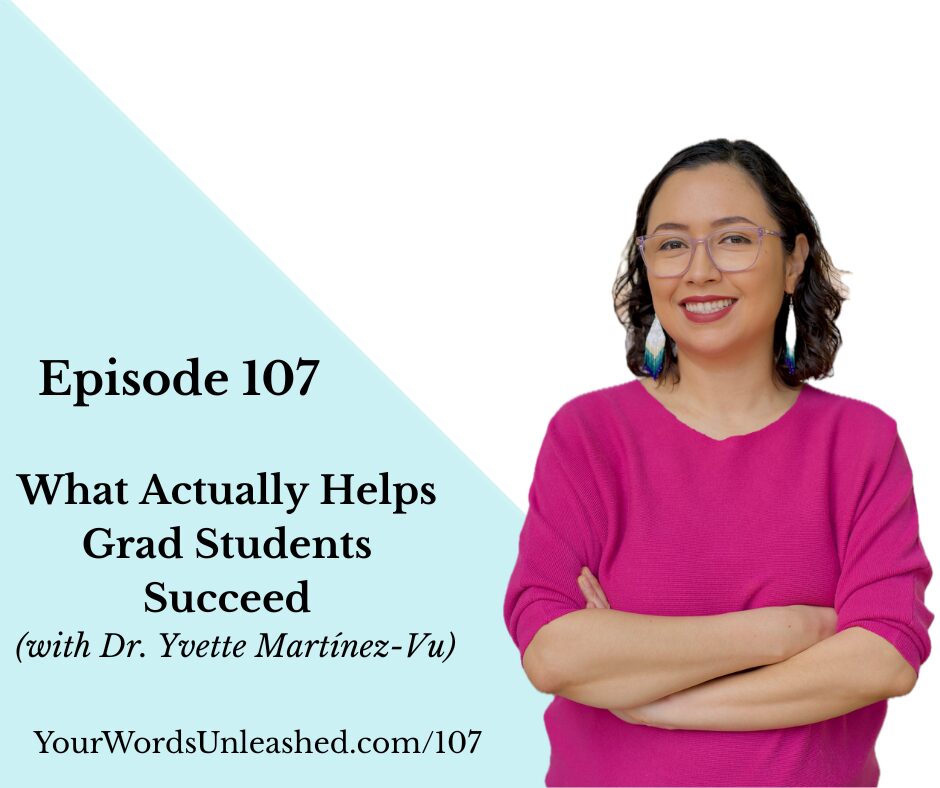
In this episode, Dr. Leslie Wang interviews Yvette Martinez-Vu, a first-generation, disabled, and autistic Chicana grad school coach, speaker, and published author. As the founder of Grad School Femtoring and host of The Grad School Femtoring Podcast, Yvette helps first-gen, BIPOC, and non-traditional students navigate academia with greater clarity, confidence, and sustainability. Leslie and Yvette discuss the hidden curriculum of graduate school, the importance of community and mentorship, values-aligned career decisions, and how students can pursue meaningful success without sacrificing their wellbeing.
How you can work with me this year~
1) Private book coaching through my signature Your Words Unleashed 6-month coaching program. Finally publish your book!
2) Personalized career coaching through my one-semester Career Reset Program for overwhelmed academics. Gain clarity and renewed purpose.
3) Group workshops on a range of writing and career-related topics. Leave with a transformed relationship to your own work.
I’m booking for the fall, so if you’re interested, email me at Leslie@nullYourWordsUnleashed.com or set up a free 30-minute consult!
Leslie:
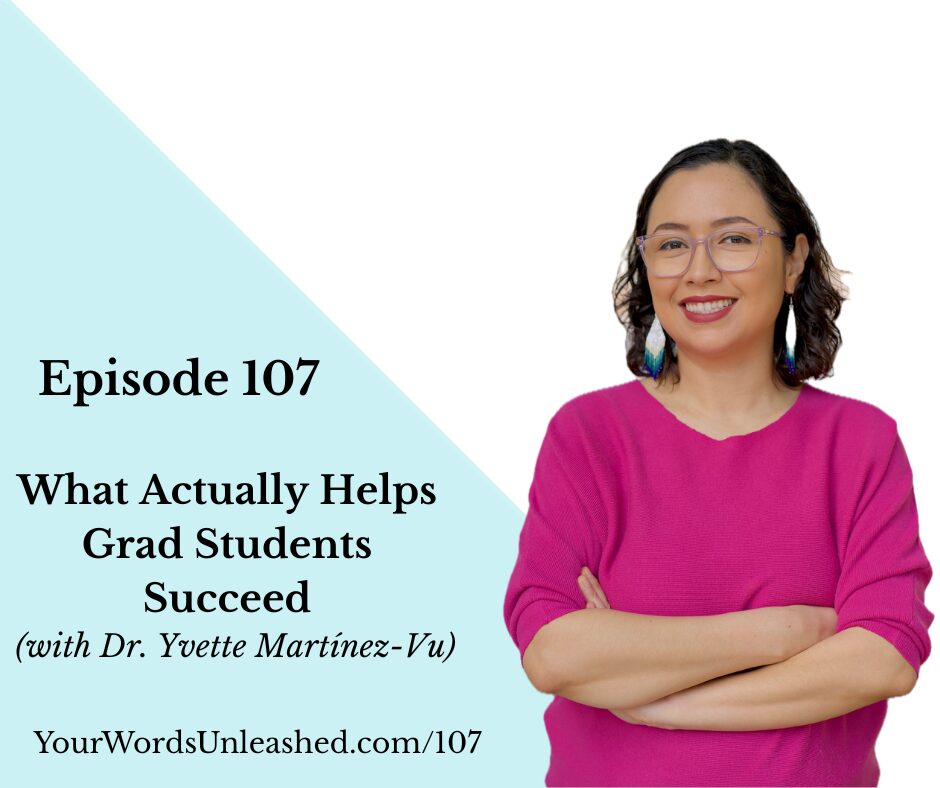
Today I’m happy to welcome Dr. Yvette Martinez-Vu to the show today!
She is a first generation, disabled and autistic Chicana grad school and productivity certified coach, consultant, speaker, and LinkedIn learning instructor. She’s also the co-author of the book is Grad School for Me?: Demystifying the Application Process for First-Gen BIPOC Students, published by UC Press in 2024 and co-editor of the Chicana Mother Work Anthology published by the University of Arizona Press in 2019. As the founder of Grad School Femtoring, LLC, and host of the award-winning The Grad School Femtoring Podcast, she helps first gen BIPOC students and professionals navigate academia and careers while pursuing sustainable success, which is so, so needed.
Her work centers on building the skills and systems that support meaningful achievement and long-term wellbeing in demanding academic and professional environments. Dr. Yvette offers coaching, consulting and speaking engagements focused on graduate school admissions, career development, and sustainable productivity.
So, as listeners know, my show and my coaching work really center around the needs of folks who’ve already earned their PhDs. The vast majority of my clients are faculty members with some postdocs sprinkled into the mix. And I would say that because of the scarcity of jobs, the postdocs I work with tend to have the experience of junior faculty members.
I wanted to bring Yvette on to talk about how the needs of grad students, particularly those who are first generation and BIPOC, really need to be focused on. Higher ed is strengthened so much by the unique perspectives these students bring, and yet many feel unwelcome or don’t know how to navigate the unwritten rules that govern academia. And hopefully this conversation can shed some light on how to best support them.
So happy to have you here today, Yvette.
Yvette:
Thank you. Thank you so much for having me here. I’m excited to chat with you.
Leslie:
Me too. So first things first. Can you talk about your journey through academia and how you decided to become a coaching consultant?
Yvette:
Yes. Well, that’s a big loaded question. And the first part, my journey through academia started as far back as college. So when I was in college, I was a theater kid and I thought I was going to pursue a career in theater, but everybody around me told me that that wasn’t a realistic or reasonable career path.
And so I later learned about undergraduate research and the academic path. And in many ways I was indoctrinated into going into the professoriate because I was admitted to a highly competitive graduate school preparation program. I received support to apply to PhD programs. I got in, I went straight in from college to a PhD program at my same institution. I was at UCLA and I decided, “well, if I cannot act for a living, why not study it? Why not teach it?”
So I pursued a PhD in theater and performance studies. And it was actually in graduate school that so much of the foundation of the work that I do got started because my first year as a graduate student, I landed a part-time job as a graduate mentor at an undergraduate research center. I didn’t do it intentionally at the time, I did it because, to be frank, I needed to pay the bills. So even though I was fully funded, I was living in a high cost-of-living city and I needed to find a way to make ends meet. But this role taught me a lot of the foundational skills that I now use to this day. Things around public speaking, facilitating workshops, essay review, all of those things.
I was working one-on-one with students and I realized “I really like this and I’m really good at this. I’m just going to keep it in my back pocket in case of anything.” And then there were other things that helped in my pathway through not just academia, but also later becoming a coach and a consultant, and that included life happening in grad school. So, for example, I burnt out really badly and developed a chronic illness in graduate school, and that forced me to slow down to rethink my values, my priorities. And that’s when it started to hit me that maybe my values were not in alignment with the pathway I was on, which was the R1 tenure track pathway.
And then another thing that happened in grad school was that I became a mom for the first time. And that was really transformative, but it was also really, really hard. It was hard on my body. I nearly died giving birth. It was hard on my mental health. I struggled with postpartum depression, and I think it provided me with this lens that I didn’t have before of what it’s like to be a non-traditional student, because for the first time I realized, “hold up, I need to learn, not just to advocate for myself but for another human too.” And that’s how a lot of my advocacy work got started working with other mother scholars in academia starting collectives and student groups. And so by the time I finished graduate school, I already knew I no longer want to be on the tenure-track path and I’m going to pursue something else. That something else was a career in student and academic affairs.
My first job out of grad school was working at a scholarship resource center, and then later I landed a role as an assistant director of a grad school preparation program. And then I moved up to directing that program. And after five years, during COVID—actually the start of COVID—I should say, that was when things shifted again for me, and I decided to pivot and transition into entrepreneurship. But I brought with me all of those skills that I learned as early as college when I was thinking about what my needs were. And then in graduate school, when I started working directly with students, and then of course in my career when I was directing a program.
Leslie:
Yeah, that is super informative and I think also instructive for folks in terms of trying to assess whether their own values are in alignment with higher education.
Can you specify what you realized were your values and what was not aligned for you?
Yvette:
Yes, I distinctly remember at the time when I was finishing graduate school, my core values weren’t super clear. But what I knew is that there were three main areas in academia: research, teaching, and service, and that was the order that I had to prioritize them. But my personal order was the opposite. Service work was what was most, what felt most purposeful to me. What felt good for me. what I enjoy doing most. What I excelled at. And then of course, I also enjoy teaching. And research, as much as I hated to admit it at the time, was not at the top of that order. And that’s what was clear to me.
Then later on, through again, other things happening, having a second child, having some full-time work experience, I realized there were other values that I had that led to me pivoting out of academia entirely. And those were things like wanting to prioritize my health first, my family first, wanting more time freedom, wanting just more freedom in general over my finances, over my schedule, et cetera. And so living more intentionally and being able to expand my impact beyond one institution were some of the things that came up for me at the time.
Leslie:
And so you’re one of the people I’ve talked to who made the decision to not pursue the tenure track while you were in grad school. How was that received by people in your department at an R1 school?
Yvette:
It was a really hard decision to make at the time. I remember feeling like I was going to disappoint so many people, and I was not a recovering perfectionist back then. I was not a recovering people pleaser back then. I was full on perfectionist and people pleaser! And what came up for me is that I realized that a lot of my relationships were tied to an institution and a career pathway and once I let go of that, those relationships went with that. And that was really hard, realizing that I was only going to receive support from some individuals, not all, but from some, only if I went one pathway and that pathway was that tenure track route.
So I did experience a lot of my own disappointment and disillusionment and grief. Grief was the overwhelming feeling I felt at that time, and I think that my leaving academia that my journey was twofold. So it was the grief that came that first time when I decided not to pursue the tenure track. And then there was the grief that came again the second time when I decided to leave my career in student and academic affairs.
Leslie:
Can you talk at all about what helped you get through the grief?
Yvette:
Yes. And actually one of the things that helped me to get through the grief in addition to therapy, right? So I highly recommend therapy for everybody no matter what’s going on in your life.
So, in addition to therapy, I feel like that’s a given and that’s a non-negotiable is what helps a lot of folks that I work with get through their programs or get through, really difficult transitions and that’s community.So at every step of the process, when I was having a hard time, I tapped into community when I was struggling with postpartum depression, I tapped into other mothers scholar collectives and they helped me to keep going. When I was struggling with the dissertation and writing, I tapped into writing groups and even dissertation support groups when I was struggling with the grief of making this transition. I had a lot of one-on-one informational calls with other people who had also left, and those informational calls have helped me. And even to this day, I am still in therapy. I still am part of a group coaching program with other women of color entrepreneurs because I feel like it’s really important to not feel alone and to access support from others.
Leslie:
Yeah, for sure. and to not feel like this is entirely an isolating experience.
Yvette:
Right, right.
Leslie:
Okay, so you yourself are first-gen grad student and you also help first-gen students.
So what do people who are not first-gen students, what do we need to know about the experiences of first-gen students to better support them?
Yvette:
One of the things that comes to mind is helping students with navigating this feeling of elusiveness or ambiguity that can come up when you are first-gen. And so a lot of what I do in my work is I help to demystify academia for the individuals that I work with. And that is a huge part of what can help make or break a student’s experience in graduate school is being able to provide that for them.
So instead of us making assumptions and thinking that your students know what to do and when to do it, to make expectations clear. Clear communication, clear expectations that really help students. Another thing that can help first-gen students is providing a sense of reassurance because I hear from so many graduate students that say that all they ever get is criticism and feedback that focuses on how to improve their work, but they never know when they’re doing anything right. And so they feel like everything they’re doing is wrong. It’s never good enough.
And so for me it’s help the student demystify the hidden curriculum. Help them tap into multiple resources, multiple mentors, because you cannot do it all for them. Clarify expectations and even things like milestones, I think about how many students I have walked through with creating their own timelines because they never had to go through that exercise with their advisor or in their program. Some of them, those handbooks are very outdated, and so they don’t even know what’s coming next.
And so again, it’s about helping them to continue to feel prepared and to not feel so underinformed or so, yeah, so confused or ambiguous about what comes next.
Leslie:
And also maybe not wanting to show others that they don’t know what’s going on.
Yvette:
Yes. So a lot of it is just not assuming. Not assuming, even if it seems like you are repeating yourself all of the time. I would rather someone provide more support than not enough support to their students. And again, if you are, I know a lot of professors are so busy and they don’t have enough time to work on this. Even something as simple as referring them to the right resources can make a big difference. Or delegating that piece of it. It’s like, “oh, this student needs extra support. Where can we tap into that? Can we make sure they go to the writing center? Can we make sure that they work with this other professor who has this expertise in this other area they need support in?” and so forth.
Leslie:
So what would you say are like the top few things that need to be demystified for first-gen students?
Yvette:
Oh, that’s a really good question. I would say the first thing that comes to mind is… actually, two things come to mind. One is about the process of navigating the program in and of itself. So how to navigate the program, what to expect year 1, 2, 3, 4, 5. That’s one side of it. And make sure to include the funding aspect of it too, because a lot of the first- gen students I work with, not all of them, but a lot of them are also working-class students and they’re working multiple jobs to make ends meet.
The second one is a big one that comes in the latter part of the program, which is all about the career development piece. And I know this is true not just for first gen students, but it comes up a lot and there’s increased anxiety and pressure for themselves and from their families about what’s coming next. And providing that support, demystifying what is it that you can do with this degree and being realistic about, “yes, we’re preparing you for maybe this one pathway, but the majority of students will not get that coveted tenure track job. And so here are your other options.”
And so those two things come up the most. Again, how to navigate the program and the major milestones and how to prepare for what comes next beyond the program.
Leslie:
And I know you also help people prepare to apply to schools. So is your work focused on the entire journey, beginning to end?
Yvette:
Yes. Yeah, so I primarily work with different graduate school preparation programs or career centers. So university programs will hire me and nonprofits too. Scholarship programs will hire me to work one-on-one and sometimes in group settings with their students. And I also facilitate workshops to help them with the process of applying to graduate school.
And then I also work one-on-one and in group capacity with graduate students. And I’ve had a few postdocs, a few professor clients as well, but it’s primarily graduate students helping them with navigating the major milestones that they have to get through in their program through coaching.
Leslie:
Okay, obviously you know that higher ed is just like changing every single day in all of these ways. Mostly negatively, probably. People still want to apply to grad programs. They still want a PhD.
So what advice do you have for students who are just starting this process now?
Yvette:
One of the things that I have said before and will say over and over again is when I was in their shoes and I was an undergrad considering graduate school, I wish that somebody would have told me that I had options. That graduate school was not the only path and that there was nothing else, that there was no way I could get a job without an advanced degree. So that’s one thing is I want students to know that you’re coming into this from a position of power because you’re the one making the decision. It is not someone else’s decision. It is your decision.
And when you do decide, let’s say you are set on applying. I want you to apply with discernment and with clarity around your non-negotiables. Why? Because a lot of folks will apply to graduate school primarily thinking about things like prestige and top programs, but they don’t take that extra step of thinking, “Wait. What do I actually need to thrive? Who am I actually going to work with? Are they actually going to support me in the way that I need to be supported?”
And also, a lot of students don’t think about the financial implications and the ROI of graduate school. “Is this program going to prepare me for the career that I want? Is it going to make financial sense when I run the numbers?” And so I want students to really slow down, take a step back, reflect and think about, again, “what are my long-term goals? Does graduate school make sense for those long-term goals?” And if so, apply with discernment by looking at what the program offers, looking at the faculty and making sure that it aligns with what you need to succeed.
Leslie:
Yeah, that’s such great advice. I think also, do you want to live in this place for the next five to 7, 8, 9 years? I mean, in my program, people were taking 10, 12 years! So that’s a huge chunk of your life. So when I was applying to grad school, I was like 23. I didn’t have a sense of anything beyond the degree.
So how do you get students or prospective grad students to think through their potential career options at the end? You know what I mean? Like it just seems, the PhD itself seems like such a huge journey.
Yvette:
So the question is “how do I help students consider what their career options are once they’re in graduate school?” There’s a lot of different ways to do this, and I think this is where maybe some of our work might overlap in terms of the coaching work. So I have a series of different exercises that I may suggest and recommend if a student is interested in them. One of them is a values assessment, just to be clear around what their core values are and how those could lead to potential career paths.
Another one is a strengths assessment to really think about what are the strengths that they bring and the transferable skills that they bring from their discipline and from their program, so that they start to think beyond subject area expertise and more aboutthe wide range of skills that they take for granted that they bring with them. And so beyond the core values, beyond the strengths assessment, I also have a life assessment exercise to really think about “what are the main areas of your life that are important to you, and are you actually tending to them? And if not, what can you do to tend to them more?”
And so a combination of that plus what’s really important beyond a million exercises is actually talking to people. So think about individuals whose work you admire. Reach out to them, build that LinkedIn profile. I know some professors will roll their eyes at me talking about LinkedIn because I know it’s not typically the platform that you may use if you use any at all. But LinkedIn can be a great way to network and to meet new people and to ask to conduct those informational interviews.
I’m always so surprised. College students are more familiar with informational interviews than some grad students are. And sometimes they’re more willing to do them and they’re more, what’s the word? Like unabashed or just they, they don’t even–
Leslie:
Like open.
Yvette:
Yeah, they don’t even blink or think twice about it. They’re like, “oh yeah, I’m going to reach out to this stranger.” Whereas with graduate students, some of them are over analyzing or they might not want to bother someone, or they think that this person would never reply back to them. You’d be surprised. Sometimes folks will make the time, 15, 30 minutes for you. And you learn a lot about different career paths.
And I often have them when they’re going on LinkedIn searching their discipline, searching their degree or their program, and seeing what are other people doing that have a similar background as me, and then that opens up other possibilities as well.
Leslie:
And those are for people that are going to choose a non-academic path?
Yvette:
Well, not necessarily, because sometimes they might tap into the alternative academic paths where you’re still in academia, but not on the tenure track pathway. So I guess it just depends on what comes up for some individuals as they do their search and as they reach out to individuals.
Leslie:
Yeah. Got it. I think LinkedIn is actually, I mean I talk about it all the time, but I think it’s really a very useful place to meet people. That’s how we know each other! It’s like you end up in certain circles and I’m like, “oh, I’ve seen Yvette now for like three years. It’s time to actually talk to each other.”
And then you’re also a published author that is published with these really high-ranking university presses. I am curious though, about the co-authoring experience. The sole authorship is always the, I don’t know, it’s I think the more common way to go when it comes to scholarly books.
Yours are coming from a totally different, probably, intention and motivation. So can you tell me a little bit about writing Is Grad school for Me? Like, what inspired you to write it and then what was it like to co-author it?
Yvette:
Yes, I’m happy to share more about this experience because this experience changed my relationship to writing and to publishing in ways that I didn’t even realize I was signing up for. And in really, really incredible ways. It was an overwhelmingly positive experience to co-author this book with one of my friends and femtors.
And so the journey of getting started with the book was, at the core of it, a femtoring relationship. So I met my co-author, Miroslava Chavez-Garcia when she became my supervisor at UC Santa Barbara, and she became my supervisor and transitioned in as I was on my way out. I was already planning to leave and because I felt, we just had this connection. I remember us introducing ourselves, telling each other a little bit more about our life stories and having so many things in common, including the strange experience of both of us losing in my case, my father at age 12, and her case, both her parents at age 12, we just felt so bonded that by the time I left and transitioned out, we continued to stay in touch.
And she knew that I was doing this work with the podcast and she encouraged me to write a book. She said, “okay, when are you writing the book?” And I did not think that was even an option. Again, I came from an academic experience where there was some small T trauma around writing and publishing, and I just didn’t feel confident enough in pursuing that, especially as someone who is not a professor and does not have an academic title.
But in any case, with her support, we decided how about we collaborate because we both know a lot about this topic? We bring our knowledge together and we take our strengths and we work on it. And so that’s really how we did it with a lot of communication, leading into our strengths and dividing the material, checking in. There was a lot of accountability. It was her modeling what it looks like to uplift others. And that’s actually one of the things that I respect about her and that I encourage other professors to do, is when you’re working with scholars to really uplift them and to provide opportunities where they can learn the process.
So because of that, I now am working on my second book and I feel really good about working on that book on my own, because I’ve had this experience of learning and femtorship through that writing process. So it really was a true collaboration. There were a lot of conversations around the co-authorship piece: whose name comes first, which name comes second, you know, in terms of even the income side of it and the book talks. And so we’ve had to really trust each other.
And also on the side of working with the press, I only have really lovely things to say about University of California press. They made the process so enjoyable in terms of very clear timelines and very supportive editing. Even the feedback, of course, we received constructive feedback. We applied the feedback, but it was, we got lucky with our reviewers. I will just say that.
Leslie:
Or it was a great book!
Yvette:
Thank you. You know what? I’ll let folks pick up a copy and determine that for themselves.
Leslie:
How’s the book structured?
Yvette:
The book is structured in three parts, and it’s the three parts or three stages of considering what to do when you’re applying. So the first part is really about answering that question, is graduate school for me, and all the things you need to know before you apply. The second part are the chapters around each part of the application process and how to tackle all of those pieces from writing the statement of purpose, personal statement, letters of rec, you name it. So that’s all the application piece of it. And then the third part of the book is what comes after you apply, from interviews to negotiating packages, to even thinking about your long-term career implications.
Leslie:
That’s so useful. That’s super useful. And what kind of feedback have you heard from readers?
Yvette:
Again, I feel incredibly grateful and there’s always that part of me that’s like waiting for the other shoe to drop. It’s like,” when is the more critical feedback going to come in?” But I’ve heard from several graduate school preparation program directors who have now included it as part of their curriculum. I’ve heard from professors who teach either first years or transfer students and have brought the book into their classrooms. I’ve heard from a lot of individual readers who have said that they felt seen and heard and reading the book, I’ve also heard from individuals who followed the steps and have gotten into graduate school, which is pretty amazing.
So it’s been really amazing to publish. Again, I used to think that publishing was this big, scary thing and that it meant that so many people could just tear you apart because of your writing. But one of my other friends and femtors, I remember she described the process of publishing as an ofrenda, as an offering. That you never really know what will come of it in terms of the impact for years to come. And that’s been the experience with writing this book is we’ve put it out there, it’s an offering. We don’t know what will happen with it or how people will receive it, but it’s really beautiful to hear from folks who have been positively impacted by it.
Leslie:
I love that so much. Like the idea of writing being an offering. And it’s something that I talk to my writing coaching clients all the time, is that your book has a life of its own, right? And part of your job as the author is to channel the message of that book and then release it so that it can have the life it’s meant to have.
But you know, so many times I think writers try to control everything, especially if you have perfectionistic tendencies. We’re like, “it’s never good enough.” But I think the never good enough idea comes from academia. And I think especially if you’re writing a practical guidebook like this is, with exercises and reflection and all of that, like the more important thing is to get it out so it can help people.
Yvette:
Yeah. I completely agree. And it definitely takes on a life of its own, and that’s what’s amazing about it and about the work that you do, supporting others and getting their books done. Yeah.
Leslie:
Did you factor in the needs of first-gen BIPOC students in the book? How did you do that?
Yvette:
Yes, so the book is called Is Grad School for Me? Demystifying the Application Process for First-Gen BIPOC Students. And really, it’s actually three different populations we were thinking about. We were thinking about first-generation; we were thinking about Black, Indigenous, and students of color; and we were thinking about non-traditional students when we wrote the book. And so we brought in voices and experiences and sample essays from individuals who had similar identities and backgrounds. And we also wrote the book in a way to make it more accessible to a reader. And even from the language and how we wrote it to the way that it was structured and ordered so that anybody could pick it up and open it to whatever chapter they need support in. And they could still get something useful even if they didn’t read the book from beginning to end.
We also made sure to acknowledge some of the harsh realities of academia and how it impacts students from bringing in. For instance, my co-author, she’s a historian, so I love that she brought in the history of academia and how a lot of people say these spaces weren’t built for us, but we’re actually going through and naming the history of institutions of higher education and at what point people of color started attending them and, again, like why we continue to feel left out or like we don’t belong.
So we brought in pieces of that as well, bringing in the research and the data to back up. What we have known to be true, not just from our experiences but from working with hundreds of students over, it might be thousands if we combine both of us together. Because she’s a senior professor, so we have a lot of combined experience together.
Leslie:
So you’ve been the host of the Grad School Femtoring Podcast for quite a while now. Can you talk a bit about what motivated you to start this podcast and what it’s all about?
Yvette:
Yes, definitely. Oh my goodness! I get so excited when people ask me about the podcast. The podcast is the seed. It’s the seed that I planted that really got all of this started, and the podcast came up from a need when I was directing the McNair program at UC Santa Barbara. I started it in 2019. Actually, in some ways it started by accident.
So there was a need and there was also just an opportunity. So what came up at the time was that I already had podcasting experience through the Chicana Mother Work podcast. So I was one of the co-hosts of the Chicana Mother Work podcast highlighting the stories and experiences of Chicana and mothers of color in academia, and at the time we needed to transition into using a new host.
And so I was doing research. When I was doing research. I found one sample host that it was one of those where you just record and it has the editing built in and it was free. And I wanted to test it out and I thought to myself “what do I know a lot about? Okay, grad school. And what do I do at the core of the work that I do with the students that I work with? What do I do? I Femtor.” And so I’m like, “oh, I’m always femtoring about grad school, femtoring.”
And I made it. I just like signed up with that name and I thought, “you know what? Since I have it, why not record an episode for my students?” So every time a student would ask me a question, “Yvette, how do I ask for a letter of rec? Yvette, how do I write my statement of purpose?” A lot of it was all how to. That’s how it started. I would record an episode and then as students would listen and send me follow-up questions, they would tell their friends about it. And so it was a really great resource because I would find myself repeating myself a lot or sometimes not having enough time to work with all the students that wanted and needed support and including some folks who didn’t get into our program, but I could always share that resource.
So that’s how it got started was from the need of a lot of students having a lot of the same questions around demystifying the grad school admissions process. And I continued to do it and I realized that I really loved it and enjoyed it. It was a really great passion project that later became my business.
And so because I had multiple years of the podcast and of recognizing what were the needs of the students that I work with, I already had a relatively strong foundation. And also, I didn’t mention this about my story, but when I was trying to debate whether or not like to go into the tenure track path or to go into student academic affairs, I actually started a side hustle with dissertation editing and some of those dissertation editing clients became very early coaching clients.
I remember someone telling me, “I need more than just you reviewing my feedback. Can we just chat and can you just offer guidance or just provide me with some, a space for me to just think?” And those became my very, very first clients that needed support graduate student clients, I should say. So yeah, all of those things, if we really put them together when it happens, I wasn’t thinking at the time this is all going to become the next thing. But these all informed the work that I do today, and the podcast is a huge part of it, and that’s why I have continued to release an episode every single Friday since 2019. I have 360 episodes!
Leslie:
Oh my goodness. Wow! Congrats on that. I reached a hundred and I was like, woo, that was, that felt like a lot. So how do you keep it fresh for yourself?
Yvette:
You know what? The root of the podcast and the core of it has not changed. For me, it’s always about serving others. And so as I do my work with my one-on-one clients, with my group coaching clients, as I hear repeated questions in my workshop facilitation, I bring that in and offer it on the work. So I treat my audience the way that I treat anyone else that I work with. If they have a question, if there’s anything that I can offer support, I always say I don’t gatekeep, happy to provide the information. I don’t have a problem with sharing info that I have access to. It’s when folks want my one-on-one time that I do charge because I have bills to pay.
Leslie:
Right.
Yvette:
But the podcast is an offering and it’s the least that I can do to support others.
Leslie:
Interesting. Yeah. Offering coming up again in this conversation, right? That no, and I think that the more you have something to say, whether it’s like through a medium like podcasting or through books, like the more you can see it as like it’s a gift to others.
The more you can see it as a gift, I think the easier it can be to not put writing into its own camp, like a rarefied realm. Instead, it’s all part of you as Yvette. I don’t know, maybe what I’m saying is I think more listeners should pitch themselves to be on podcasts, right? Everybody has something to say and it like the medium is just the way that you’re getting your message out. But that message can be very similar.
Yvette:
Exactly, and one of the things I didn’t say earlier is that a lot of the material that we pulled to write the book came from the podcast. And so sometimes that’s why I’m a big fan of multimodal writing and multimodal ways of learning, is that some of us, our first drafts are brainstorming. If you need to do it by recording yourself and taking a look at the transcript and pulling from what’s useful, you can do that. If you need to talk things out to help you process and to help you to think straight, that’s completely fine. Sometimes you need to write to think, and that’s also part of the process.
Leslie:
So let’s return to talking about grad students again, because I’m so far from students, I have to say.
And so when we’re talking about first-gen grad students or BIPOC grad students or non-traditional grad students, what have you observed to be the most important when it comes to them feeling confident and them being able to persist in their programs?
Yvette:
Confidence and persistence. That’s such a good question and it’s something that has come up a lot in my work. And I don’t think that I really started out thinking, “oh, I’m someone that’s going to help people with their confidence and persistence.” But it just kept coming up over and over again in my work when I would review the feedback that I was receiving, and three things that come to mind right now, especially since I have several grad student clients at the moment, is that what helps them is some of what I mentioned earlier.
So the clarity, the community, and being able to notice the evidence of them doing good work. So those three things, and by clarity I mean explicit, clear expectations, communication, all of that helps. And then community means having ways for them to not have to do the work alone. A lot of times we see that the graduate students who start to fall off the track or who won’t finish their programs, it doesn’t happen when they’re in coursework. It doesn’t happen when they’re with their cohort. It happens afterward when they’re on their own. And so if there’s more ways to, to structure that support and to provide community so that they feel seen, they feel heard, they don’t have to mask as much. They can have a space where they don’t have to code switch, where they can put the cape down and be themselves.
That in and of itself helps them to reduce the cognitive fatigue that comes with being in certain spaces, which frees up time and energy for them to focus on the work they need to get done. I think this kind of goes back to coaching and it’s part of the work that we both do. It’s like the mindset side of things where you want them to start to celebrate themselves, to own their work, to redefine success for themselves, and to notice all the many ways that they’re already doing the work.
I recently interviewed someone on my podcast and she talked about her experience of navigating a non-linear graduate school pathway. And she told me that one of her professors told her she’s closer to the finish line than she thought, even though she took longer than everyone else in her cohort or in her program. And that this professor attributed that to like the writing that’s on the rear view mirror, you know, when it says objects are closer than they may appear. That’s what, that every time she sees that she thinks about, “oh yeah, I’m closer to my goal than I even think.” And that’s what that evidence of okay, you’re meeting milestones, you’re getting there, and you celebrate them.
And that celebration, that’s all tied to a lot of the foundations of even habit formation cue action reward. You need to reward yourself consistently to maintain that motivation, to remember why you even got started, to help you ultimately get to the finish line.
Leslie:
Yeah, that’s such a great point about celebrating achievements along the way. And what’s interesting is that in my work with faculty members, one of the first questions I always ask them is, how and when do you celebrate your achievements? And it’s very telling. Their answers tell me how they approach their work.
So for the folks who are like, “I never celebrate, I mostly just feel a sense of relief and then I move on” or “I never celebrate because it just doesn’t feel like a big enough deal.” Or “the last time I celebrated was when I graduated from my PhD program like seven years ago.” And I’m like, “celebration can just be acknowledgement that you are doing the work. Not even about hitting milestones or something being published, but just that you are consistently doing the work and you are moving things forward and it is meaningful. And it can be just more like a pat on the back.” It doesn’t have to be “I’m throwing a party!”
Yvette:
Yeah, and if anything, that’s more important than the big celebrations because that’s the work that is habitual, that is routine, that is ongoing. That’s why a lot of times it reminds me of when I talk about self-care and community care. A lot of times people think, “oh, I don’t have enough time for this. But I’m like, “wait, there are micro moments. You have 5-to-10-minute windows each day where you can find a moment to take care of yourself.” Similarly, you have micro moments where you can celebrate yourself even if you have to tend to your inner child.
And I say that because I’m a mom and my kids love stickers. So even if you have to get yourself your own sticker chart or your own reward chart. Or you name it, whatever it is that makes you feel happy, I got myself one of those autism Barbie dolls, and that was one way I celebrated myself recently because I didn’t really have a lot of Barbies growing up. But whatever it is, it can be silly, it can be fun, it can be whatever you need it to be, but as long as it’s a way for you to, like you said, pat yourself on the back.
Leslie:
Yeah. Little spark of joy, little glimmer. And I think that also, the more you do for yourself, the more you probably end up doing for your students.
Yvette:
Yes. And you’re modeling that for them. You’re modeling possibility. And that’s why I think it’s so important for faculty to model boundaries to their students too, so that way they see, “oh wait, my professor isn’t responding to emails in the middle of the night or on the weekends, they actually have a family, or they actually have a life outside of academia.” Then they realize “I get to do that too.”
Leslie:
Yeah, just today I was coaching one of my faculty members to have a boundary of stopping work at 7:00pm but then she told me that she starts work at 5:00am. So I was like, if you’re on from 5:00am to 7:00pm, at the very least, we can pull it up to 6:00pm that you stop.
Right? Like, that’s a lot. It’s a lot of time being on. But sometimes it’s just permission- giving. And the more permission faculty members can give themselves and then they actually honor those in ways that students see, the more students will too.
Yvette:
Exactly, yes.
Leslie:
So this has been super interesting, wide-ranging discussion. Yvette, thank you so much for coming on. What are the best ways for listeners to connect with you?
Yvette:
The best way to reach me is through my website, gradschoolfemtoring.com. You can also find me on Instagram and on LinkedIn. For listeners, I work directly with graduate students, as I mentioned earlier, through one-on-one group coaching, and I also fundraise to sponsor students in my group coaching program.
So if you would be interested in sponsoring one of your students. Please feel free to reach out. And if an undergraduate who’s debating or considering going to graduate school, definitely check out Is Grad School For Me?, my co-authored book. But in any case, I look forward to hearing from you. Please connect with me. Please let us know that you listened to this episode. We, I know that you and I, we both really enjoy hearing from folks.
Leslie:
For sure, for sure. So listeners, please check out Yvette’s services. Go listen to her awesome podcast and go get her book. She’s doing really necessary and important work. Thanks so much for being here.
Yvette:
Thank you so much for having me!
If you liked this episode, make sure to also check out:
Ep. 8 – Why Transforming Your Dissertation into a Book is So Hard
Ep. 61: Empowering Women of Color in Academia (with Dr. Katherine Lee)
Ep. 76 – How to Succeed in Academia Without Sacrificing Your Well-Being (with Dr. Roxanne Donovan)