Leslie:
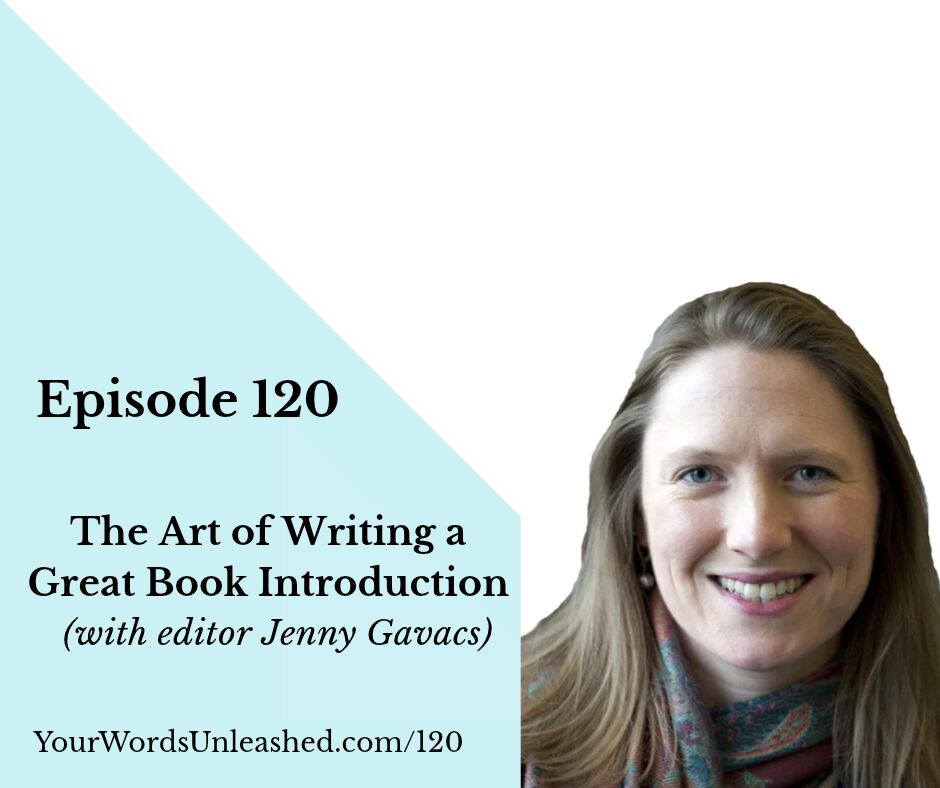
Today, I’m so excited to talk about introductions with my friend and fellow developmental editor, Jenny Gavacs. You may have listened to Episode 114, How to Write Stronger Conclusions with editor Katherine Wiley. It was really fun for me to brainstorm with another editor about this topic, which received really great feedback from listeners. People found it super useful because no one is ever taught how to write a conclusion.
So this naturally led me to realizing I should do another episode on book introductions, which is what we’re gonna discuss today. Jenny was actually one of my very first guests on the podcast. She appeared all the way back on Episode 59, What Acquisitions Editors Truly Want. Since Jenny has such a wealth of experience, both as an acquisitions and developmental editor, I thought she’d be a great person to chat with about the art of writing introductions.
So here’s a bit about her:
Jenny Gavacs is a freelance developmental editor with 10 years-experience, specializing in scholarly and crossover books. Previously, she was an acquisitions editor at Stanford University Press, after also working in acquisitions at both Northwestern University Press and the University of Chicago Press. This career path has allowed her to edit diverse and award-winning books. So, Jenny, thanks again for being here.
Jenny:
Thank you, Leslie. I am so honored and happy to be back.
Leslie:
Yeah, super exciting.
And so for those who haven’t had the chance to listen to your first episode, can you just quickly sum up your journey through professional publishing and developmental editing?
Jenny:
Yeah, no problem. Originally in college, I studied journalism and I did briefly work at one of the glossy magazines in New York, but that was not my world. And I realized I really wanted to go deeper into topics. So I went back to graduate school and I got a master’s degree in humanities from the University of Chicago. While considering going into a PhD program, I realized that that was probably not my best path either, because I just love the writing. But I also was so inspired by the academic ideas. So after I finished that, I went into working with university presses, the three different university presses you just mentioned, starting with Northwestern, then on to Chicago, and finally to Stanford University Press, where, you know, for your listeners,
As a reminder, I had the privilege and the pleasure of working with you to publish your first book with Stanford. Then I went and became a freelance developmental editor, which I’ve been doing for 10 years. And I was then able to work with you a second time as a developmental editor on your second book. And now here we are talking. I love how it all comes full circle.
Leslie:
I know, I know. And that’s the thing. These relationships last, right? Yeah. And I’m no longer an academic and we’re still in this, right? Let’s talk about intro chapters. I feel like there’s a million different ways people sort of conceptualize how to do this. And so maybe we can just start by talking about what you think are the necessary elements everyone needs to include in an intro chapter.
Jenny:
Sure. Yeah. And for everyone out there struggling with an introduction chapter, I just also want to say that I hear you, I see you. The introduction chapter is usually the most difficult chapter of the book to get right. So if you are struggling, know that you are not alone in that. It is hard.
Leslie:
Yeah, yeah. The struggle is real. It’s real.
Jenny:
Very much is. Now, the main necessary elements that you need in your introduction are going to be the opening section, which I’ll come back to in just a moment. But then you go from there into a section that is background, maybe historical background, maybe cultural background for readers that may not know as much about those topics as they need to know. To follow the rest of your investigation in the rest of the book. After that, you would want to have a section where you some people call this split review, but I call it the contribution section. Because yes, you are going to be talking about the other literature out there, the other scholarship on your topic, but rather than just listing what it is.
That section’s purpose is to talk about what is out there, but what is still not covered. What questions remain despite the fact that there is other scholarship on your topic? So that’s that section. And then depending on what field you’re in, you might want to have a discussion of your methods. Some scholars, though, find that so important that they move that discussion into appendix, into it, sorry, into an appendix at the back of their book. So you may or may not have a methods section in your introduction chapter. And some authors will also have a section that outlines the rest of the chapters in the book, a kind of summary of the chapters to come. Although some publishers are starting to discourage that practice a little bit.
So again, your introduction may or may not have that element of a tour through the rest of the book. But you always want to end your introduction chapter with a good conclusion, as Katherine Wiley talked about, and a good strong last statement, last punch to your reader of why your investigation in the book is important and they should keep reading.
Leslie:
So that’s a great outline. Do you have like a general sense of word count that you give people? Or can it really vary?
Jenny:
That’s a good question. The word count can vary depending on what your word count is for the body chapters of the book. I think of the introduction more proportion rather than as a hard and fast word count. So the proportion I think of is that an introduction chapter should probably, in most cases, be about two-thirds or maybe three-quarters the length that your body chapters are going to be. This is no longer the day of books that have hundred-page introductions and then chapters that are each like 15 pages. That we are past those days. And that is not the publishing world model anywhere anymore. And it would be hard to find readers that want to read an introduction that is that long.
So the introduction needs to be pithy and succinct. And that’s why it’s hard, because you have a lot of material to get into a chapter that is going to be slightly shorter than your body chapters. And in the opening, there are three really important jobs that the opening section has to do. This is why the opening can be very difficult. And I know Leslie and I are going to talk about chapter openings later, because most other sections only have one job to do, but openings usually have three. And so that’s hard. The opening of an introduction chapter needs to start off with some material that piques the reader’s interest. Now, oftentimes, this is a vignette or an anecdote from something in your research. And that is a tried-and-true formula. It absolutely works.
Feel free to use that in your book anytime. We all love a good story. But make sure that whichever anecdote or vignette you choose is a vignette or anecdote that starts to raise questions in the reader’s mind. And hopefully, questions that are going to be in line with the questions your book is going to ask. So make it a good juicy, interesting vignette or anecdote. But one that is going to suggest lines of inquiry, you will later pursue. So that’s job one of the opening.
Job two of the opening is to take those questions that might be foaming around in the reader’s mind and show the reader how you are directing all of the different questions that could be part of it, how you are directing your inquiry onto one main question. One question that is going to structure the way you approach the research in the rest of your book. So, this is the big question of the book. And your opening has to say what it is. Then the third and final job of your opening section is to talk a little bit about why this question is important, then to end the opening section with a good, strong statement of what your answer to the questions/argument for the book is going to be.
All of that encapsulated in one opening section. So those are three very important jobs for the book as a whole. And it is all in one little section of the introduction, which makes it tough to do. But you can do it. And when you do it, it will really pay off in clarity for your reader.
Leslie:
Yeah, I love that.
And so if someone is doing say like a 20-to-25-page intro chapter, that first intro section that has, you know, the opening hook, the primary research question, and an argument should be how long? Like three pages, four pages, double spaced?
Jenny:
Very good question. I usually advocate for those opening sections to be no longer than three pages or shorter, if possible, in some cases, because the main job again of the introduction is to create interest in the part of the reader and to outline what they will need, but not to actually go into the argument.
An analogy that I think works really well, and I think I’ll be touching on this throughout our talk this morning is the analogy of you are getting the reader to go on an expedition with you. And so the introduction’s job is to tell the reader: okay, here’s the route we’re taking, here’s why we’re taking it, and here’s all the gear that you need so that we can successfully complete this investigation or this expedition together.
Leslie:
Yeah, so that expedition idea is interesting one. Yeah, I often use the analogy of people are a tour guide in a museum and they’re taking people to different rooms and that sort of thing. So similar kind of idea. And so this idea of like, okay, these are the tools you need, this is the gear you need, that also presumes that people don’t have that gear already, right? That they’re not already right in the place where you’re in.
How do people kind of strike that balance, especially junior scholars who feel like they need to impress reviewers? They need to impress like senior scholars. At the same time, we want this book to be read. We want it to be read by college students and beyond. So how do we kind of find that balance?
Jenny:
That’s a very good question. Okay, so I might break that down into a couple of smaller questions. The first one I would say is how do you know what your reader needs? And the most important way of figuring that out is figuring out who is your reader? Who is your audience? You know, I I’ve worked with many first-time authors and authors who write in the who are writing their second, third, or in one case their fifth book, that is always a difficult question to answer. Who is my audience? But you can determine that by determining which fields you’re speaking to.
So you decide, and you know, because many books these days are interdisciplinary. So let’s say that you are a scholar of Korea, but you’re also writing for sociologists. So that means that you are going to have to think about all right, what do Korean scholars know about sociology? And what do sociologists know about Korea? And that is anything, precisely, indeed, indeed. So that is what you need to have in mind in the introduction chapter to guide you about.
What information do you need to give your readers so that they are equipped? And what information can you assume they already know? And sometimes there will be overlap. For example, this scholar of Korea who was writing the sociologist that I just made up, that scholar will have to give a you know background on Korea that the Korean scholars reading her book will already know. Those Korean scholars may skip some of that. But vice versa, she’s gonna have to also give some basic information on sociology that the sociologists are going to be very bored with. But the Korean studies people need, so sometimes there’s a give and a take there.
Leslie:
Right. Yeah, and you know, they might not be very bored with it. They might be just checking to make sure that the author knows what they’re talking about.
Jenny:
True, very true. Yeah. That’s exactly it. But yeah, how do you find that balance of what you need to know? That is where the discussion in the introduction section about contribution, or what some people call a lit review, that is where that section becomes a very good tool for the author. Because as the author is going through and figuring out what is the most germane scholarship to discuss in this section? That is also going to show the author what material has been covered, where and by who and in what depth, so that the scholar will get a very good idea of well, Korean studies people probably know, you know, a little bit about Bourdieu, maybe, right? But sociologists probably don’t know much about that small period of time between Japanese colonial rule ended and before the Korean War and the split of the two Koreas. You figure that out from doing that research.
And in that research, that is where you, as the author, are also going to see where are the holes, where are the places where there is data that has been overlooked or perspectives that have been unexplored. And that’s what you highlight in the contribution section. But as you are defining that, as you, the author, are defining that for yourself and also for your readers at the same time, that will give you a very clear idea of what your readers already know and don’t know. So that should be a pretty good guide to how to balance how much background you give your reader on various topics.
Leslie:
That’s super useful. So while we’re still on the topic of the intro part of the intro chapter, let’s talk about the argument. So this is a constant struggle for authors, definitely for everyone I’m with, most people that I work with. And arguments get very convoluted or there’s multiple important findings or statements that could be the argument and they have a hard time prioritizing which one is the argument.
So what do you tell people when it comes to stating the book’s argument in a really clear way?
Jenny:
That’s big question. Because yes, there are so many different aspects of the book-level argument to consider. And you’re right, that is why there are so many different things that could go into the argument. And that’s what makes it so very difficult to define an argument for the entire book. So there are a couple of rules of thumb that I would recommend.
One piggybacks on what I was just talking about, about finding your audience, finding your contribution, because part of that is knowing what debates are most current, what debates are most active, and how you’re going to enter into that debate. So that is part of what will define your argument, because if you know that there is a current debate about, let’s say, multi-step migration and you want to be part of that debate, then you are going to want to look at what the other arguments in that debate are. And you are going to want to formulate your own argument in a way that answers what has been said already. So that is definitely one thing because the main job of an academic book is to further debate.
So look at your debate, look at what has been said, and then figure out what your voice is going to add to that debate. That is one major way of thinking about the debate. Now some people ask me, my gosh, how do I know if the debate is too narrow or too wide? And how can I sort of calibrate that in a in a good way? One thing that I recommend is thinking about the major conference in your discipline. Going back to this fictional scholar of Korea who is also a sociologist, for example, I might recommend that that scholar look at the ASA, the American Sociological Association, and look at all the different sections of the ASA and think about: well, if my book was going to win an award, which section would give me that award? And then you speak to that section.
Now that doesn’t mean that you have to write an award-winning book. You don’t need that pressure on yourself. You don’t. But it’s a good way of thinking about one, the level of audience and the level of debate that will make for a good book argument because it’s going to be big enough. That you’re gonna have a wide set of readers. You know, the major conferences, these sections are all usually very large. There are hundreds of people in that. And especially if you’re writing an interdisciplinary book, you have two major conferences or three major conferences that you’re gonna want your book at. So you are going to have maybe two or three sets of several hundred people that would be interested in your debate. And that is really a good way to, again, frame for yourself what your argument needs to say, what debates and concerns your argument needs to address.
And then the last bit of advice I give as another rule of thumb is that there are usually three types of argument that are successful. And you want to sit down and think to yourself: is my argument one of these three types? Can it be one of these three successful types? The one type is the one that we all stereotypically think of as argument, the one that says, well, all these other scholars have said X, but I disagree. I think the answer is Y, right? Straight out disagreement. That is what we all think of usually as the first thing when someone says argument.
But another form of argument that also is very successful is agreement with addition. So in this argument, you say, “okay, all these other scholars have said X and I agree, but also I want them to consider this new data.” So it adds a nuance to what they’re saying. Or if you want to put it in improv talk, it’s a yes and, right? Right. So that can be very successful as well. And then argument number three is not usually thought of as an argument, and it’s kind of a difficult one to pull off.
But the third type is when you say, “okay, the field has all been asking this question. And I think, on the other hand, we need a new question. We haven’t been asking the right questions, or we haven’t been looking at this from the most productive perspective. So we need to shift the way we’re thinking about things.” So, you know, that doesn’t sound like an argument because there’s, you know, not as much disagreement in that one. But that is another successful way of showing how you, the author, are bringing a new lens onto something that is important to the other people in your field or fields.
Leslie:
Yeah. And I mean, it also sounds like that’s a little bit of a disagreement of the current paradigm, right? So shifting paradigms and being like, okay, we need to fully redirect our attention. I mean, I think there’s a lot of arguments that are like, because this hasn’t been studied in this way, or yeah, it’s been neglected, overlooked, here’s why it’s important, that kind of thing.
Jenny:
Exactly, exactly. And that third type of argument, what you call the paradigm shift. I like that. I’m gonna use that if you don’t mind. But yeah, that paradigm shift, that’s the kind of argument where applying different theories can come into it. So if somebody is a theoretical thinker, that is the kind of argument they might use, where, okay, I’m looking at maybe the same kind of data as my colleagues are looking at. I am asking some similar questions that my colleagues are looking at, but I’m going to put it through a different analysis tool than my colleagues have used before. You know, so yeah, that’s a really good place for theory thinkers.
Leslie:
So let’s talk about theory for a second. I have so many authors who are really stressed out about theory because they’re like, I don’t think I’m a very theoretical scholar and I feel all this pressure to be really theoretical as if that makes them seem smarter to others. And it feels sometimes like they’re trying to force a framework, you know, force a theoretical perspective onto their data.
And then when you’re talking about a book intro, it needs to be like something that’s gonna frame the whole book. How do you talk people through how to use theory in the intro?
Jenny:
Yes, that is also a great question. Theory is tricky. It can be a little slippery, right? And it requires a lot of analysis and discussion. So yeah, theory can be hard to handle. So a couple of things to think about if you are a scholar who really is working with theory.
First of all, as Leslie, as you just said, you don’t need theory. Like don’t if you are feeling uncomfortable with it. If it feels like it’s something you’re grafting onto the project, don’t do it. You don’t need it. There are a lot of successful and award-winning scholarly books out there that don’t rely on theory. They present new data or they ask different questions, but they’re using the same analysis tools that other scholars have used. So first of all, ask yourself, do I actually need the theory? You may not actually need it.
But if you do need the theory, genuinely, that is also great. Two things to think about with that. First of all, theory is a tool. Theory is meant to be there as, let’s say, a wrench that you can pick up and you can do something with. It is not an object of analysis and study in itself, in most cases. We all know that there are those big books out there that introduce a new theory. If you are one of those few amazing scholars, that is fantastic, great for you. But 99% of us are not going to come up with a new theory, right?
So if you are somebody who is using theory with other data, again, remember it’s a tool like a wrench. So your job as a scholar in the introduction is to let the reader know which theory is it that is going to be integral to your investigation. So you have to tell them, like again, I’ll go back to the Korean studies scholar working in sociology. Maybe she’s gonna rely on Bourdieu, right? So she has to say in the introduction, “I will be talking about Bourdieu’s, you know, ideas of habitus,” let’s say.
And so you have to tell the reader that’s what you’re doing. And you have to, in the introduction, give a very brief overview of what the theory is and what you as the author, what your personal perspective is on that theory. Because again, theory is slippery and people have different ways of thinking about it. So you have to, in the introduction chapter, show the reader what is your take on habitus, but then you end it there in the introduction. That’s all you do. You only outline it the same way.
If I go back to that expedition metaphor, you hand the reader a climbing rope and you say, “Here is the rope we’re using, and here is the knot that you have to tie so that you’re safe,” but you’re not doing it yet. You’re not on the expedition yet. So you just all you do is you let them know what it is, how it might be useful, and you stop there. Then in the body chapters of the rest of your manuscript, that is where you go more in depth because that is where you are actually applying the theory.
So in those body chapters, that is where you tell the reader, okay, here’s some data. And now if I look at it through the lens of habitus, what ideas does that bring up? What new information do I have using this lens from Bourdieu? And why is this important? What new information does this bring up for the field? How can this be useful? So all of that more in-depth work is what you do in your body chapter. And because again, you’re showing the reader how you’re using theory as a tool, how that wrench is allowing you to turn a bolt that creates something new.
Leslie:
Really good analogy there, thinking about it as a tool. And I definitely have clients where they will just devote an entire chapter to a theory. Either they’ve been asked to do it, it’s maybe common in their field, like Poli Sci or something like that, or they just have a lot to say and it can’t go anywhere else. But that’s another option. But I see you grimacing.
Jenny:
Yes, I am grimacing. That is an option, but I would say if I’m putting on my acquisitions editor hat from back in the day, that is an option that I don’t think acquisitions editors will be happy to see. Because if you take all the theory in your book and you quarantine it in one chapter, then it’s not doing useful work throughout all of the places where you present data. And therefore, it is going to seem unnecessary. Now, that might be wrong. The theory might be extremely necessary to your project, but the way to show that is to show yourself using it in the body chapters throughout the whole book, making the theory a through line in your manuscript rather than just taking it all in a chunk and putting it in one place.
And, you know, that also goes for the introduction chapter because I do have authors who are concerned that they have to give a sort of 20-page disquisition on what is the theory, and what has everyone else said about it, and how am I supposed to be using it and all that kind of thing. But the one thing to remember about a book is, as I already mentioned, this is just an outline for the reader. You are not doing the work of showing how the theory creates new knowledge in the introduction. The introduction only says, “here’s the tool.” This is what it is. You’re not showing how the tool works. And that’s one thing.
But the other thing is, especially for first-time authors, people going from dissertation to book, there is pressure to feel like you have to be impressive. You have to really show your knowledge. And of course, there are also habits that have been built up from dissertation writing, where dissertation writing is very much about being comprehensive, showing the breadth of your research and your knowledge. But if you’re going to have a successful book that a publisher is going to want to publish from you, you’ve got to remember that this book is there to persuade your audience that your perspective is the right perspective. They don’t care how wide and deep your knowledge is. You already have that PhD after your name. Most people already have a junior faculty position at this point. So take some confidence from the fact that you have already proved your credentials.
You don’t have to do any more of that credential proving in your book manuscript. What you have to do is make a solid argument, which means that you are showing how you’re using the tool and you’re getting rid of extraneous things that are only there to be impressive.
Leslie:
Yeah, no, I mean that’s a big, big, big habit to turn around. And it is one of the I think not talked about enough in terms of stepping into your power, I guess, as an expert. Like actually accepting the fact that you have earned that right to say you’re an expert. Okay, so this brings us to the fact that introductions are unlike other chapters.
What would you say are some of the biggest mistakes you tend to see in people’s intro chapters?
Jenny:
There are several that I can talk about. And again, it’s not because people are bad at writing, it’s because introduction chapters are hard to write. They have to do so much work in a very limited amount of word count. But these are things that I commonly see and I hope that authors listening to this will find ways to catch that in their own introductions.
The most common mistake I see is that people write an abstract rather than an introduction. And you know, abstracts as your authors will know are what you do for a journal article. And that abstract’s job is to lay out in a very succinct way a summary of what the article is going to claim, what data it’s going to use to back up that claim and what the overall conclusion of that article is going to be. So basically, that abstract is a summary of every single thing that’s going to come later in the article. And I do see this in introduction chapters for books. People want to just put everything into the introduction so that the introduction is a summary or a capsule of the rest of the book. And that is unfortunate.
Now, I know that many scholars who are short on time will sometimes only read the introduction of a book. But that is leaving out so much of the analysis that needs to be done in the body chapters. And you are doing your reader a disservice if you put that in the introduction. And you are doing yourself as a scholar a disservice if you try to cram all of that in the introduction because the rest of your work is going to be ignored. Like having the reader only read one chapter of your book, does that make you feel good? You know, but beyond just the feelings, it is that your skill and the thinking that you put into the rest of it is not being seen.
Leslie:
So basically, you’re saying people cram too much into their intro, is that right?
Jenny:
Yes. They try to give away everything in the book in the introduction chapter. And that’s not going to be helpful. Then another problem in introduction chapters, and we already touched on this a bit, is that they write a big disquisition on theory in the introduction chapter rather than just focusing on what is the theory and how is it used and stop there.
The other problem is with background data. I mentioned earlier that you would probably need a section in your introduction chapter where you do give your readers some kind of background on the fields that you are going to address. But as I also said then, it is difficult to balance: am I giving them too much or not enough background? And that is a problem that I see a lot of authors running into. It is hard to find that balance, but hopefully my suggestions from earlier will help you find that balance by again looking at the secondary literature, looking at the main conferences and what each section is focusing on. Hopefully that will help you calibrate what is enough and what is too much or too little.
The other problem that I see, again, this touches on something that we already discussed a bit, but that section that I called the contributions section, authors oftentimes truly do make it a literature review. And all it does is list what else has been done without giving the reader any reason for reading through this list. You know, so as we talked about before, it needs to be a list that says, “well, there’s been good work in this area but they haven’t asked these questions.” Or “they’ve asked these good questions, but they haven’t considered this type of data.” You know, that is something you’ve got to do to show your reader why this book is useful. Because that is an academic book needs to persuade, but what it needs to persuade the reader of is that it is a useful tool in their thinking. And that is what that section can help you do, is show why it’s useful.
And then, of course, the last and most perhaps prickly area is that the argument for the book is not stated clearly in the introduction. And we already spoke about different ways that authors can try to make their argument more clear and more targeted for the debates they want to be in. But remember, authors, that if it takes you an entire paragraph to write that argument statement, that is going to confuse readers and be too long. A good argument statement is going to be one sentence long.
Leslie:
That someone can remember later! There could be paragraph-long sentences. And also not to put that argument ten pages into your introduction, which I see a lot of.
Jenny:
Exactly. That’s why I was saying in the opening of the introduction, you’ve got to put that argument statement in the opening, in the very first part of the introduction, so that your reader understands where your expedition is heading and why it’s important to go there.
Leslie:
And I just want to add your description of the three things that that first intro section needs to do, I think is also a great set of guidelines for any chapter. Of having like a relatively short, within three pages, you’re stating why are we here? Where are we going? What do you need? What’s the question? You got a hook. You got an argument. So I think that’s, you know, since we don’t have a lot of time to talk about like actual chapter intros, but I do think you already hit the nail on the head with that.
Jenny:
Yeah, what all of those three things that the opening of an introduction chapter has to do, those are exactly the same things that the opening of a body chapter also has to do. The only difference there is that a body chapter should show some connection to the chapter before it so that the reader can see the flow happening from one chapter to the next. But that can be done in one paragraph.
Leslie:
Right. Okay. So as I’m always talking to my authors about, writing a book is very nonlinear. You’re going between different chapters all the time.
When should someone really buckle down and write the introduction chapter?
Jenny:
That is a perennial question, definitely. And I may not be very popular for this answer, but I truly believe the answer is that you should write the introduction at the very beginning of the project and then write it again at the end of the project. I mean, nobody likes to hear that they have to write it twice. And I understand that that is sounds like a lot of work and it is a lot of work. But as we’ve talked about already here, the introduction has to very succinctly encapsulate all of the necessary tools for the project that is going to happen in the body paragraphs. So when you write the introduction in the beginning, before you’ve tackled any of those body paragraphs, because that introduction paragraph is getting giving your reader a guide to the expedition.
It’s also forcing you, the author, to map out what that expedition is and what tools you will be relying on in that expedition. So then you can use that as a blueprint for what you’re going to do in the rest of the body chapters as you go forward and you draft the body chapters. Now, does everything always go according to plan? No, it does not. And so I guarantee that things will change as you are drafting the body chapters. Maybe you will realize that you have to shift your stance on one thing or another, or that you know, a focus that you thought was going to be important no longer is. So you you’re going to have a different focus for one of the chapters. Things like that. Things will shift.
Maybe you’ll get feedback from colleagues or mentors or friends that open your eyes to new things you have to cover. This is the process of writing a book. And that is absolutely great. Open yourself to making sure you’re doing what is best for the book. But because of the fact that things will shift as you write those body chapters, that is why when you have drafted the full manuscript, you also then need to go back to that introduction chapter and you have to heavily revise it so that it reflects the manuscript you actually wrote rather than what your initial hopes were. But again, it is good to have both because you need a guide in the beginning, but then in the end, you actually need to make that a solid introduction chapter.
Leslie:
Yeah, I think that’s really good advice. And I actually think most of my clients do that maybe inadvertently because they might be moving from a dissertation to a book. So they already have something that they know of as an intro and they know they’re gonna have to really heavily revise it. What they usually don’t do is start by revising it first and then writing the body chapters and then revising it again. That makes a lot of sense.
Jenny, it’s been so lovely to talk with you about this topic. I feel like I have all kinds of new insights and strategies. So I just really want to thank you for being here and sharing your wisdom because you’ve been doing this for a really long time in so many different capacities.
How can listeners connect with you and find out more about your services?
Jenny:
Well, first of all, thank you for having me here as a guest again, Leslie. I always really enjoy coming on your podcast. And I do hope that this is going to help authors with some conundrums or obstacles that they’re dealing with. And if somebody would like to contact me, I welcome that through my LinkedIn page, which you can look up just under my name, Jenny Gavacs.
And there’s, you know, the messaging part of LinkedIn where if you’d like to contact me directly, please do.
Leslie:
Absolutely. Folks, I’ve worked with her at different times in my scholarly career and it was always well, well worth it. And also I just really wish I had all of these strategies before I even started. Just having some clarity around expectations, I think is so, so important. So thanks again, Jenny, for being here.
Jenny:
You’re welcome. Thank you, Leslie.
Leslie:
Take care, everyone, and I will talk to you again soon.
If you liked this episode, make sure to also check out:
Ep. 114 – How to Write Stronger Conclusions (with Dr. Katherine Wiley)